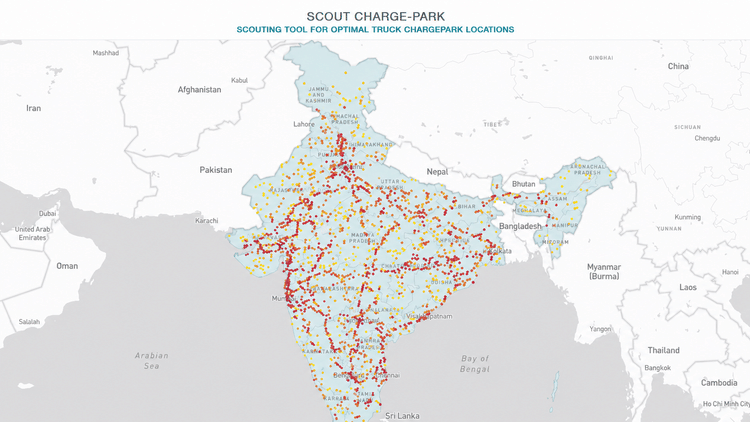
- Scout Charge-Park maps priority electric truck charging sites.
- India faces major truck charging infrastructure requirements.
Scout Charge-Park Identifies Electric Truck Charging Locations
The International Council on Clean Transportation (ICCT) launched Scout Charge-Park at the fourth India Clean Transportation Summit in Delhi on Tuesday, introducing a digital tool designed to help identify locations for electric truck charging stations across India. Developed with the Centre of Excellence for Zero Emission Trucking (CoEZET) at the Indian Institute of Technology Madras, the platform is intended for charge point operators, fleet owners, grid planners, and government agencies. The tool is designed to support charging infrastructure decisions by combining truck movement data with freight corridor activity and electricity network information, helping stakeholders identify locations where charging demand and available grid infrastructure can be aligned more effectively.
How Scout Charge-Park Maps EV Truck Charging Sites
Scout Charge-Park draws on GPS data from more than two lakh trucks transmitted every six seconds over 120 days spread across a year under India's AIS-140 tracking standard. This dataset generated 14 billion GPS pings and 15.7 million recorded stop events, providing a detailed view of truck movement and stopping behavior. The platform uses this information to identify truck stopping hotspots, the busiest freight corridors, and priority areas that could become charge parks. By using observed vehicle activity rather than relying only on planned routes, the tool provides a data-driven basis for identifying locations where electric truck charging infrastructure could support freight operations.
Charging Sites Aligned With Freight Corridors and Grid Capacity
The platform also overlays more than 15,000 electricity substations and power lines with India's top 10 priority freight corridors. This approach allows potential charging locations to be assessed against both freight movement and electricity infrastructure, helping planners consider where charging demand can be supported by available grid capacity. ICCT has used the tool to identify 56 priority sites nationwide, including a container port near Mumbai. The combination of vehicle GPS information, freight corridor mapping, and electricity network data is intended to help charge point operators, fleet owners, grid planners, and government agencies make more informed decisions about the deployment of heavy-duty electric vehicle charging infrastructure.
Delhi and National Capital Region Pursue Phased Truck Electrification
At the summit, Rajesh Verma, chairperson of India's Commission for Air Quality Management, said authorities are pursuing phased electrification mandates for goods vehicles and three-wheelers in Delhi and the National Capital Region. Verma urged industry participants to view the planned timelines as signals for investment rather than only as compliance requirements. He said, “I would urge the industry partners in this room to treat these timelines not as compliance deadlines, but as investment signals.” The proposed phased approach could increase the need for charging infrastructure and encourage businesses involved in commercial vehicle operations to prepare for the transition toward electric goods transportation.
India's Long-Term Requirement for Truck Chargers
ICCT research presented at the summit projects that India will need more than 50,000 truck chargers by 2030, increasing to over 1.5 million by 2050 to support a target of 100% electric trucks by that year. The scale of the projected requirement highlights the infrastructure challenge associated with electrifying long-distance and heavy-duty freight operations. Medium and heavy trucks currently account for 45% to 48% of emissions from India's road transport sector, according to the research presented at the summit. Expanding charging capacity along major freight corridors will therefore be an important part of supporting the transition to electric trucks while addressing emissions from road freight.
Truck Charging Infrastructure Requirements Through 2050
The projected charger requirement illustrates how India's charging network needs could expand alongside the country's long-term electric truck ambitions. The near-term requirement is focused on establishing an initial network capable of supporting freight electrification, while the much larger 2050 requirement reflects the infrastructure needed for a fully electric truck fleet. Data-driven planning tools such as Scout Charge-Park can help stakeholders identify priority locations by combining truck movement patterns, freight corridors, stopping activity, and electricity infrastructure. This can support more targeted infrastructure deployment as charging requirements increase and commercial fleets progressively adopt electric trucks.
| Metric | Reported Figure |
|---|---|
| Trucks analyzed | More than 200,000 |
| GPS tracking period | 120 days across a year |
| GPS pings | 14 billion |
| Recorded stop events | 15.7 million |
| Electricity substations and power lines mapped | More than 15,000 |
| Priority sites identified | 56 |
| Truck chargers required by 2030 | More than 50,000 |
| Truck chargers required by 2050 | More than 1.5 million |
The charging infrastructure challenge extends beyond the number of chargers that need to be installed. Charging locations must also correspond with truck operating patterns, freight demand, stopping behavior, and the availability of suitable electricity infrastructure. Scout Charge-Park addresses these factors by mapping truck activity alongside substations, power lines, and priority freight corridors. Its identification of 56 priority locations demonstrates how such integrated data can be used to narrow a nationwide infrastructure requirement into specific candidate areas. As electrification expands across commercial transportation, this type of planning could become increasingly important for coordinating investments among charging operators, fleet owners, utilities, and public agencies.
Frequently Asked Questions
What is Scout Charge-Park?
Scout Charge-Park is a digital tool developed by the International Council on Clean Transportation with the Centre of Excellence for Zero Emission Trucking at the Indian Institute of Technology Madras to identify potential electric truck charging locations across India. It uses GPS data from more than two lakh trucks, truck stopping patterns, freight corridors, electricity substations, and power lines to identify priority charging areas. ICCT has used the tool to identify 56 priority sites nationwide, including a container port near Mumbai, supporting data-driven planning for electric freight charging infrastructure.
Click above to visit the official source.
Discussion
Join the conversation.