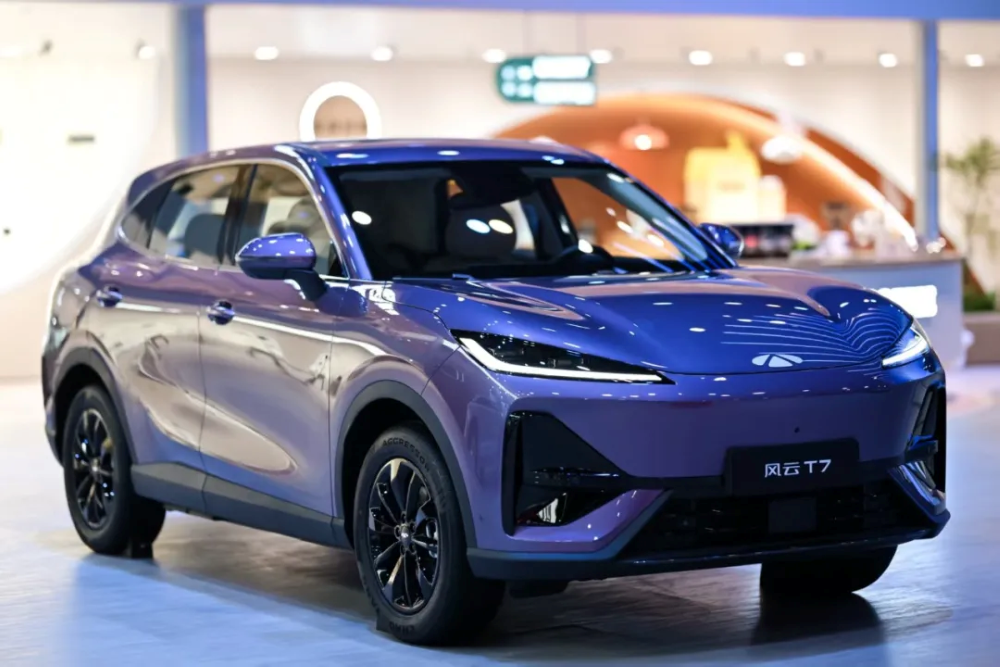
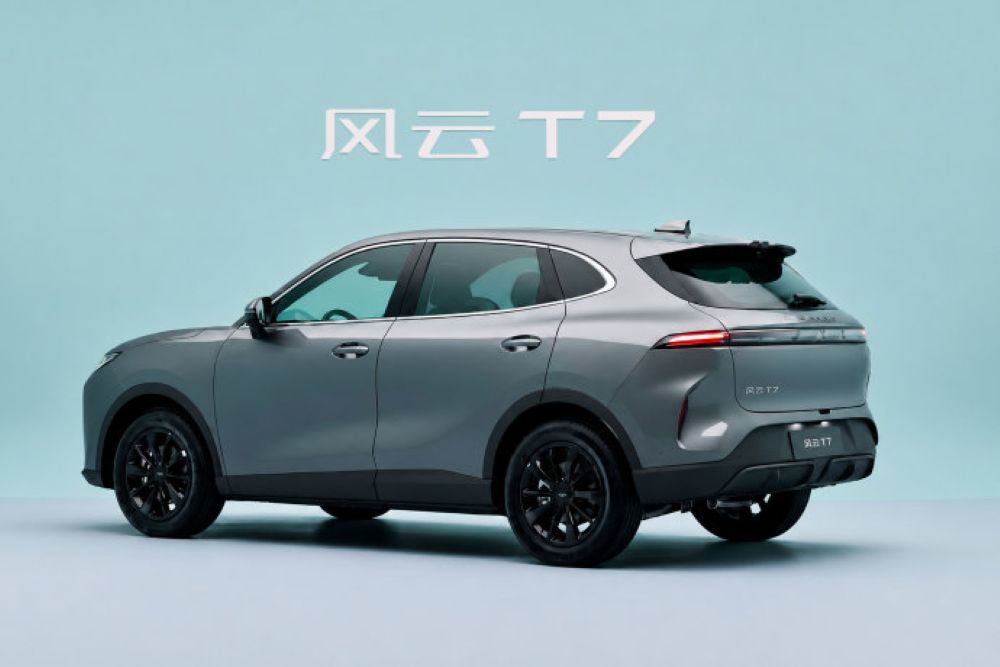
- Fulwin T7 launches with 600 km CLTC range.
- Chery’s electric SUV combines fast charging and advanced assistance.
Chery Fulwin T7 Launches With Global-Market Focus
On August 26, Chery’s Fulwin New Energy Vehicle (NEV) series officially launched the new Chery Fulwin T7 battery-electric SUV. The model is offered in three variants, with official prices ranging from CNY 97,900 to CNY 118,900. Limited-time promotional pricing lowers the range to between CNY 94,900 and CNY 115,900. The Fulwin T7 is positioned as Chery’s first model developed for global markets from the outset, marking an important step in the company’s approach to creating a battery-electric vehicle with international market appeal while retaining design characteristics associated with its development in the Fulwin NEV series.
Exterior Dimensions and Design
The Fulwin T7 uses a wind-inspired exterior design that combines Eastern aesthetics with design elements intended to appeal to global customers. The battery-electric SUV measures 4,570 mm in length, 1,852 mm in width, and 1,694 mm in height, while its wheelbase measures 2,700 mm. These dimensions place the model within the compact-to-midsize SUV space and support its positioning as a practical passenger vehicle. The design approach also reflects the model’s global-market development objective, with Chery seeking to balance regional styling influences with a broader international design direction.
Electric Powertrain and 600 km Range
The Fulwin T7 uses a front-motor, front-wheel-drive (FWD) configuration and incorporates a 12-in-1 intelligent electric drive system. Its electric motor produces a maximum power output of 178 kW and peak torque of 275 Nm, while the vehicle has a top speed of 180 km/h. Power comes from a 65.05 kWh lithium iron phosphate (LFP) battery, delivering a CLTC EV-mode driving range of 600 km. The vehicle records energy consumption of 12.9 kWh/100 km, combining the specified battery capacity with an efficiency-focused electric powertrain for its intended operating range.
Fast Charging and Vehicle-to-Load Capability
Charging performance is another notable element of the Fulwin T7’s electric vehicle specification. The battery can be charged from 30% to 80% state of charge (SoC) in approximately 20 minutes using DC fast charging, providing a relatively short charging window for longer-distance use. The vehicle also supports 6.6 kW AC vehicle-to-load (V2L) power output, allowing the battery system to supply electrical power to compatible external equipment. Together, the fast-charging capability and V2L functionality broaden the vehicle’s practical electric-energy applications beyond conventional vehicle propulsion.
Connected Cockpit and Advanced Driver Assistance
The Fulwin T7 comes standard with a 15.6-inch 2.5K center touchscreen and an 8.8-inch instrument cluster, along with intelligent voice interaction. The higher-specification variant adds a 4 nm Qualcomm Snapdragon 8775 integrated cockpit-and-driving chip with 72 TOPS of computing power and the Falcon 500 driver-assistance system. Its sensing architecture incorporates 22 high-precision sensors, including three millimeter-wave radars and twelve ultrasonic sensors. These systems support functions including Highway Navigation on Autopilot (NOA), Automated Parking Assist (APA), and Driver Monitoring System (DMS), extending the vehicle’s technology offering beyond its electric powertrain.
Frequently Asked Questions
What are the main specifications of the Fulwin T7?
The Fulwin T7 is a battery-electric SUV with a 65.05 kWh LFP battery, 600 km CLTC EV-mode range, and a 178 kW front-mounted electric motor. The vehicle uses front-wheel drive and produces 275 Nm of peak torque, with a top speed of 180 km/h. DC fast charging from 30% to 80% SoC takes approximately 20 minutes, while 6.6 kW AC V2L is supported. Higher-specification versions add a 4 nm Qualcomm Snapdragon 8775 chip, 72 TOPS computing capability, Falcon 500 driver assistance, 22 high-precision sensors, NOA, APA, and DMS.
Click above to visit the official source.
Discussion
Join the conversation.