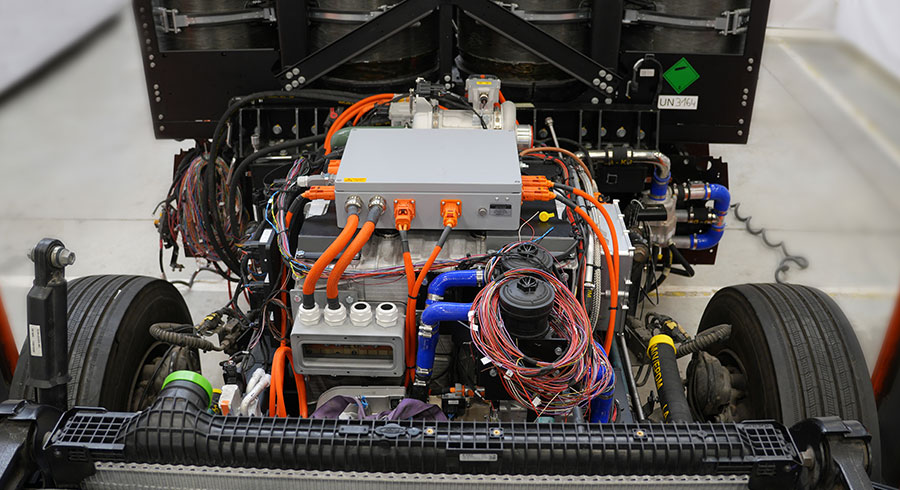
- NM20 fuel cell stack enters real-world truck testing.
- Hydrogen truck trials target 360 kW output.
EKPO and Akkodis Begin Real-World Fuel Cell Truck Testing
EKPO Fuel Cell Technologies GmbH (EKPO), the joint venture between ElringKlinger and OPmobility, has started a collaborative project with Akkodis to evaluate its NM20 fuel cell stack in real-world driving conditions. The initiative moves the NM20 beyond controlled development environments and into a heavy-duty vehicle application, where its performance can be assessed under practical operating demands. The project is focused on demonstrating how the fuel cell system responds to varying loads and environmental conditions while generating operational data that can support further technical development.
NM20 Stack Integrated Into 40-Ton Hydrogen Truck
Akkodis is integrating the NM20 fuel cell stack into a 40-ton hydrogen-powered truck intended for logistics operations. The company is responsible for developing, integrating, and assembling the vehicle’s fuel cell electric powertrain, creating a complete platform for testing the technology in an application representative of heavy-duty freight transportation. The NM20 uses proton exchange membrane (PEM) fuel cell technology and has been developed for demanding heavy-duty applications. It can deliver up to 400 kW and is designed for a service life exceeding 25,000 operating hours, supporting applications where durability and sustained power delivery are critical.
Fuel Cell System Targets 360 kW Output
With a single NM20 stack, the hydrogen-powered truck can achieve system output of up to 360 kW, while overall efficiency can reach 61%. These specifications position the system for high-power commercial vehicle applications that require substantial energy conversion capability during demanding operating cycles. Testing the stack within a complete truck allows the partners to examine how the stated performance characteristics translate into real vehicle operation. The project therefore provides an opportunity to assess power delivery and efficiency while also identifying areas where system-level integration may influence performance under different operating requirements.
Testing Focuses on System Optimization
The collaborative testing program will evaluate the fuel cell system across different loads, environmental conditions, and operational requirements. The findings will support optimization across several interconnected areas, including the fuel cell stack, balance of plant, control system, thermal management, and high-voltage architecture. Examining these elements together is important because heavy-duty fuel cell performance depends not only on the stack itself but also on how supporting systems manage energy, heat, controls, and electrical power. Real-world testing can consequently provide practical information that is difficult to establish through isolated component-level evaluation.
Project Could Support Broader Fuel Cell Applications
The results of the project are intended to establish a reference platform for fuel cell applications beyond road freight. By operating the NM20 within a 40-ton truck, the partners can generate experience with the integration and management requirements associated with high-power fuel cell electric propulsion. The project also gives the development teams an opportunity to identify improvements that could be applied to future systems and applications. For EKPO Fuel Cell Technologies GmbH, the real-world program provides an important step in demonstrating the NM20 technology in demanding commercial vehicle conditions and assessing its potential for broader heavy-duty use.
Frequently Asked Questions
What is the NM20 fuel cell stack being tested for?
The NM20 fuel cell stack is being tested in a 40-ton hydrogen-powered truck to assess its performance under real-world driving conditions. The program examines operation across different loads, environmental conditions, and logistical requirements while evaluating the wider fuel cell electric powertrain. The NM20 uses PEM fuel cell technology, can deliver up to 400 kW, and has a service life exceeding 25,000 operating hours. A single stack enables system output of up to 360 kW with efficiency reaching 61%, while testing will also support optimization of thermal management, controls, balance of plant, and high-voltage architecture.
Click above to visit the official source.
Discussion
Join the conversation.