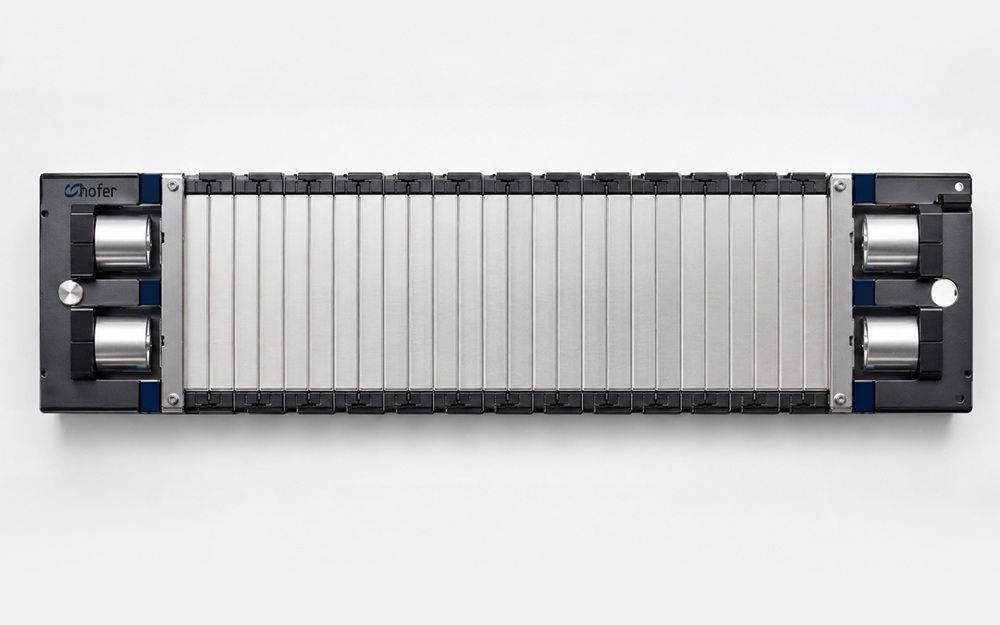
- Smart battery pressure control can extend battery life.
- Cell chemistry and operating conditions shape pressure needs.
Hofer Powertrain Studies Cell Mechanics and Battery Life
On August 26, Hofer Powertrain studied how cell pressure, swelling, deformation, and operating conditions influence battery life and performance. The objective is to identify mechanical conditions that allow different battery cells to maintain performance for longer periods. The company developed its own test methods and programmable equipment to measure cell deformation, temperature, voltage, capacity, and impedance during charging and operation. Testing across NMC, LFP, and next-generation solid-state cells showed that there is no single ideal pressure applicable to every battery type, making cell chemistry, format, charge level, temperature, and usage important factors.
Programmable Equipment Enables Detailed Cell Testing
The testing approach developed by Hofer Powertrain is designed to evaluate battery behavior under different mechanical and operating conditions. Programmable equipment can measure changes in deformation, temperature, voltage, capacity, and impedance while cells undergo charging and operation. These measurements provide a clearer understanding of how mechanical forces interact with electrochemical performance across different cell chemistries and formats. The findings indicate that battery pressure cannot be treated as a universal fixed value, because the appropriate mechanical conditions depend on several interacting parameters that change throughout a cell's operating life.
Smart Pressure Control Supports Flexible Battery Modules
These findings have helped Hofer Technology develop a new generation of battery modules featuring smart pressure control. The system can adjust pressure according to the requirements of individual cells, creating greater flexibility in how mechanical forces are managed within the module. A programmable force map allows pressure applied to cells to change according to operating conditions. This approach transforms pressure from a fixed mechanical setting into an actively controlled part of the battery system, potentially supporting more consistent cell performance while accommodating differences between battery chemistries, formats, charge levels, temperatures, and usage patterns.
Longer Battery Life Could Improve Total Ownership Economics
Extending battery operating life could reduce replacement and recycling requirements while improving residual value, total cost of ownership, and resource efficiency. The technology could potentially be applied across electric vehicles, commercial vehicles, stationary energy storage, and other energy-storage applications. Longer service life becomes particularly important for solid-state energy storage systems and future vehicle-to-home (V2H) and vehicle-to-grid (V2G) applications, where batteries can be subjected to significantly more charging and discharging cycles. Managing cell mechanics during these repeated cycles could therefore become an increasingly important part of future battery development.
Frequently Asked Questions
How does Hofer Powertrain's battery pressure technology support longer battery life?
Hofer Powertrain's approach uses programmable equipment and adjustable mechanical pressure to account for differences between battery cells and operating conditions. Testing across NMC, LFP, and next-generation solid-state cells showed that pressure requirements vary according to chemistry, format, charge level, temperature, and usage. By using a programmable force map, battery modules can adjust pressure rather than relying on one fixed mechanical setting. This can help maintain stable cell performance across repeated charging and discharging cycles while potentially reducing replacement and recycling needs and improving residual value and resource efficiency.
Click above to visit the official source.
Discussion
Join the conversation.