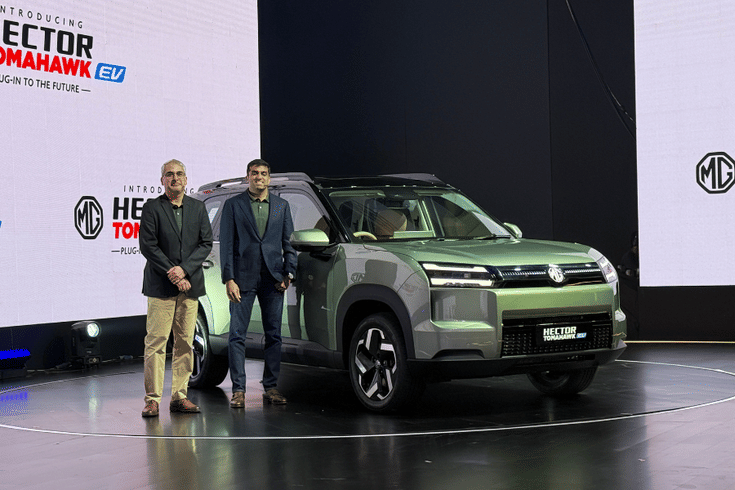
- Hector Tomahawk launches in EV and PHEV forms.
- BaaS lowers upfront pricing for electrified SUVs.
JSW MG Motor India has launched the Hector Tomahawk in electric and plug-in hybrid forms, with introductory ex-showroom prices starting at Rs 19.49 lakh for the EV and Rs 25.69 lakh for the PHEV. Both prices apply to the complete vehicle, while a separate Battery-as-a-Service structure is available for a limited number of bookings. Under the BaaS program, the battery cost is separated from the vehicle’s upfront price and recovered through a usage-linked rental charge. The company has opened bookings for both versions through dealerships and its website, with EV deliveries scheduled to begin in September 2026 and PHEV deliveries following in November. The new model is the first vehicle based on the company’s MG ADAPT architecture.
Hector Tomahawk BaaS Pricing And Delivery Timeline
Under the Battery-as-a-Service program, the Hector Tomahawk EV starts at Rs 13.99 lakh, with a battery-rental charge of Rs 4.90 per kilometer. The PHEV starts at Rs 21.79 lakh and carries a battery-rental charge of Rs 3.20 per kilometer. Electricity and petrol expenses remain additional to these charges. JSW MG Motor India has opened bookings for both versions, while delivery timing differs by powertrain. EV deliveries are scheduled for September 2026, followed by PHEV deliveries in November. The company is positioning the lower BaaS entry prices as a way to reduce the initial purchase cost of an electrified C-segment SUV while shifting part of the battery expense into a usage-based ownership model.
“At this price point, customers can step into a C-segment SUV at a price comparable to many B-segment ICE SUVs,” said Parth Jindal, Director, JSW MG Motor India, referring to the EV’s BaaS price. Jindal also said the PHEV’s BaaS price placed it close to diesel automatic SUVs, providing an electrified powertrain without a significant increase in the initial vehicle cost. The pricing structure therefore gives buyers a choice between conventional upfront pricing and a BaaS model, depending on their preference for how the battery expense is paid. The BaaS program is available for a limited number of bookings, while the standard vehicle prices remain the introductory ex-showroom figures announced by the company.
MG ADAPT Architecture Supports Multiple Powertrains
The Hector Tomahawk is the first product based on MG ADAPT, a flexible new-energy vehicle architecture developed to accommodate multiple powertrain configurations. The platform can support battery-electric, plug-in hybrid, range-extended electric and hybrid systems, allowing the company to use a common architectural approach across different electrification strategies. “When we introduced MG ADAPT, we said the road to new energy would not be the same for everyone. That is exactly why the platform was designed to enable more than one answer,” Jindal said. The architecture is therefore central to the Tomahawk’s positioning, as the same vehicle line combines fully electric and plug-in hybrid options rather than relying on a single electrified propulsion format.
Tomahawk EV Delivers 517km Claimed Range
The Hector Tomahawk EV uses a 69.2kWh battery and has a claimed driving range of 517km on a single charge. The company has not specified the certification cycle used for this range figure. Its electric motor produces 150kW and 310Nm, enabling a claimed zero-to-100kph acceleration time of 8.2 seconds. The SUV supports DC fast charging at up to 90kW, with a 30-80% charging time of around 35 minutes. A 7.4kW home-charging system is also supported. The combination of battery capacity, claimed range, charging capability and motor output places the EV version around the practical requirements of customers seeking a larger electrified SUV for both daily driving and longer-distance travel.
JSW MG Motor India claims the Tomahawk EV is India’s first car with vehicle-to-home technology. The system can use energy stored in the vehicle’s battery to power selected household lights and appliances during an outage, while vehicle-to-load functionality can supply energy to external devices. The company said the battery completed more than 2,000 bench tests and 490 whole-vehicle validations covering high-temperature, extreme-cold and high-altitude conditions. These validation activities are intended to assess battery and vehicle behavior across demanding operating environments. The vehicle-to-home and vehicle-to-load functions also expand the potential role of the EV beyond transportation by allowing stored electrical energy to be used for selected household and external applications.
Tomahawk PHEV Combines Electric And Petrol Power
The Hector Tomahawk PHEV combines a 20.5kWh battery with a 1.5-liter petrol engine developed for hybrid applications. The engine has a claimed thermal efficiency of 43.2%. The vehicle can travel more than 115km in pure-electric mode and has a claimed combined range of more than 1,100km when the battery is fully charged and the fuel tank is full. Its combined powertrain produces 148kW and enables a claimed zero-to-100kph acceleration time of less than nine seconds. JSW MG Motor India says users traveling around 100-150km per day could achieve fuel efficiency of more than 50kpl when most of that distance is covered in electric mode. For customers charging two or three times a week, the company estimates 22-25kpl.
The stated fuel-efficiency figures depend on charging frequency, driving distance covered using battery power and individual operating conditions. They do not include the electricity consumed during charging. The PHEV’s hybrid system uses what JSW MG describes as an electromagnetic dedicated hybrid transmission, with an electronic clutch capable of switching between driving modes in 0.1 seconds. Depending on vehicle speed, accelerator demand, battery charge and road conditions, the system selects among pure-electric, series-hybrid, parallel-hybrid and engine-direct modes. Series mode uses the petrol engine to generate electricity while the motor drives the wheels, while parallel mode combines engine and motor output. Engine-direct mode allows the petrol engine to drive the wheels at highway speeds.
The PHEV also incorporates a 10-in-1 drive unit that integrates 10 powertrain functions into a single assembly. The integrated approach is designed to improve packaging and communication between different systems within the propulsion architecture. By combining multiple functions into one unit, the vehicle reduces the number of separate components required within the powertrain system while supporting the different operating modes available through the dedicated hybrid transmission. The combination of a 20.5kWh battery, 1.5-liter petrol engine, electromagnetic transmission and integrated drive unit allows the Tomahawk PHEV to operate across electric and combustion-driven modes. This architecture is intended to balance electric driving capability with longer-distance operation using conventional fuel.
Five- And Seven-Seat Configurations Expand Practicality
The Hector Tomahawk measures 4,745mm in length, 1,850mm in width and 1,770mm in height, with a wheelbase of 2,810mm. JSW MG Motor India claims the vehicle is the tallest and among the longest models in its segment. Buyers can choose between five-seat and seven-seat configurations, broadening the vehicle’s intended use across different customer requirements. Company figures show that the five-seat version provides 610 liters of boot capacity, while the seven-seat version offers 528 liters with the third row folded. The two configurations allow customers to prioritize either luggage capacity or additional passenger accommodation without changing the core vehicle architecture.
Connected Cabin And Advanced Safety Equipment
The cabin includes a 39.62cm HD touchscreen and a 22.35cm digital instrument cluster, along with wireless Android Auto, Apple CarPlay, wireless phone charging and a 10-speaker Infinity audio system. The iSmart system provides more than 80 connected features and supports more than 30 English voice commands. Other equipment includes ventilated front seats, an electrically adjustable driver’s seat with memory, rear-window sunshades, 256-color ambient lighting and a dual-pane panoramic sunroof. The Jio-powered connected package adds a generative AI-based conversational assistant as well as entertainment, regional content and music-streaming services, extending the vehicle’s connected functions beyond basic smartphone integration and conventional infotainment.
Safety equipment includes a 360-degree camera, electronic stability control, traction control, hill-hold control, ABS with EBD and an electronic parking brake. The vehicle also receives Level 2 advanced driver-assistance technology with 11 functions. JSW MG Motor India is additionally offering different ownership support packages for the two powertrains. The Tomahawk EV is covered by a lifetime warranty on the high-voltage battery, a three-year unlimited-kilometer vehicle warranty, three years of roadside assistance and two labor-free services. An assured buyback program will also be offered, although detailed eligibility conditions have not yet been disclosed. The PHEV receives a three-year vehicle warranty, three years of roadside assistance and three labor-free services.
Customers purchasing the PHEV will also have access to more than 130 options under MG’s e-Shield ownership program. The combination of warranty coverage, roadside assistance, labor-free services and additional ownership options is designed to support customers adopting electrified powertrains. The Tomahawk therefore represents a broader product strategy rather than only the introduction of another SUV, combining multiple propulsion technologies with a flexible platform, connected features, advanced driver assistance and alternative battery ownership structures. With bookings already open and deliveries scheduled separately for the EV and PHEV, the model gives buyers in India access to two electrified configurations from the same vehicle family while allowing the company to test different approaches to new-energy vehicle adoption.
Frequently Asked Questions
What are the Hector Tomahawk EV and PHEV prices in India?
The Hector Tomahawk EV starts at Rs 19.49 lakh, while the PHEV starts at Rs 25.69 lakh, with both prices quoted as introductory ex-showroom prices for the complete vehicle. Under the Battery-as-a-Service program, the EV starts at Rs 13.99 lakh with a battery-rental charge of Rs 4.90 per kilometer, while the PHEV starts at Rs 21.79 lakh with a charge of Rs 3.20 per kilometer. Electricity and petrol costs are additional. EV deliveries are scheduled for September 2026, while PHEV deliveries are scheduled to begin in November 2026.
Click above to visit the official source.
Discussion
Join the conversation.