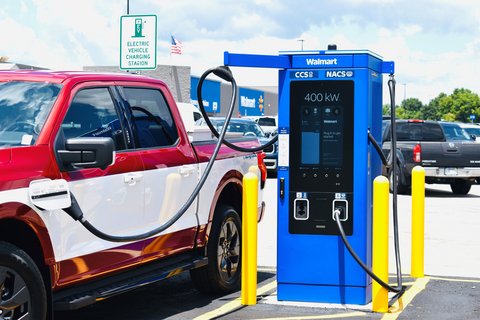
- EV Fast-Charging Networks are becoming more affordable.
- Charging networks compete through prices, amenities and memberships.
Competition Is Lowering EV Fast-Charging Costs
Competition among Ionna and other EV fast-charging networks in the United States is beginning to put downward pressure on charging costs, while network operators increasingly compete on price, convenience and customer experience. Walmart is rapidly expanding its own charging network after an early partnership with Electrify America, adding stations equipped with 400-kW Alpitronic chargers that support both NACS and CCS connectors. Walmart+ members also receive a 10% charging discount. Hundreds of chargers have been installed recently as the retailer increases its presence in the U.S. charging market.
Ionna Targets a Large North American Charging Footprint
Backed by BMW, GM, Honda, Hyundai, Kia, Mercedes-Benz, Stellantis and Toyota, Ionna plans to deploy 30,000 fast chargers across the United States and Canada by 2030. Many Ionna locations are designed to provide more than charging alone, incorporating convenience stores and restrooms while supporting both major connector types. The network's expansion reflects the growing importance of reliable and accessible public charging infrastructure as automakers and charging operators seek to make longer-distance electric vehicle travel more convenient across United States and Canada.
Charging Prices Vary Significantly Across Networks
Recent pricing analysis by Chargeonics found that Ionna averaged just USD 0.37 per kWh, making it the lowest-priced network among 17 U.S. networks analyzed. Walmart ranked as the fourth-cheapest network, while Shell Recharge and Rocky Mountain Power were also below several major competitors. Walmart's average price was USD 0.43 per kWh, compared with USD 0.56 per kWh for Tesla and Electrify America. Ionna has also offered temporary promotional pricing near USD 0.20 per kWh, demonstrating how competitive pricing can become an important differentiator as charging networks expand.
Operators Are Competing Beyond Charging Prices
Price is not the only factor shaping competition among U.S. charging providers. Networks are increasingly differentiating themselves through amenities, reservations, memberships and larger charging hubs intended to improve the overall customer experience. Mercedes-Benz High Power Charging is focusing on amenities and reservation capabilities, while BP is targeting larger charging hubs. Meanwhile, Tesla, Electrify America and EVGo continue promoting membership-based offerings. This broader competitive approach indicates that charging operators are balancing lower electricity prices with convenience, location quality, charging capacity and customer loyalty.
What the Competitive Shift Means for EV Charging
The expanding network landscape is creating more choice for electric vehicle drivers while encouraging operators to improve both pricing and service quality. Walmart's retail footprint, Ionna's OEM backing and the different approaches adopted by established charging providers illustrate how the market is developing beyond a single-network model. Faster chargers, dual-connector availability, reservations, memberships and customer amenities are becoming increasingly important alongside charging prices. As more networks expand across North America, competition could continue encouraging operators to improve accessibility, charging speed and overall value for EV users.
Frequently Asked Questions
Why are U.S. EV fast-charging networks becoming cheaper?
The growing number of charging operators is increasing competition, encouraging networks to compete more aggressively on electricity prices, memberships, amenities, charging speed and convenience. Ionna averaged USD 0.37 per kWh in the Chargeonics analysis of 17 U.S. networks, while Walmart averaged USD 0.43 per kWh. By comparison, Tesla and Electrify America averaged USD 0.56 per kWh. Temporary promotional pricing, including Ionna offers near USD 0.20 per kWh, also shows how operators can use discounts to attract customers and strengthen their position in an increasingly competitive charging market.
Click above to visit the official source.
Discussion
Join the conversation.