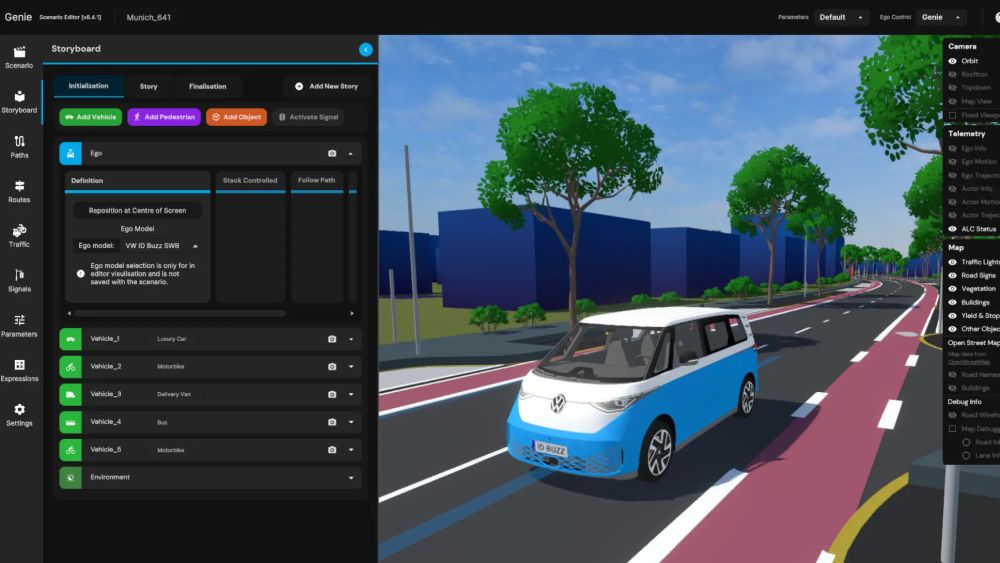
- Bosch Photorealistic Simulation Technology targets safer autonomous development.
- Generative AI expands testing across varied driving scenarios.
Bosch and Five AI Advance Autonomous Vehicle Simulation
Robert Bosch GmbH has announced that its subsidiary Five AI will develop new photorealistic simulation technology in Cambridge, UK, designed to make autonomous vehicle development faster, safer, and less costly. The project is supported through the UK Government’s GBP 150 million CAM Pathfinder program, which is delivered in partnership with Zenzic and Innovate UK. Bosch Photorealistic Simulation Technology will focus on creating highly realistic digital driving environments that can help developers evaluate automated driving systems under controlled and repeatable conditions before broader real-world deployment.
Generative AI Creates More Realistic Driving Scenarios
The technology will combine Gaussian scene reconstruction with generative AI to produce detailed 3D digital representations of real-world roads, junctions, and other driving environments. Diffusion-based AI models will allow developers to rapidly generate variations in lighting, weather, and other scene conditions, expanding the range of situations available for autonomous driving system testing. By reproducing more diverse environmental conditions within a simulated setting, the approach is intended to support broader validation while reducing the time and resources required to repeatedly test automated driving technologies on physical roads.
Technology Targets Higher Levels of Automated Driving
The new simulation capability will support the development of Level 2++ and Level 3 automated driving systems and will integrate with other Robert Bosch GmbH Mobility solutions to create a comprehensive development platform. The longer-term objective is to support the training and validation of Level 4 autonomous vehicle systems. The initiative therefore extends beyond individual simulation scenarios, combining advanced digital environment generation with broader development and validation capabilities intended to help accelerate progress toward increasingly automated driving functions.
UK Funding Supports Autonomous Mobility Development
The project forms part of the UK’s wider effort to strengthen technologies required for connected and automated mobility. The CAM Pathfinder program provides funding for projects intended to advance autonomous vehicle development, while collaboration with Zenzic and Innovate UK supports the program’s delivery. Development in Cambridge also places the initiative within a technology ecosystem focused on automated mobility research and testing in the United Kingdom. The resulting simulation capabilities could help developers assess increasingly complex driving conditions before autonomous systems are exposed to comparable scenarios in real-world environments.
Frequently Asked Questions
What is Bosch developing through Five AI?
The project will develop photorealistic simulation technology combining Gaussian scene reconstruction and generative AI to create realistic digital driving environments for autonomous vehicle development. The system will represent roads, junctions, and other real-world conditions while allowing developers to generate variations in lighting, weather, and related scenarios. The technology is intended to support Level 2++ and Level 3 automated driving development and ultimately contribute to training and validation for Level 4 autonomous systems. Funding comes through the UK Government’s GBP 150 million CAM Pathfinder program, delivered with Zenzic and Innovate UK.
Click above to visit the official source.
Discussion
Join the conversation.