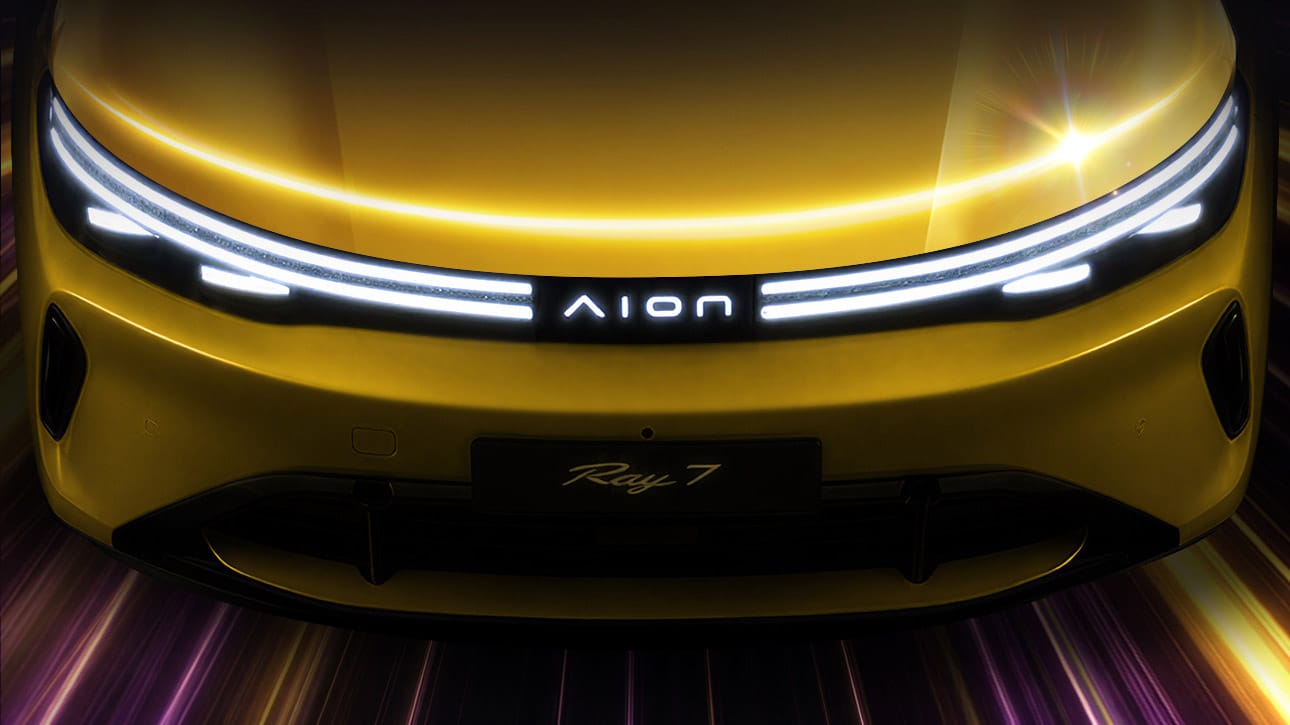
- GAC Aion Ray 7 debuts August 19 with advanced technology.
- New sedan targets younger buyers as sales recover.
GAC Aion Ray 7 Debut Targets Younger Consumers
GAC Aion will officially debut the GAC Aion Ray 7 on August 19, introducing the first model in a new lineup designed to appeal to younger consumers. Zhang Xiong, president of the GAC Hyptec and Aion Business Unit, disclosed the plan on Weibo on Sunday. The Ray 7 is positioned as a “super electric sedan loved by young people,” with a focus on sporty handling and advanced driver assistance. The model also introduces GAC Aion’s new brand identity, including an illuminated logo and a full-width star-ring light strip across the front. Its arrival marks a significant step in the brand’s effort to refresh its model portfolio while sales continue to recover in 2026.
Sporty Fastback Design And Mid-to-Large-Size Dimensions
The five-seat electric sedan measures 4,960 mm in length, 1,900 mm in width and 1,455 mm in height, with a 2,920 mm wheelbase. These dimensions place the Ray 7 in the mid-to-large-size segment, while its low-slung wide-body stance and fastback profile give it a distinctly sporty appearance. The exterior also features semi-hidden door handles and a blacked-out C-pillar, reinforcing the streamlined design theme. Buyers will have a choice of 17-inch and 19-inch wheels. The combination of proportions, fastback styling and new lighting details is intended to give the model a more youthful visual character as GAC Aion expands the Ray family.
Electric Powertrain Uses LFP Batteries
For propulsion, the Ray 7 uses a permanent-magnet synchronous motor supplied by Huawei, with a peak output of 180 kW, equivalent to 241 hp, according to its regulatory filing. The vehicle uses lithium iron phosphate, or LFP, batteries, with battery cells for its two filed variants supplied by CATL and Yinpai Battery. Yinpai Battery is GAC Aion’s battery subsidiary. The use of LFP chemistry and a Huawei-supplied motor gives the Ray 7 a defined technical configuration ahead of its market debut. The disclosed specifications also show the model combining established battery technology with components sourced through both external and internal supply relationships.
Super Chassis And LiDAR-Based Driver Assistance
GAC Aion says the Ray 7 will be the world’s first production vehicle equipped with its “Super Chassis,” which features a chip-level drive-control integration architecture. Its driver-assistance system uses a LiDAR-based solution, while the algorithms are derived from the same technology base as Level 4 autonomous driving. A roof-mounted LiDAR sensor will be available as an option. Together, these features position the Ray 7 around integrated electronic control and advanced sensing rather than relying only on conventional driver-assistance functions. The technology package is also intended to support the model’s positioning as a sporty electric sedan with a stronger emphasis on intelligent driving capabilities.
Chengdu Auto Show Appearance Follows August Debut
The August 19 debut is expected to precede the Ray 7’s public appearance at the 2026 Chengdu Auto Show, which will run from August 21 through August 30. The event is described as China’s first A-class auto show of the second half of 2026, giving GAC Aion an early opportunity to present the new model to a broader audience. The timing places the Ray 7 launch alongside the brand’s wider product and technology refresh. Its new logo, fastback design, electric powertrain and LiDAR-based driver assistance are likely to be among the key elements highlighted as GAC Aion builds visibility for the new Ray lineup in China.
GAC Aion Sales Recover In 2026
The new model arrives as GAC Aion’s sales show signs of recovery. The brand sold 28,807 vehicles in July 2026, representing a 36.37% year-on-year increase. Sales for the first seven months reached 210,386 vehicles, up 62.08% from the same period a year earlier. The improvement contrasts with the brand’s performance in 2025, when full-year sales totaled 290,081 vehicles, down 22.62% from the previous year. The Ray 7 therefore enters the market at a time when GAC Aion is rebuilding momentum, making the new model strategically important for sustaining growth beyond the recovery already recorded during 2026.
GAC Aion Monthly Sales, 2024-2026
GAC Aion’s monthly sales figures show substantial variation across the three-year period, while several 2026 months recorded stronger volumes than their corresponding months in 2025. The data provide context for the Ray 7’s launch as the brand seeks to sustain its recovery through a refreshed product lineup and increased technology differentiation.
| Month | 2024 | 2025 | 2026 |
|---|---|---|---|
| January | 11,005 | 7,965 | 21,635 |
| February | 10,006 | 14,482 | 11,742 |
| March | 27,856 | 24,656 | 40,733 |
| April | 21,350 | 23,408 | 38,034 |
| May | 30,420 | 18,280 | 31,946 |
| June | 25,692 | 19,886 | 37,489 |
| July | 28,287 | 21,124 | 28,807 |
| August | 31,772 | 24,318 | |
| September | 40,360 | 27,297 | |
| October | 38,152 | 28,199 | |
| November | 42,301 | 38,326 | |
| December | 67,683 | 42,140 |
Ray 7 Supports GAC Aion’s Product Recovery
GAC Aion’s monthly sales data also show a stronger pattern in several months of 2026 compared with the corresponding periods of 2025. Sales reached 21,635 vehicles in January, 40,733 in March, 38,034 in April, 31,946 in May and 37,489 in June before July’s 28,807 units. The figures indicate that the recovery has not been limited to a single month, although monthly volumes continue to fluctuate. Against this backdrop, the Ray 7 gives GAC Aion an opportunity to broaden its appeal with a new sedan architecture, updated brand design and higher-level intelligent driving technology as it works to strengthen its position in China’s competitive electric-vehicle market.
Frequently Asked Questions
When will GAC Aion Ray 7 debut?
The GAC Aion Ray 7 is scheduled to make its official debut on August 19, 2026, ahead of its appearance at the Chengdu Auto Show. The model is the first vehicle in GAC Aion’s new Ray lineup and is aimed at younger consumers. It combines a sporty fastback design with a 180 kW permanent-magnet synchronous motor, LFP batteries and a LiDAR-based driver-assistance system. GAC Aion has also positioned the sedan as the first production vehicle using its “Super Chassis” chip-level drive-control integration architecture.
What technology does the Ray 7 use?
The Ray 7 combines LFP battery technology, a Huawei-supplied electric motor and LiDAR-based driver assistance in a new mid-to-large-size electric sedan. Its permanent-magnet synchronous motor produces a peak 180 kW, or 241 hp, while battery cells for two filed variants come from CATL and Yinpai Battery. The driver-assistance algorithms are derived from the same technology base as Level 4 autonomous driving, and a roof-mounted LiDAR sensor is optional. The model also introduces GAC Aion’s “Super Chassis,” featuring chip-level drive-control integration architecture.
Click above to visit the official source.
Discussion
Join the conversation.