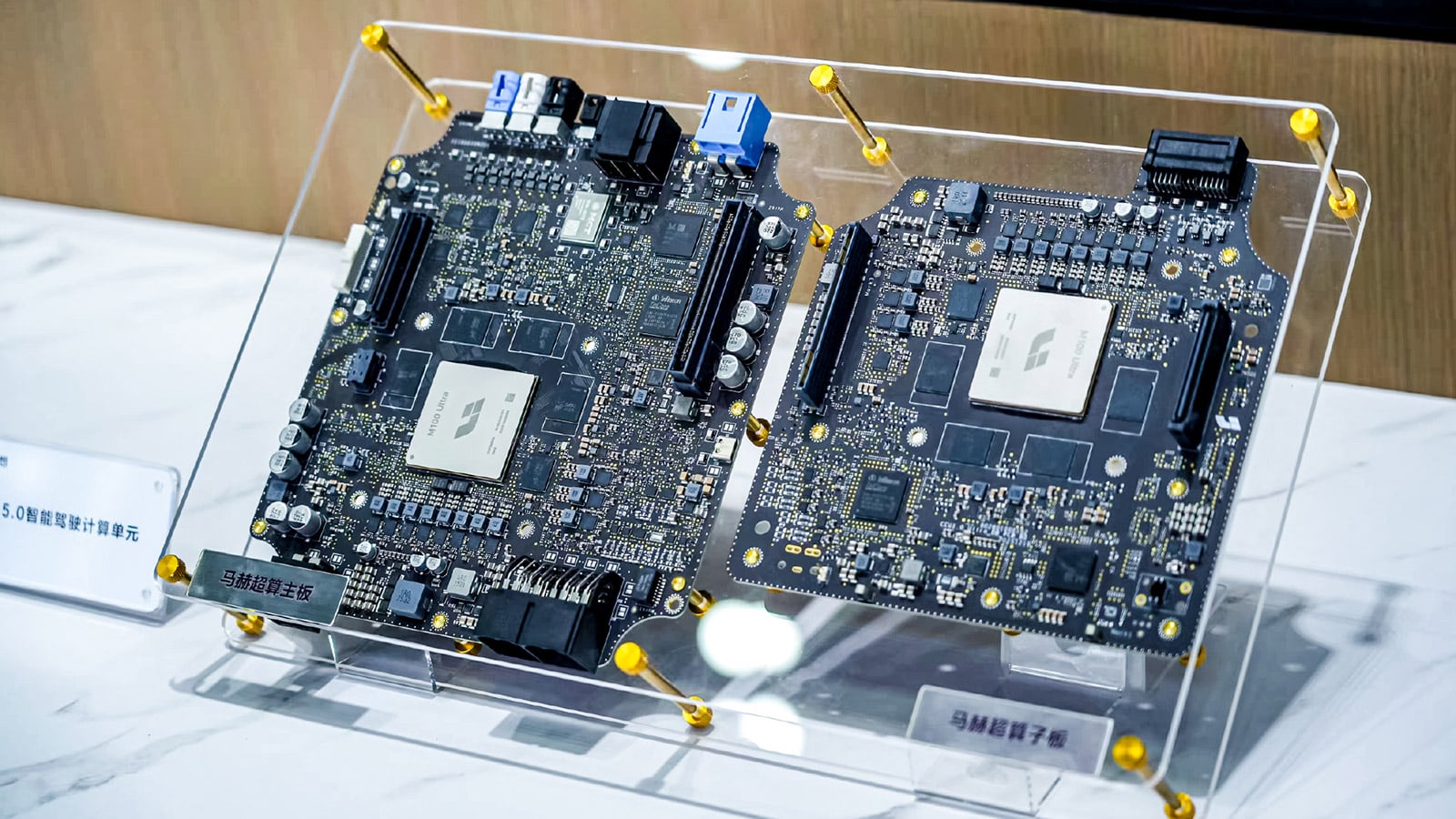
- Li Auto Cloud Inference Chip enters early-stage development.
- Dataflow architecture could connect vehicle and cloud AI.
Li Auto Cloud Inference Chip development is reportedly being explored as the Chinese automaker evaluates whether its existing assisted-driving semiconductor architecture can be extended into cloud computing applications. According to a Friday report by local media outlet LatePost, the proposed chip remains at an early stage and would use the same dataflow architecture as Li Auto’s assisted-driving chip. The initiative reflects a broader effort by automakers to develop proprietary computing capabilities spanning vehicles and data centers. It could potentially allow the company to reuse selected hardware designs and software tools while supporting artificial intelligence workloads associated with assisted-driving development and large language models.
Li Auto Considers Dataflow Architecture For Cloud Computing
The proposed cloud inference solution would target workloads that are currently handled largely by GPUs in artificial intelligence data centers. Dedicated inference chips can process selected AI workloads without relying entirely on general-purpose graphics processors, potentially improving efficiency for specific applications. Industry sources cited by LatePost said these workloads could include data processing, testing and simulation for assisted-driving models, along with request handling for large language models. However, training operations that require parameter updates would continue to depend on dedicated training hardware. This distinction highlights the intended role of the proposed technology as an inference-focused solution rather than a complete replacement for conventional AI accelerator infrastructure.
Taking a dataflow architecture developed for vehicle computing into the cloud is considered technically feasible, according to industry insiders cited by the report. One possible approach would involve reusing the compute design of the vehicle-side neural processing unit and packaging multiple AI compute dies into a larger processing solution. High-bandwidth memory and high-speed interconnect technologies could then provide the additional memory capacity and communication bandwidth required for data-center workloads. Such an approach could give Li Auto Inc an opportunity to share portions of its hardware architecture and software development tools between vehicle and cloud applications, potentially distributing research and development expenditure across multiple use cases.
Cloud AI Requirements Differ From Vehicle Computing
Despite the potential for architectural reuse, a cloud inference chip cannot simply be treated as a larger version of an automotive AI processor. Vehicle computing typically operates within comparatively predictable conditions, where the models, sensor inputs and operating patterns are more controlled. Automotive processors are therefore optimized around requirements such as low power consumption, low latency and stable execution. Cloud infrastructure faces a substantially different workload profile because it must support multiple models simultaneously, accommodate changing model versions and process widely varying input lengths and concurrent requests. These differences create additional hardware and software requirements that could determine whether the proposed architecture becomes commercially viable.
Cloud inference infrastructure also requires technologies and system-level capabilities that are less critical in a vehicle environment. These include high-bandwidth memory, multi-chip interconnects, dynamic batching and cluster scheduling. According to an industry source quoted by LatePost, achieving a particular performance level with an individual processor is not necessarily the most difficult challenge. Instead, the more important question is whether the complete inference system can deliver competitive costs at scale. The commercial advantage of extending a dataflow architecture from vehicles into cloud infrastructure would therefore depend on how effectively models can be adapted and how efficiently the resulting system operates across different workloads.
Dataflow Competition Extends Beyond Automotive
Li Auto is not alone in investigating dataflow-based computing architectures. LatePost identified companies including SambaNova, Groq and Tenstorrent as organizations also pursuing approaches based on dataflow processing. The teams behind these businesses bring significant semiconductor and artificial intelligence expertise, with SambaNova and Groq having roots connected to Stanford and Google’s TPU development work respectively. Tenstorrent is led by Jim Keller, who previously worked on Tesla’s self-driving chip program. Their activities demonstrate that alternative AI accelerator architectures are attracting attention beyond traditional GPU-based computing, although the technology still faces significant challenges before achieving broad data-center adoption.
Compared with GPUs, dataflow architectures still need to demonstrate sufficient model versatility, software ecosystem maturity and large-scale deployment capability. GPUs have benefited from established programming environments, broad developer adoption and compatibility across a wide variety of AI workloads. A specialized architecture can potentially achieve advantages for particular inference applications, but those benefits may be reduced if developers need extensive model adaptation or if software support remains limited. For Li Auto, this means that hardware performance alone would not determine the success of a cloud computing initiative. Software portability, deployment efficiency and the ability to support evolving AI models would also become critical factors.
Executive Changes Raise Questions About Project Progress
The development effort comes alongside changes within Li Auto’s chip organization. LatePost confirmed through multiple channels that Jin Yihua, who led chip software research and development, and Dai Jie, who headed one of the company’s chip front-end design groups, have left the company. Both executives previously reported to Luo Min, head of the computing power unit, who reports to group chief technology officer Xie Yan. The available information does not establish whether these departures are directly connected to the proposed cloud inference initiative. Their timing nevertheless introduces uncertainty around the project’s organizational structure and whether responsibilities within the semiconductor program will change as development progresses.
Mach M100 Provides The Existing Semiconductor Foundation
Li Auto already has experience developing proprietary automotive AI silicon through its Mach M100 assisted-driving chip. The company officially unveiled the processor on May 12, describing it as a 5nm automotive-grade chip with 1,280 TOPS of computing power per device. The processor has entered mass production in the latest Li L9, L8 and L6 models, while a dual-chip configuration provides a combined 2,560 TOPS. This existing semiconductor program provides an important technical foundation for the company’s exploration of broader computing applications, although the architecture, memory subsystem and system design required for cloud inference would still involve substantial additional engineering.
Li Auto founder, chairman and chief executive Li Xiang has previously described the motivation behind the company’s proprietary chip efforts as moving artificial intelligence from technical demonstrations into practical operation in the physical world. The Mach M100 therefore represents more than an isolated semiconductor development program, as it supports the company’s broader strategy around intelligent vehicles and assisted driving. Extending related computing concepts into cloud infrastructure could potentially create another layer of integration between vehicle-generated data, model development, simulation and deployment. However, the technical and economic requirements of data-center inference mean that the company would need to prove that such integration provides a measurable advantage over established accelerator solutions.
New Semiconductor Entity May Signal Broader Strategy
Li Auto also registered Xinchuang Zhihe Shanghai Technology Co Ltd on July 13, with a business scope that includes integrated circuit chip design. The creation of this entity could indicate that the company is considering a more independent structure for its semiconductor activities, although the available information does not establish that the new company was created specifically for the cloud inference project. A dedicated semiconductor organization could nevertheless provide greater flexibility for chip development, investment and partnerships. The move is particularly notable because other Chinese electric vehicle manufacturers have increasingly established separate semiconductor businesses as they seek greater control over proprietary computing technologies.
The strategy has a precedent at Nio Inc, which established its GeniTech Co Ltd semiconductor subsidiary, also known as Shenji, in June 2025. That business has subsequently raised nearly 3 billion yuan, equivalent to about $442 million, at a post-money valuation of approximately 8.27 billion yuan. The development illustrates how semiconductor activities can evolve beyond an internal vehicle engineering function into a separately funded business. For Li Auto, any similar move would represent a significant strategic step, potentially changing how its chip activities are financed, organized and commercialized while creating opportunities to serve applications beyond its own vehicle programs.
Chinese Automakers Continue Building Proprietary AI Silicon
The semiconductor push extends across several major Chinese electric vehicle manufacturers. Xpeng has also introduced its proprietary Turing assisted-driving chip and deployed the technology in its vehicles. Meanwhile, China remains an important market for the development of automotive artificial intelligence, as vehicle manufacturers increasingly seek control over computing platforms, assisted-driving systems and related software. Developing proprietary chips can potentially reduce dependence on external semiconductor suppliers while allowing automakers to optimize hardware and software together. At the same time, these programs require substantial investment and long development cycles, making cost efficiency, production scale and software capability critical to their long-term success.
For Li Auto, the proposed cloud inference initiative therefore represents an early-stage extension of a semiconductor strategy that is already visible in its vehicle computing products. The potential benefits include architectural reuse, closer integration between vehicle and cloud AI systems and the possibility of spreading research and development costs across multiple computing applications. The challenges are equally significant because cloud infrastructure demands broader model support, higher memory bandwidth, faster interconnects and efficient system-level scheduling. Whether the approach becomes a meaningful commercial advantage will depend on future technical validation, software maturity, deployment economics and the company’s ability to execute its semiconductor roadmap.
Frequently Asked Questions
What is Li Auto reportedly developing for cloud computing?
Li Auto is reportedly exploring an in-house inference processor designed for artificial intelligence workloads in cloud data centers, extending technology concepts already used in its vehicle computing systems. The project is described as being at an early stage and is expected to use a dataflow architecture related to the company’s assisted-driving chip. Potential applications include assisted-driving model processing, testing and simulation, as well as handling requests for large language models. The proposed solution would complement training hardware rather than replace processors used for model training operations that require parameter updates.
How would a cloud inference chip differ from Li Auto’s vehicle chip?
A cloud inference processor would need to address a much broader and less predictable workload environment than an automotive AI processor installed in a vehicle. Vehicle-side computing generally operates with relatively fixed models, sensor inputs and execution patterns, allowing optimization around low power consumption, low latency and stable performance. Cloud systems must simultaneously support multiple models, changing model versions, variable input lengths and large numbers of concurrent requests. They also require technologies such as high-bandwidth memory, multi-chip communication, dynamic batching and cluster scheduling, making system-level efficiency just as important as the performance of the individual processor.
What is the Mach M100 chip developed by Li Auto?
The Mach M100 is Li Auto’s proprietary assisted-driving processor, officially unveiled as a 5nm automotive-grade chip with 1,280 TOPS of computing capability per chip. The processor has entered mass production in the latest Li L9, L8 and L6 vehicles, while a dual-chip configuration provides 2,560 TOPS of combined computing performance. The chip forms part of Li Auto’s broader effort to develop proprietary artificial intelligence computing capabilities for vehicles. Its dataflow-oriented architecture is also reportedly being considered as a technical reference for the company’s early exploration of cloud-based inference computing applications.
Could Li Auto create a separate semiconductor business?
Li Auto registered Xinchuang Zhihe Shanghai Technology Co Ltd on July 13 with integrated circuit chip design included in its business scope, potentially indicating a broader organizational strategy for semiconductor development. However, the available reporting does not establish that this company was created specifically for the cloud inference project. A separate structure could potentially provide greater flexibility for investment, engineering and future commercialization. The development is notable because other Chinese electric vehicle manufacturers have also created dedicated semiconductor entities, demonstrating a wider industry movement toward greater control over proprietary computing hardware and the supporting software ecosystem.
Click above to visit the official source.
Discussion
Join the conversation.