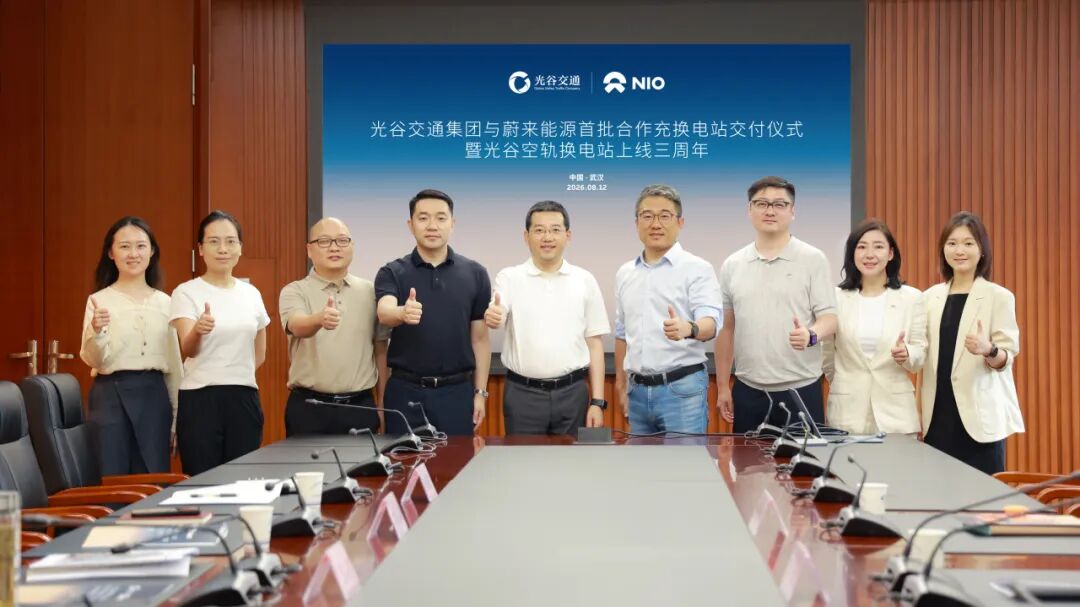
- NIO charging and battery swap stations expand in Wuhan.
- NIO Power scales infrastructure through state-owned partnerships.
NIO Delivers 36 Charging And Battery Swap Stations In Wuhan
NIO charging and battery swap stations are expanding in Wuhan as the first batch of 36 stations jointly operated by NIO Inc, through NIO Energy Investment (Hubei) Co., Ltd., and Wuhan Optics Valley Transportation Investment Group Co., Ltd. has officially been delivered. The assets are owned by Optics Valley Transportation, while NIO Power will manage their operation using its charging, battery swapping, and network management capabilities. The delivery represents an important implementation of NIO Power’s asset-ownership and professional-operations model in Hubei Province, creating a framework in which state-owned partners fund and own infrastructure while NIO contributes operating expertise.
State-Owned Asset Ownership Supports NIO Power Operations
The latest delivery establishes a clear division of responsibilities between the two partners. Wuhan Optics Valley Transportation Investment Group Co., Ltd. owns the charging and battery swap station assets, while NIO Energy Investment (Hubei) Co., Ltd. is responsible for operating them. This arrangement allows the infrastructure investment burden and operational responsibilities to be separated, with the state-owned partner controlling the physical assets and NIO Power applying its established technical capabilities and operating experience. The model is designed to support professional management while enabling local partners to participate in the expansion of electric-vehicle energy infrastructure.
Expansion Planned Across Hubei And China
The Wuhan deployment is also expected to serve as an important implementation of the cooperation model in Hubei Province. NIO and its partners intend to continue advancing subsequent batches of charging and battery swap stations across Hubei and other parts of China. Under the model, locally owned infrastructure can be combined with NIO Power’s operational capabilities, supporting the broader objective of establishing a high-quality charging and battery swap network. The companies said the continued cooperation will focus on nationwide deployment as well as the long-term and stable operation of the infrastructure as the network expands.
NIO Power Expands Partnerships With Local Investment Platforms
NIO Power has already developed this partnership approach beyond Wuhan. The company said it has established practical cooperation with more than 40 local state-owned investment platforms and financial institution partners across 25 provinces, municipalities, and regions. Through these relationships, the partners are jointly building and putting charging and battery swap infrastructure into operation. This scale indicates that NIO Power is using partnerships with asset owners and financial institutions as an important mechanism for expanding its energy network, while retaining responsibility for professional operations across a geographically broader infrastructure footprint.
More Than 800 Battery Swap Stations In Operation
The company also reported that these partnerships have contributed to more than 800 battery swap stations being jointly built and placed into operation to date. The figure highlights the scale of NIO Power’s existing infrastructure deployment and the growing role of partnership-based ownership in its expansion strategy. By combining local or institutional capital ownership with NIO’s operating capabilities, the approach can support additional station deployment without requiring every asset to be directly owned by NIO. The continuation of this model in Hubei and across China will determine how effectively the network can expand while maintaining consistent operating standards.
Frequently Asked Questions
How many charging and battery swap stations were delivered in Wuhan?
The first batch included 36 charging and battery swap stations delivered under a cooperation model between NIO Power and Wuhan Optics Valley Transportation. The station assets are owned by the state-owned partner, while NIO Power is responsible for professional operations. The model is intended to accelerate infrastructure deployment by combining local asset ownership with NIO’s established operating capabilities. NIO Power also reported cooperation with more than 40 state-owned investment platforms and financial institution partners across 25 provinces, municipalities, and regions, with more than 800 battery swap stations jointly built and operating to date.
Click above to visit the official source.
Discussion
Join the conversation.