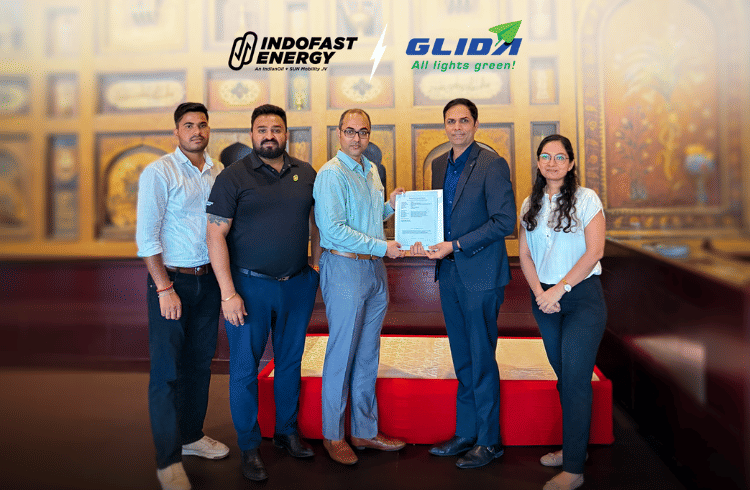
- Indofast Energy partners with GLIDA for expansion.
- Battery swapping expands alongside high-power charging hubs.
Indofast Energy has entered into a strategic partnership with GLIDA, an EV charging infrastructure provider, to co-locate battery swapping stations at established public charging sites across India. The initiative launches with 10 Quick Interchange Stations deployed across GLIDA locations in Chennai, Bengaluru, and Hyderabad. Over the next 12 months, the two companies aim to expand the network to 50 sites housing more than 100 battery swapping stations. The integrated approach combines high-power charging and battery swapping within single energy hubs designed to serve diverse vehicle categories from established infrastructure locations.
Indofast Energy, GLIDA Leadership on the Partnership
Subhash Bhat, Interim CEO of Indofast Energy, said, "Our partnership with GLIDA enables us to rapidly expand our Battery-as-a-Service network by leveraging well-connected, power-ready sites that can be quickly activated for battery swapping operations." The statement highlights the role of existing charging infrastructure in accelerating the deployment of battery-swapping operations. By using established, power-ready locations, the partnership is intended to support faster activation of additional swapping facilities while expanding access to the Battery-as-a-Service network. The initial deployment across Chennai, Bengaluru, and Hyderabad provides the starting footprint for the planned network expansion during the next 12 months.
Deepak Paliwal, Managing Director and CEO of GLIDA, said, "This partnership with Indofast Energy allows us to display future-ready mobility infrastructure where high-power charging and rapid battery swapping coexist to serve different vehicle categories from a single location." The partnership therefore combines two energy infrastructure approaches within shared locations. The companies plan to increase the network from the initial 10 Quick Interchange Stations to more than 100 battery swapping stations across 50 sites, creating integrated energy hubs that can support both high-power charging and rapid battery swapping requirements.
Planned Battery Swapping Network Expansion
The initial rollout consists of 10 Quick Interchange Stations across GLIDA locations in Chennai, Bengaluru, and Hyderabad. Over the following 12 months, the companies aim to scale the network to 50 sites with more than 100 battery swapping stations. This expansion is structured around co-locating swapping infrastructure with established public charging facilities rather than developing separate locations for each energy service. The approach is intended to leverage existing power-ready sites while creating shared energy hubs capable of supporting different vehicle categories through high-power charging and battery swapping infrastructure at the same location.
Battery-as-a-Service Infrastructure Strategy
The collaboration strengthens the Battery-as-a-Service approach by combining rapid battery exchange capabilities with an existing public charging network. The model is designed to improve the availability of energy infrastructure for vehicles requiring battery swapping while maintaining access to conventional high-power charging facilities at the same sites. By integrating these services, the partnership creates a broader energy infrastructure proposition that can accommodate different vehicle requirements. The planned expansion to 50 sites and more than 100 stations represents the next stage of the companies' strategy to increase the geographic reach and operational availability of battery-swapping infrastructure across India.
Frequently Asked Questions
What is the Indofast Energy and GLIDA partnership?
The partnership combines battery swapping with established EV charging infrastructure at public charging locations across India. It begins with 10 Quick Interchange Stations at GLIDA locations in Chennai, Bengaluru, and Hyderabad. Over the next 12 months, the companies aim to expand the network to 50 sites with more than 100 battery swapping stations. The integrated model is intended to create energy hubs where high-power charging and rapid battery swapping can coexist, allowing infrastructure at individual locations to serve diverse vehicle categories and supporting the expansion of Battery-as-a-Service operations.
How many battery swapping stations are planned?
The initial deployment includes 10 Quick Interchange Stations across Chennai, Bengaluru, and Hyderabad. Over the next 12 months, the companies aim to expand the network to 50 sites housing more than 100 battery swapping stations. The planned expansion will use established, power-ready public charging locations to support faster deployment. By combining battery swapping and high-power charging at shared sites, the initiative is designed to create integrated energy hubs capable of serving different vehicle categories while increasing the availability of battery-swapping infrastructure across India.
Click above to visit the official source.
Discussion
Join the conversation.