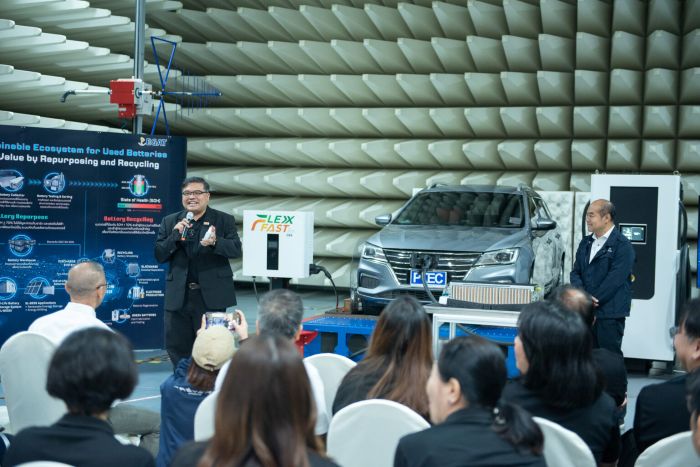
- EV battery recycling in Thailand advances through EGAT projects.
- Second-life BESS targets batteries above 70% SOH.
Thailand Advances EV Battery Circularity
Announced on August 7, 2026, EV battery recycling in Thailand is advancing through projects led by the Electricity Generating Authority of Thailand (EGAT) and the National Science and Technology Development Agency (NSTDA). The initiatives cover reuse and recycling of used EV batteries, including second-life battery energy storage systems (BESS). EGAT is also collaborating with Thammasat University on a prototype facility designed to process batteries from EVs and electrical devices and separate black mass.
Battery Reuse, Recycling and Circular-Economy Plans
Under the planned approach, batteries with a State of Health (SOH) above 70% will be reused in 100 kWh and 20 kWh BESS, while batteries below 70% or damaged batteries will be recycled to recover important materials for developing new green battery cells. EGAT is studying sites and operating models for a Circular Industrial Estate with the Industrial Estate Authority of Thailand (IEAT), while its work with the Thailand Development Research Institute (TDRI) covers circular-economy policies and measures, including proposals for a Battery Passport and Extended Producer Responsibility (EPR) in Thailand.
Frequently Asked Questions
What is EGAT planning for used EV batteries?
EGAT is developing projects covering battery reuse, recycling and material recovery, with batteries assessed according to their State of Health. Units above 70% SOH are planned for second-life use in 100 kWh and 20 kWh BESS, while batteries below 70% SOH or those that are damaged are intended for recycling. The program also includes black mass separation, potential Circular Industrial Estate models, and policy proposals involving a Battery Passport and Extended Producer Responsibility.
Click above to visit the official source.
Discussion
Join the conversation.