Quick Takeaways
- The Honda Base Station Prototype focuses on space efficiency, off-grid capability, and flexible camping comfort.
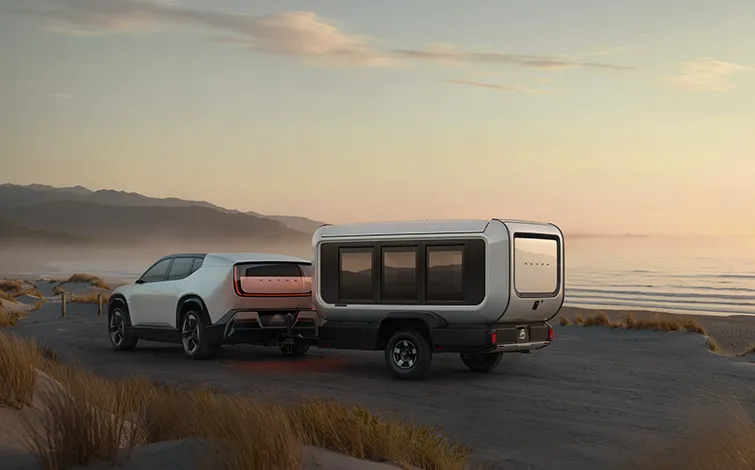
On January 14, Honda introduced the Honda Base Station Prototype, a towable travel trailer concept developed by engineers and designers at the company’s U.S. research and development centers in Los Angeles and Ohio. The concept highlights modular design, integrated smart technology, and efficient packaging aimed at modern outdoor travel needs.
Honda Base Station Prototype designed for compact and electric SUVs
The Honda Base Station Prototype is engineered to be towed by popular Honda models such as the Honda CR-V, the electric Honda Prologue, and the upcoming Honda 0-Series SUV. This compatibility reflects Honda’s focus on extending outdoor mobility options for both conventional and electric vehicle owners.
Space-efficient design built on Honda’s philosophy
Following Honda’s “Man Maximum/Machine Minimum” design approach, the trailer maximizes usable interior space while keeping its exterior footprint compact. Its dimensions allow it to fit within a standard residential garage or parking space, making ownership and storage more practical for urban and suburban users.
Flexible interior layout for family travel
The top section of the trailer can be raised quickly to provide nearly seven feet of standing height. A rear tailgate hinged at the top enables smooth movement between the trailer interior and the campsite. Inside, the layout supports comfortable accommodation for a family of four.
Key interior features include:
Off-grid power with zero-emission capability
The Honda Base Station Prototype supports zero-emissions operation during off-grid use through a standard lithium battery system paired with an inverter and integrated solar panels. For longer stays, the system allows quick connection to external power sources, including campsite hookups or a Honda generator, offering flexibility across different travel scenarios.
By combining compact towing compatibility, adaptable interior design, and clean energy capability, the Honda Base Station Prototype reflects Honda’s vision for future recreational mobility centered on efficiency, versatility, and sustainability.
Honda Base Station Prototype designed for compact and electric SUVs
The Honda Base Station Prototype is engineered to be towed by popular Honda models such as the Honda CR-V, the electric Honda Prologue, and the upcoming Honda 0-Series SUV. This compatibility reflects Honda’s focus on extending outdoor mobility options for both conventional and electric vehicle owners.
Space-efficient design built on Honda’s philosophy
Following Honda’s “Man Maximum/Machine Minimum” design approach, the trailer maximizes usable interior space while keeping its exterior footprint compact. Its dimensions allow it to fit within a standard residential garage or parking space, making ownership and storage more practical for urban and suburban users.
Flexible interior layout for family travel
The top section of the trailer can be raised quickly to provide nearly seven feet of standing height. A rear tailgate hinged at the top enables smooth movement between the trailer interior and the campsite. Inside, the layout supports comfortable accommodation for a family of four.
Key interior features include:
- Futon-style couch that converts into a queen-sized sleeping area
- Optional bunk bed designed specifically for children
- Open flow between living and outdoor spaces
Off-grid power with zero-emission capability
The Honda Base Station Prototype supports zero-emissions operation during off-grid use through a standard lithium battery system paired with an inverter and integrated solar panels. For longer stays, the system allows quick connection to external power sources, including campsite hookups or a Honda generator, offering flexibility across different travel scenarios.
By combining compact towing compatibility, adaptable interior design, and clean energy capability, the Honda Base Station Prototype reflects Honda’s vision for future recreational mobility centered on efficiency, versatility, and sustainability.
Company Press Release
Click above to visit the official source.
Discussion
Join the conversation.
Share: