
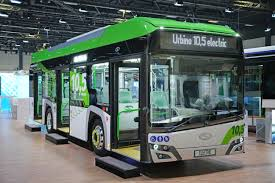
- Solaris introduced a compact electric midibus capable of transporting up to 85 passengers.
- The bus features a 240-kW electric motor and up to 400 kWh battery capacity for all-day operation.
At Mobility Move 2026 in Berlin, Solaris introduced its latest compact zero-emission bus, the Solaris Bus & Coach Urbino 10.5 Electric. The unveiling highlights the company’s continued focus on electrified urban mobility solutions designed for cities requiring smaller yet efficient transit vehicles. The midibus targets dense urban routes where maneuverability and passenger capacity must be balanced while maintaining full-day electric operation without reliance on intermediate charging stops.
Compact Electric Bus Built on Modular Drive Concept
The Solaris Bus & Coach Urbino 10.5 Electric is built on the manufacturer’s modular electric drive architecture, a design approach that enables flexible configuration while maximizing passenger capacity. Despite its compact footprint, the midibus can accommodate up to 85 passengers, including 33 seated travelers. This modular concept also allows cities and operators to deploy the vehicle on routes where space constraints demand smaller buses without sacrificing operational efficiency or passenger throughput.
Battery Capacity and Charging Flexibility
The electric midibus is equipped with a 240-kW electric motor and high-energy battery packs with capacities reaching up to 400 kWh. This configuration enables the bus to operate throughout an entire day of service without the need for intermediate charging. Operators can recharge the vehicle using either plug-in charging infrastructure or pantograph systems, providing flexibility for different depot setups and urban charging networks while supporting consistent zero-emission public transport operations.
Click above to visit the official source.
Discussion
Join the conversation.