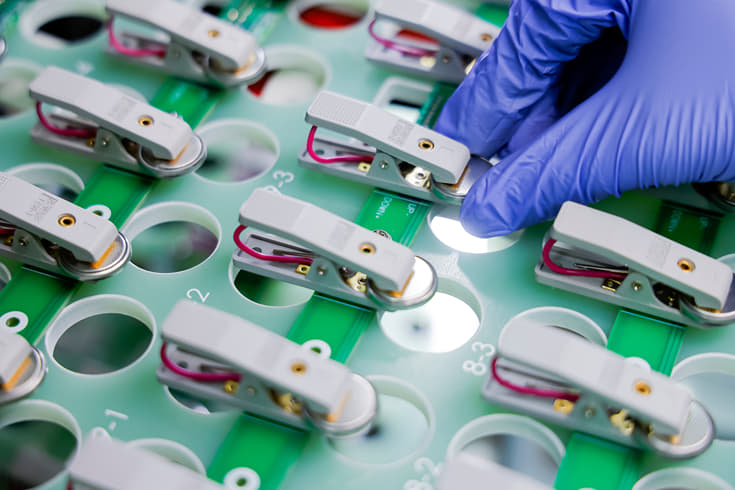
- Epsil silicon-graphite anode material targets up to 30% higher EV range.
- Epsil offers reversible capacity of 600–650 mAh/g.
- Epsilon plans to expand graphite and cathode production capacity.
Epsilon Advanced Materials has launched Epsil, a silicon-graphite composite anode material designed to increase electric vehicle (EV) driving range by up to 30% without requiring a larger battery pack. The Mumbai-based company said the material is engineered to improve energy density at the battery cell level, potentially allowing manufacturers to achieve greater driving range with existing pack dimensions or use smaller battery packs while maintaining current vehicle range. However, the actual benefits will depend on several factors, including cell chemistry, silicon loading, electrode and battery pack design, and overall vehicle performance.
Epsil offers a reversible capacity of 600–650 mAh/g, compared with 340–360 mAh/g for conventional graphite anodes. Its silicon-graphite composition is designed to address one of the major technical challenges associated with silicon-based anode materials: expansion during charging and contraction during discharging. Managing these volume changes is important for maintaining battery performance and cycle life. By combining silicon with graphite, Epsilon aims to improve energy storage capacity while addressing the durability challenges that have limited the wider application of silicon in battery anodes.
Epsil Supports 1C–5C Charging Rates
The new material is designed to support charging rates ranging from 1C to 5C while controlling electrode expansion and maintaining uniform silicon dispersion within the anode. Epsilon said its composite engineering approach is intended to reduce the risk of lithium plating during high-rate charging. Lithium plating can contribute to battery degradation and increase the risk of dendrite formation, which may lead to internal short circuits. The material's ability to manage these challenges is expected to be relevant to battery manufacturers seeking to balance charging performance, durability and energy density.
Epsilon also highlighted that the material's performance will depend on individual battery cell designs, operating temperatures, charging protocols and validation results in customer battery cells. These factors will determine how effectively Epsil performs under different operating conditions and whether its intended charging and durability characteristics can be achieved in production applications. The company is positioning the composite as a material solution that can offer battery manufacturers additional flexibility without requiring fundamental changes to existing cell manufacturing infrastructure.
Vikram Handa, managing director of Epsilon Advanced Materials, said Epsil is intended to give battery manufacturers greater flexibility in balancing electric vehicle driving range, charging performance and battery pack size. He also highlighted the material's compatibility with existing cell manufacturing lines, an important consideration for manufacturers evaluating new anode technologies and their integration into established production processes.
Epsilon's Graphite and Cathode Material Expansion Plans
The launch comes amid increasing global demand for electric vehicle batteries and battery materials. According to the International Energy Agency (IEA), more than 20 million electric cars were sold globally in 2025, while battery deployment reached 1.2 TWh. The agency expects annual battery deployment to approach 3 TWh by 2030. These figures underline the growing scale of the battery industry and the importance of expanding material production capabilities to support future demand. Higher-capacity anode materials such as silicon-graphite composites are among the technologies being developed to improve battery energy density and support evolving electric vehicle requirements.
Established in 2018, Epsilon Advanced Materials manufactures battery materials, including anode and cathode active materials. Its graphite anode manufacturing facility, EAM-ONE, is located in Vijayanagar, India. The company plans to increase its graphite anode production capacity to 30,000 tonnes per annum by 2028, followed by a further expansion to 100,000 tonnes per annum by 2031. These targets reflect its plans to expand its position in the battery materials supply chain and increase its manufacturing capabilities.
In the United States, Epsilon has announced a $650 million investment in a graphite anode material manufacturing facility in North Carolina. The planned facility is expected to have a production capacity of 60,000 tonnes by 2031. The investment represents another part of the company's manufacturing expansion strategy, complementing its existing operations in India and its longer-term graphite anode capacity targets.
Epsilon is also expanding into cathode active materials through its lithium iron phosphate (LFP) business. The company has established a technology centre in Germany as part of its entry into the LFP cathode active materials segment. In addition, it plans to establish a cathode active material manufacturing facility in India, with an initial production capacity of 20,000 tonnes by 2028. The company intends to expand this capacity to 100,000 tonnes per annum by 2035, extending its manufacturing ambitions beyond graphite anode materials.
Industry Impact & Outlook
Epsil's launch highlights the role of advanced anode materials in improving electric vehicle battery energy density, charging capabilities and pack design flexibility. Its stated capacity of 600–650 mAh/g compared with 340–360 mAh/g for conventional graphite provides a potential technical advantage, although commercial performance will depend on validation in customer cells and the specific battery configurations used. Epsilon's planned expansion across graphite anodes and LFP cathode materials also demonstrates its intention to develop capabilities across multiple battery material segments. Its manufacturing targets in India and the United States, alongside its technology centre in Germany, form part of this broader expansion strategy.
Frequently Asked Questions
1. What is Epsil silicon-graphite anode material?
Epsil is a silicon-graphite composite anode material developed by Epsilon Advanced Materials for electric vehicle batteries. It is designed to improve energy density at the cell level by combining silicon and graphite. The company reports a reversible capacity of 600–650 mAh/g, compared with 340–360 mAh/g for conventional graphite anodes. Its composition is engineered to manage the expansion and contraction of silicon during battery charging and discharging, addressing an important technical challenge associated with silicon-based battery anodes.
2. How much can Epsil increase electric vehicle driving range?
Epsil is designed to potentially increase electric vehicle driving range by up to 30% without requiring a larger battery pack. Epsilon Advanced Materials attributes this potential improvement to higher energy density at the cell level. The material's increased capacity could also allow manufacturers to use smaller battery packs while maintaining existing vehicle range. However, the actual improvement will depend on cell chemistry, silicon loading, electrode configuration, battery pack design and overall vehicle performance. The 30% figure represents the company's stated potential rather than a universal improvement across all vehicles.
3. What is the reversible capacity of Epsil compared with conventional graphite?
Epsil has a stated reversible capacity of 600–650 mAh/g, compared with 340–360 mAh/g for conventional graphite anodes. This higher capacity is intended to improve the amount of energy that can be stored at the battery cell level. The composite combines silicon and graphite to address the volume changes associated with silicon during charging and discharging. Its practical performance will depend on the composition, cell chemistry and electrode design used by individual battery manufacturers.
4. What charging rates does Epsil support?
Epsil is designed to support charging rates ranging from 1C to 5C while controlling expansion and maintaining uniform silicon dispersion within the anode. Epsilon has engineered the material to reduce the risk of lithium plating during high-rate charging, which can contribute to battery degradation and dendrite formation. However, actual charging performance will depend on individual cell designs, operating temperatures, charging protocols and validation in customer battery cells. The company has not presented these charging capabilities as independent of battery system configuration.
5. What are Epsilon Advanced Materials' graphite anode production expansion targets?
Epsilon Advanced Materials plans to expand its graphite anode production capacity at its EAM-ONE manufacturing plant in Vijayanagar, Karnataka, to 30,000 tonnes per annum by 2028 and 100,000 tonnes per annum by 2031. The company has also announced a $650 million investment in a graphite anode material facility in North Carolina, United States, which is planned to have a capacity of 60,000 tonnes by 2031. These initiatives form part of its broader manufacturing expansion strategy in battery materials.
6. What are Epsilon's plans for LFP cathode material manufacturing?
Epsilon has entered the lithium iron phosphate (LFP) cathode active materials business through a technology centre in Germany and plans to establish a manufacturing facility in India. The proposed Indian facility is expected to begin with an initial production capacity of 20,000 tonnes by 2028. The company plans to expand this capacity to 100,000 tonnes per annum by 2035. These plans complement its graphite anode manufacturing investments and represent an expansion into another major segment of the battery materials industry.
Click above to visit the official source.
Discussion
Join the conversation.