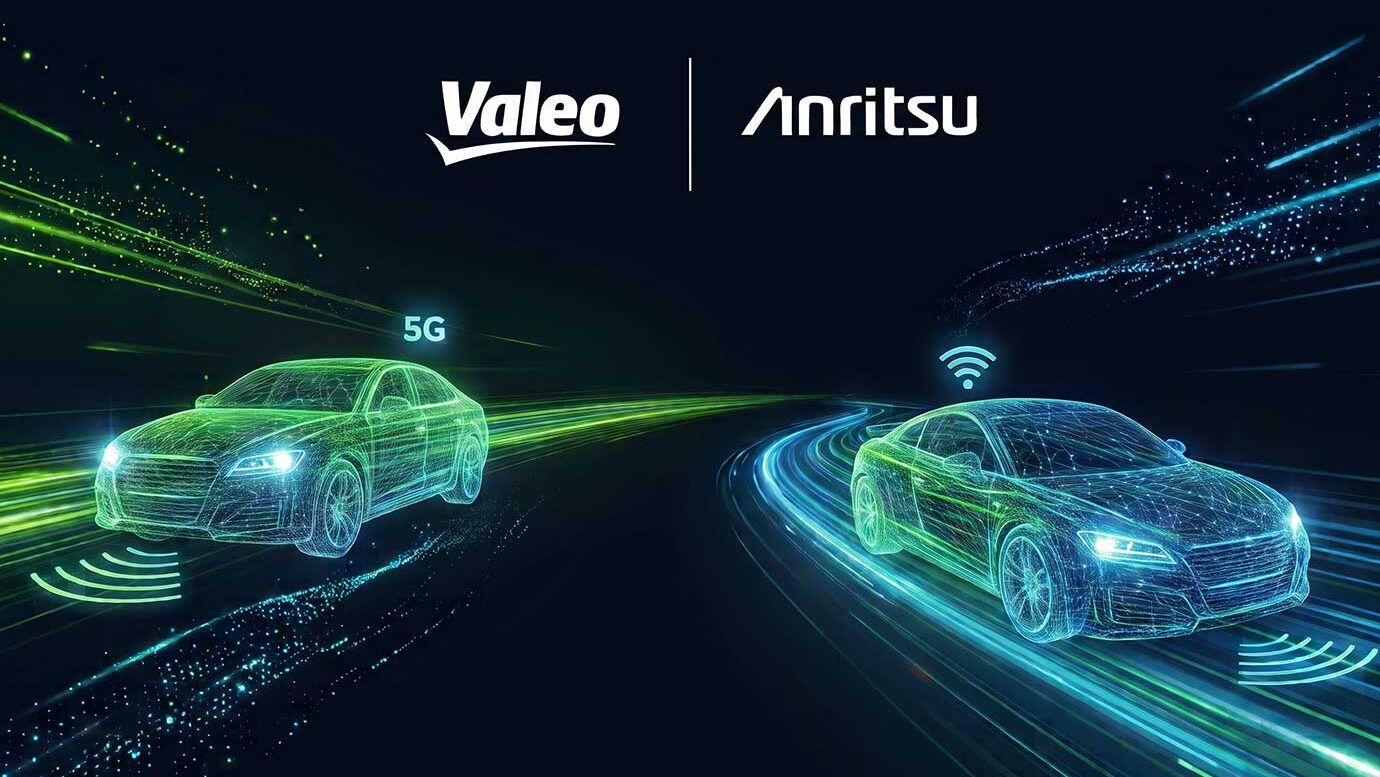
- SDV digital twin validation expands with new use cases.
- Valeo and Anritsu are showcasing the solution in New Delhi.
- The technology simulates multi-carrier handoffs and multi-vehicle scenarios.
Valeo and Anritsu Expand Digital Twin Validation for Software-Defined Vehicles
Valeo Group and Anritsu Corporation are jointly showcasing an expanded digital twin validation solution for Software-Defined Vehicles (SDVs) at the 5G Automotive Association (5GAA) 39th Meeting in New Delhi, India, from October 26 to 29, 2026. Building on their joint demonstration at Mobile World Congress (MWC) 2026 in March, the companies have added new use cases, including Emergency Call (eCall). The solution combines virtualized electronic control unit (ECU) simulation with cellular network testing technology to reproduce complex connected-vehicle scenarios in a controlled environment. The companies aim to reduce dependence on physical track testing, lower validation costs, improve test reproducibility, and accelerate the development of connected-vehicle features.
Digital Twin Solution Combines ECU Simulation and Cellular Testing
The joint platform integrates Valeo's virtualized ECU simulation platform with Anritsu's advanced cellular testing technology. Anritsu contributes a software-in-the-loop simulator and a virtual engine designed to recreate complex, real-world network conditions. Together, these technologies enable virtual testing of connected-vehicle functions without relying exclusively on physical vehicles and road-based trials. The approach allows engineers to evaluate how vehicle systems interact with simulated cellular networks under controlled conditions. By combining ECU virtualization with network simulation, the solution addresses validation requirements associated with software-defined vehicles, where connected functions and network-dependent services must be tested across different operating scenarios.
Cloud-Based and Local Digital Twins Simulate Complex Networks
The solution supports cloud-based or locally deployed digital twins to simulate complex multi-carrier network handoffs involving different mobile network operators (inter-MNO handoffs). It also enables the virtual simulation of multi-vehicle vehicle-to-network (V2N) and vehicle-to-everything (V2X) scenarios. These capabilities allow connected-vehicle behavior to be evaluated within a controlled, scalable testing environment. Simulating network transitions and interactions among multiple vehicles can help engineers reproduce specific conditions consistently, rather than depending entirely on variable conditions during physical testing. The companies position the platform as a way to validate increasingly connected vehicle features while improving the control and repeatability of test scenarios.
Emergency Call Joins the Expanded Validation Use Cases
Valeo and Anritsu have expanded their joint demonstration beyond the use cases presented at MWC 2026 by adding new scenarios, including Emergency Call (eCall). This addition broadens the range of connected-vehicle functions represented in the demonstration at the 5GAA 39th Meeting in New Delhi. The platform's ability to simulate cellular network conditions provides a setting for evaluating network-dependent vehicle functions within virtualized test scenarios. The announcement does not specify detailed eCall test procedures, performance results, or certification outcomes. It establishes that eCall is among the new use cases being showcased as the companies extend their collaborative digital twin validation work.
Virtual Validation Targets Lower Costs and Faster Development
The companies aim to reduce the need for physical track testing, lower validation costs, improve test reproducibility, and accelerate the development of connected-vehicle features. Digital twins can provide a repeatable environment for recreating complex network conditions, including inter-MNO handoffs and multi-vehicle V2N/V2X interactions. Such simulation can help engineering teams assess behavior under controlled conditions and repeat tests when investigating particular scenarios. The announcement describes these benefits as objectives of the solution rather than providing measured cost reductions, development-time savings, or comparative test results. The approach is intended to support connected-vehicle validation through a combination of virtual ECU simulation and cellular network testing.
Industry Impact & Outlook
The collaboration reflects the growing importance of integrated vehicle and network validation as automakers develop software-defined vehicles and connected services. For automotive manufacturers and technology suppliers, virtual testing could offer a more repeatable way to examine complex communication scenarios before relying on physical track trials, potentially helping teams manage validation effort and development costs. The inclusion of eCall also brings an additional connected-vehicle use case into the companies' expanded demonstration. However, the announcement does not quantify commercial benefits or establish deployment timelines. The practical impact will depend on how the solution performs across real validation programs and how effectively manufacturers integrate virtual testing into their existing engineering processes.
Frequently Asked Questions
What are Valeo and Anritsu demonstrating at the 5GAA 39th Meeting?
Valeo Group and Anritsu Corporation are showcasing an expanded digital twin validation solution for software-defined vehicles at the 5GAA 39th Meeting in New Delhi, India. The event runs from October 26 to 29, 2026. The solution combines Valeo's virtualized ECU simulation platform with Anritsu's cellular testing technology to simulate complex connected-vehicle scenarios. The expanded demonstration builds on their presentation at MWC 2026 in March and adds use cases such as Emergency Call (eCall). The companies aim to improve validation efficiency and reduce reliance on physical track testing.
How does the digital twin validation solution work?
The solution combines Valeo's virtualized electronic control unit simulation platform with Anritsu's cellular testing technology, including a software-in-the-loop simulator and a virtual engine that recreates complex network conditions. It uses cloud-based or local digital twins to simulate connected-vehicle scenarios in a controlled environment. Engineers can virtually reproduce multi-carrier network handoffs and interactions involving multiple vehicles. This approach is intended to make testing more scalable and repeatable while reducing the need to conduct every validation scenario with physical vehicles on a test track.
What new use cases have Valeo and Anritsu added?
Valeo and Anritsu have expanded their digital twin validation demonstration to include new use cases, such as Emergency Call (eCall). The companies previously demonstrated their collaboration at MWC 2026 in March 2026 and are presenting the expanded solution at the 5GAA 39th Meeting in New Delhi. The announcement identifies eCall as an addition but does not provide detailed test procedures, performance measurements, or certification results. The broader demonstration focuses on using virtualized ECU simulation and cellular network testing to evaluate connected-vehicle functions under simulated network conditions.
Which network scenarios can the platform simulate?
The platform can simulate complex multi-carrier network handoffs involving different mobile network operators and multi-vehicle vehicle-to-network and vehicle-to-everything scenarios. It supports cloud-based or locally deployed digital twins, allowing these situations to be reproduced in a controlled and scalable environment. Anritsu's software-in-the-loop simulator and virtual engine help recreate complex, real-world network conditions for validation. These capabilities are intended to help engineers examine connected-vehicle behavior across different simulated situations. The announcement does not specify the full range of supported network configurations or provide detailed technical performance benchmarks.
What benefits do Valeo and Anritsu expect from digital twin validation?
Valeo and Anritsu aim to reduce physical track testing, lower validation costs, improve test reproducibility, and accelerate connected-vehicle feature development through their digital twin solution. Virtual simulation can help engineering teams recreate complex cellular network conditions and repeat test scenarios in a controlled environment. This may reduce dependence on physical trials for some validation activities, although the companies have not disclosed measured savings or development-time improvements. The stated benefits are objectives of the solution, and its practical results will depend on its application in actual automotive validation programs.
Click above to visit the official source.
Discussion
Join the conversation.