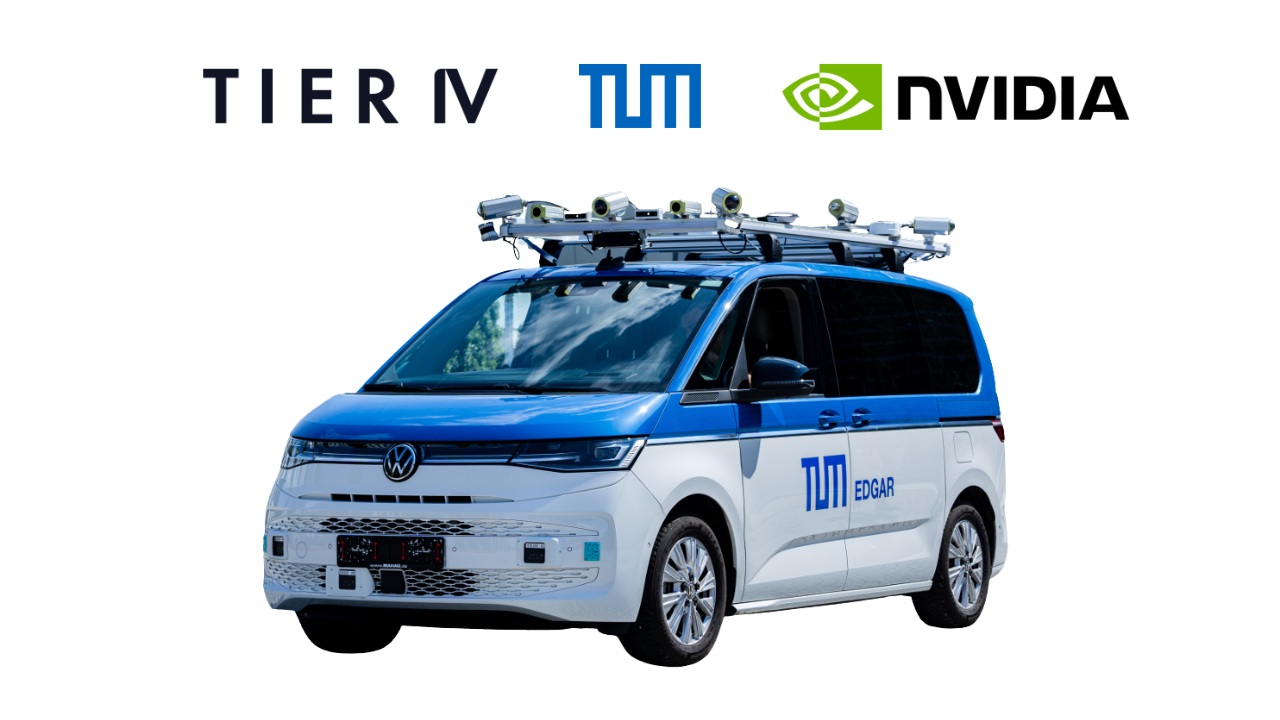
- TIER IV and TUM autonomous driving development advances in Germany.
- NVIDIA Hyperion and Halos support autonomous driving development and safety.
- The collaboration targets public transportation and Level 4 robotaxis.
TIER IV and TUM Accelerate Level 4 Autonomous Driving Development in Germany
On October 22, TIER IV and the Technical University of Munich (TUM) announced plans to accelerate autonomous driving system development in Germany using NVIDIA Hyperion, a development platform for Level 4 autonomous driving, and NVIDIA Halos, a safety system. Through their jointly established TUM Autoware Research Center by TIER IV, the organizations will integrate Autoware, open-source autonomous driving software, with NVIDIA Hyperion. The combined platform will be deployed in autonomous vehicle development projects across Germany. The collaboration brings together TIER IV's software capabilities, TUM's automotive research expertise, and NVIDIA's automotive computing and safety technologies to support an integrated environment for developing, testing, and validating autonomous driving systems.
How the TUM Autoware Research Center Will Support Development
The TUM Autoware Research Center by TIER IV provides the framework for combining open-source autonomous driving software with NVIDIA's development and safety technologies. Under the announced collaboration, TIER IV and TUM will integrate Autoware with NVIDIA Hyperion and deploy the resulting platform in autonomous vehicle development projects across Germany. This approach is intended to give researchers and developers an integrated environment for working on autonomous driving systems, from development through testing and validation. By bringing software, automotive research, computing, and safety capabilities together, the organizations aim to support a more coordinated process for advancing autonomous driving technology while maintaining a focus on the development and evaluation of these systems.
Roles of Autoware, NVIDIA Hyperion, and NVIDIA Halos
The collaboration combines three technology elements with complementary roles. Autoware is open-source software for autonomous driving, while NVIDIA Hyperion is a development platform for Level 4 autonomous driving. NVIDIA Halos provides the safety-system component identified in the announcement. TIER IV and TUM plan to integrate Autoware with Hyperion through their research center, while the collaboration also draws on NVIDIA's automotive computing and safety technologies. Together, these elements are intended to support the development, testing, and validation of autonomous driving systems. The announcement does not specify additional technical specifications, performance figures, deployment schedules, or validation results, so the practical capabilities of the integrated platform will depend on the development projects in which it is used.
Potential Applications in Public Transportation and Robotaxis
Beyond research and development, TIER IV and TUM aim to bring research results into real-world applications. The announcement specifically identifies public transportation services and robotaxis powered by Level 4 autonomous driving as potential application areas. The integrated environment is intended to help researchers and developers develop, test, and validate autonomous driving systems that could support these uses. However, the announcement does not confirm the launch of a commercial robotaxi service, a specific public transportation deployment, or a timeline for introducing either application. Instead, the stated objective is to connect research outcomes with practical applications, creating a pathway through which the technologies developed and evaluated through the collaboration could eventually be applied in real-world mobility services.
Collaboration Across Germany's Autonomous Driving Ecosystem
The initiative combines the capabilities of TIER IV, the Technical University of Munich, and NVIDIA to advance autonomous driving development in Germany. TIER IV contributes its software expertise, TUM brings automotive research capabilities, and NVIDIA contributes automotive computing and safety technologies. The jointly established research center is intended to connect these strengths through an integrated development environment based on Autoware and NVIDIA Hyperion, with NVIDIA Halos also part of the announced technology combination. Deploying the platform in autonomous vehicle development projects across Germany gives the collaboration a broader project focus than a standalone research announcement. The organizations' stated ambition is to move research results toward practical applications, although specific participating projects, commercial partners, and implementation milestones were not disclosed.
Industry Impact & Outlook
The collaboration could strengthen Germany's autonomous driving research and development ecosystem by bringing open-source software, academic automotive expertise, and commercial computing and safety technologies into a shared development environment. For researchers and developers, integrating Autoware with NVIDIA Hyperion may support coordinated development, testing, and validation, while NVIDIA Halos adds the announced safety-system component. The intended applications in public transportation and Level 4 robotaxis highlight the potential relevance to future mobility services, but commercial deployment and timing remain unconfirmed. The next meaningful developments will be the implementation of the integrated platform in German autonomous vehicle projects and evidence of how research results translate into practical applications. Until project outcomes are disclosed, the collaboration represents a development initiative rather than confirmation of operational autonomous transportation services.
Frequently Asked Questions
What did TIER IV and TUM announce on October 22?
TIER IV and the Technical University of Munich announced a collaboration to accelerate autonomous driving system development in Germany using NVIDIA Hyperion and NVIDIA Halos. Through their jointly established TUM Autoware Research Center by TIER IV, they plan to integrate Autoware open-source software with NVIDIA Hyperion and deploy the platform in autonomous vehicle development projects across Germany. The initiative combines TIER IV's software expertise, TUM's automotive research capabilities, and NVIDIA's automotive computing and safety technologies to support the development, testing, and validation of autonomous driving systems.
What is the role of the TUM Autoware Research Center by TIER IV?
The TUM Autoware Research Center by TIER IV serves as the collaborative framework through which TIER IV and TUM plan to integrate Autoware with NVIDIA Hyperion. The two organizations jointly established the center to support autonomous driving development using their combined expertise and technologies. The integrated platform is intended for deployment in autonomous vehicle development projects across Germany. Its stated purpose is to provide researchers and developers with an environment for developing, testing, and validating autonomous driving systems, helping connect automotive research with the practical development of autonomous vehicle technologies.
What are NVIDIA Hyperion and NVIDIA Halos used for in the collaboration?
NVIDIA Hyperion is identified as a development platform for Level 4 autonomous driving, while NVIDIA Halos is identified as a safety system. TIER IV and TUM plan to integrate Autoware with Hyperion through their research center, drawing on NVIDIA's automotive computing and safety technologies. These components are intended to contribute to an integrated environment for autonomous driving development, testing, and validation. The announcement does not provide detailed technical specifications or describe the precise implementation of every component, so additional performance characteristics should not be assumed from the announced collaboration alone.
What is Autoware, and why is it part of this initiative?
Autoware is open-source software for autonomous driving that TIER IV and TUM plan to integrate with NVIDIA Hyperion. Its inclusion is central to the announced effort to combine software capabilities with a development platform designed for Level 4 autonomous driving. The collaboration aims to give researchers and developers an integrated environment for building, testing, and validating autonomous driving systems. TIER IV contributes software expertise, while TUM contributes automotive research capabilities and NVIDIA provides automotive computing and safety technologies. The announcement does not specify additional integration details or measured results.
Which real-world applications are TIER IV and TUM targeting?
TIER IV and TUM aim to bring research results into real-world applications, specifically identifying public transportation services and robotaxis powered by Level 4 autonomous driving. The integrated development environment is intended to support the development, testing, and validation work needed to advance autonomous driving systems toward practical uses. However, the announcement does not confirm that either a public transportation service or a commercial robotaxi operation has launched as a result of the collaboration. It also does not provide deployment dates, locations for specific services, or details about the operators that might use the technology.
Will the collaboration lead to commercial Level 4 autonomous driving services in Germany?
The collaboration is intended to help move autonomous driving research toward practical applications, including public transportation services and Level 4 robotaxis, but commercial deployment has not been confirmed. TIER IV and TUM plan to integrate Autoware with NVIDIA Hyperion and use the platform in autonomous vehicle development projects across Germany. Their work will provide an environment for developing, testing, and validating autonomous driving systems. Whether the initiative results in specific commercial services will depend on subsequent development and implementation, and the announcement does not identify launch dates, operational locations, or confirmed service providers.
Click above to visit the official source.
Discussion
Join the conversation.