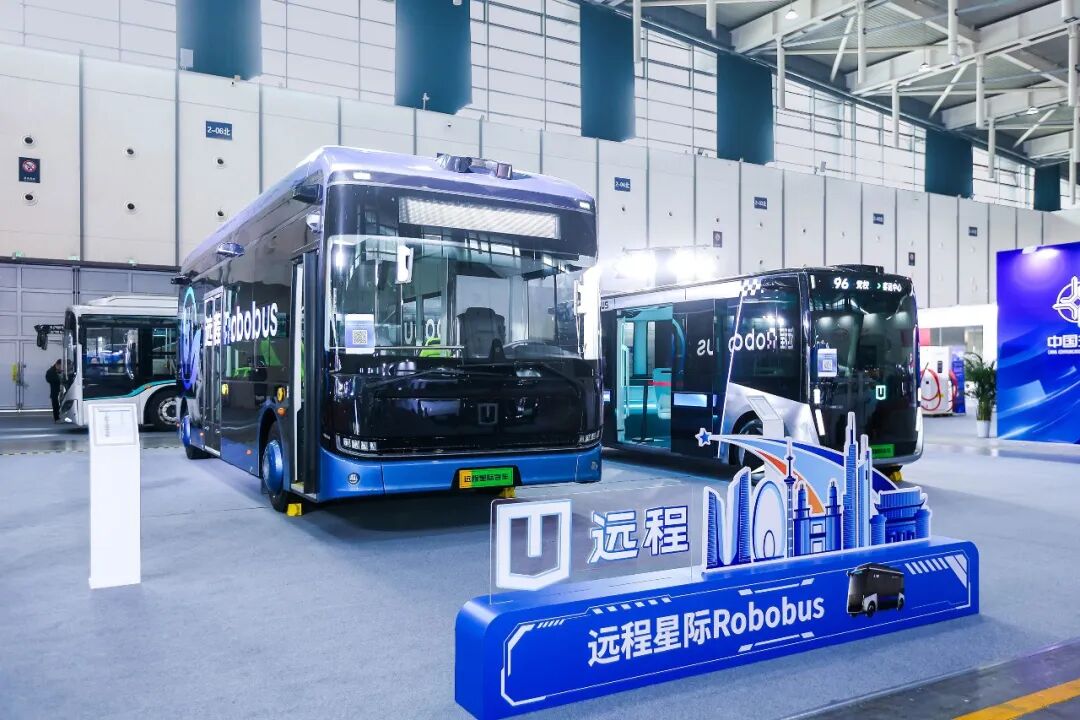
- Farizon Robobus models debut at the 2026 transportation expo.
- Robobus C8E delivers over 440 km per charge.
- Both models support L4 automated driving and zero tailpipe emissions.
Farizon Robobus C6E and C8E Debut at 2026 Transportation Expo
On October 21, Farizon Interstellar Bus introduced its latest autonomous electric bus models, the Robobus C6E and Robobus C8E, at the 2026 Green Digital Intelligent Transportation Expo in Nanjing. Both vehicles feature advanced intelligent driving capabilities and are built on the new-generation GXA-TB3.0 platform architecture developed by Zhejiang Geely Farizon New Energy Commercial Vehicle Group Co., Ltd. (Geely Farizon). The platform incorporates improvements in overall vehicle performance and module commonality. The two fully electric models combine a self-developed, fully redundant drive-by-wire chassis with a multisensor fusion autonomous driving system designed to enable Level 4 automated driving, positioning them for different passenger transportation applications.
GXA-TB3.0 Platform and L4 Autonomous Driving Technology
Both buses use the GXA-TB3.0 platform, which supports their vehicle architecture and shared modules. According to the announcement, their self-developed, fully redundant drive-by-wire chassis works alongside a multisensor fusion autonomous driving system to enable L4 automated driving. High-precision positioning technology further supports autonomous vehicle operation. The buses can perform maneuvers such as overtaking and obstacle avoidance without driver intervention throughout operation, according to the company announcement. These capabilities are intended to reduce the need for operating labor and support automated passenger transportation in designated service environments. The shared platform and improvements in module commonality also provide a common technical foundation for two vehicles designed to address different operating distances and transportation requirements.
Electric Powertrain, Speed, and Driving Range
The Robobus C6E and C8E are fully electric vehicles that produce zero tailpipe emissions and have a stated top speed of 50 km/h. Their principal range difference makes each model suitable for distinct service requirements. The C6E offers a driving range of more than 150 km on a single charge, targeting comparatively short-distance shuttle operations. The C8E delivers more than 440 km per charge, making it suitable for longer fixed-route services. These stated figures distinguish the models by operating range, while their shared electric propulsion and autonomous driving capabilities provide common features across the lineup. The announcement does not specify battery capacity, charging time, passenger capacity, or the testing conditions used to determine the driving ranges.
Robobus C6E Targets Short-Distance Shuttle Operations
The Robobus C6E is designed for short-distance passenger shuttle services in enclosed or semi-enclosed environments. Its identified applications include campuses, parks, scenic areas, and transportation hubs. These locations provide a defined set of potential operating scenarios for a fully electric vehicle equipped with L4 automated driving capabilities. The C6E's stated range of more than 150 km per charge distinguishes it from the longer-range C8E and aligns with its intended shuttle role. High-precision positioning, obstacle avoidance, and autonomous maneuvering are among the technologies described for both vehicles. Farizon Interstellar Bus has positioned the C6E as an option for transportation operations that require repeated passenger movements across designated areas rather than longer fixed-route journeys.
Robobus C8E Designed for Longer Fixed-Route Services
The Robobus C8E is intended for fixed-route services on major urban bus routes, as well as transportation operations in industrial parks, university districts, and transportation hubs. Its driving range of more than 440 km on a single charge exceeds the C6E's stated range of more than 150 km, giving the C8E a different operational profile within the lineup. The company describes the vehicle as supporting the intelligent upgrading of urban trunk bus services. Its electric powertrain, L4 automated driving system, and high-precision positioning technology are shared elements of the two models. The C8E's longer stated range may support service planning across more extensive routes, although actual route suitability depends on operating conditions and requirements not detailed in the announcement.
Shared Technology and Complementary Transportation Applications
The two models combine a common platform foundation with different intended transportation roles. The GXA-TB3.0 architecture and improvements in module commonality provide shared engineering elements, while the C6E and C8E differ in stated driving range and target operating scenarios. Both vehicles use fully electric propulsion and autonomous driving technologies, including a fully redundant drive-by-wire chassis and multisensor fusion. Farizon Interstellar Bus presented the models at the 2026 Green Digital Intelligent Transportation Expo in Nanjing as part of its latest intelligent bus lineup. The announcement identifies their intended applications but does not provide confirmed deployment schedules, vehicle pricing, production volumes, or details of commercial service launches.
Industry Impact & Outlook
The introduction of the Robobus C6E and C8E highlights an approach to autonomous passenger transportation that separates shorter shuttle operations from longer fixed-route services while retaining a shared technology platform. For fleet operators, the stated ranges and intended applications provide initial points of comparison when evaluating vehicles for campuses, industrial parks, transportation hubs, and urban bus corridors. The L4 automated driving capabilities and zero-tailpipe-emission powertrains may also be relevant to organizations pursuing automated and electrified transportation services. However, commercial impact will depend on deployment conditions, operating performance, applicable requirements, and the availability of supporting infrastructure. The announcement establishes the models' technical positioning and intended use cases but does not confirm when or where commercial deployments will begin.
Frequently Asked Questions
1. What are the Farizon Robobus C6E and C8E?
The Farizon Robobus C6E and C8E are fully electric buses featuring L4 automated driving capabilities, introduced at the 2026 Green Digital Intelligent Transportation Expo in Nanjing. Both models use the GXA-TB3.0 platform developed by Geely Farizon and incorporate a fully redundant drive-by-wire chassis and multisensor fusion autonomous driving system. They are designed for different passenger transportation applications. The C6E targets short-distance shuttle services, while the C8E is intended for longer fixed-route operations, including major urban bus routes, industrial parks, university districts, and transportation hubs.
2. What is the driving range of the Robobus C6E and C8E?
The Robobus C6E offers a driving range of more than 150 km per charge, while the Robobus C8E provides more than 440 km per charge, according to the announcement. Both vehicles are fully electric and have a stated top speed of 50 km/h. This difference in driving range reflects their intended operating roles, with the C6E designed for shorter shuttle services and the C8E developed for longer fixed-route applications. The announcement does not provide battery capacity, charging duration, or standardized range-testing conditions for either model.
3. What autonomous driving technology do the two Robobus models use?
Both Robobus models use a self-developed, fully redundant drive-by-wire chassis and a multisensor fusion autonomous driving system designed to enable L4 automated driving. They also incorporate high-precision positioning technology to support autonomous vehicle maneuvers. According to the announcement, the buses can perform overtaking and obstacle avoidance without driver intervention throughout operation. These capabilities are intended to support automated passenger transportation and reduce operating labor costs. The announcement does not specify the complete sensor configuration, operational design domain, deployment approvals, or other conditions governing the vehicles' use.
4. Where are the Robobus C6E and C8E intended to operate?
The Robobus C6E is designed for short-distance shuttle services in enclosed or semi-enclosed campuses, parks, scenic areas, and transportation hubs. The Robobus C8E is intended for fixed-route services on major urban bus routes, as well as operations in industrial parks, university districts, and transportation hubs. These applications reflect the models' different stated driving ranges and intended operating roles. Both vehicles share the GXA-TB3.0 platform and L4 automated driving capabilities. The announcement describes their target applications but does not confirm specific commercial deployment locations or launch dates.
Click above to visit the official source.
Discussion
Join the conversation.