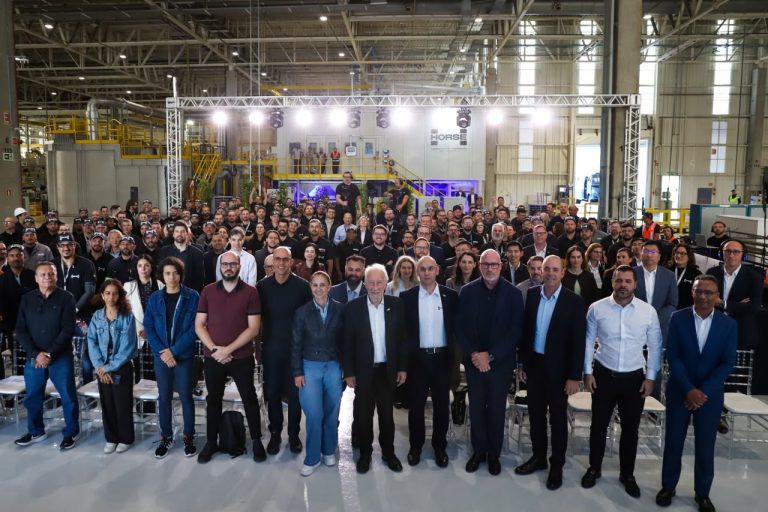
- Horse Powertrain inaugurated a BRL 200 million aluminum casting line.
- The new line can produce 210,000 cylinder heads annually.
- The casting process uses 98% recycled aluminum and reduces CO2 emissions by approximately 35%.
Horse Powertrain Opens New Aluminum Casting Line in Brazil
Horse Powertrain inaugurated a new gravity aluminum casting line at its plant in Paraná, Brazil, on October 21, following an investment of BRL 200 million, according to an announcement by the Government of São José dos Pinhais. The installation expands the facility’s component manufacturing capabilities and supports localized production for Brazilian and wider Latin American markets. The new line is designed to manufacture approximately 210,000 aluminum cylinder heads annually for two turbo flex-fuel engine families: the 1.0-liter, three-cylinder H10 and the 1.3-liter, four-cylinder H13. The investment adds another casting process to the plant’s existing industrial operations, strengthening its role in the production of engines and related components for regional vehicle manufacturing.
BRL 300 Million Invested in Paraná Since 2023
The latest BRL 200 million investment brings Horse Powertrain’s total investment in Paraná to BRL 300 million since 2023. The additional BRL 100 million was previously invested in production of the H13 turbo flex-fuel engine. Together, these investments support engine manufacturing and component localization at the Brazilian facility. The new cylinder-head casting line is intended to supply components for engines manufactured locally and serve markets across Latin America. By producing these components at the plant, Horse Powertrain is expanding the range of manufacturing processes available at the site. The announcement identifies the investment amount, production capacity, and supported engine families, while establishing the project as part of the company’s continuing industrial investment in Paraná.
Three Aluminum Casting Technologies at One Facility
The new operation introduces gravity casting alongside the plant’s existing high-pressure and low-pressure casting technologies. Bringing all three methods together at the same facility broadens its casting capabilities and supports the manufacture of aluminum components for the H10 and H13 turbo flex-fuel engines. The new line’s stated annual capacity is approximately 210,000 cylinder heads, although the announcement does not specify how production will be divided between the two engine families. The combination of casting technologies represents an expansion of the plant’s existing manufacturing infrastructure rather than a replacement of its previous processes. The project also contributes to local component production for Brazil and other Latin American markets.
AI Validation, Renewable Energy, and Recycled Aluminum
The casting operation incorporates artificial intelligence for component validation, uses renewable energy, and relies on aluminum that is 98% recycled. According to the announcement, the process reduces CO2 emissions by approximately 35% compared with traditional injection furnaces. These measures combine production validation technology with material and energy choices intended to reduce the environmental impact of manufacturing. The recycled-aluminum share is specified at 98%, while the emissions reduction is an approximate comparison against the traditional furnace process identified in the source. The announcement does not provide additional details about the AI system, the source or quantity of renewable electricity, or the methodology used to calculate the emissions reduction. Those figures therefore describe the stated features of the new operation without establishing a broader lifecycle emissions result.
Brazilian Engine Capacity and Regional Exports
The Paraná plant has installed capacity to produce 600,000 engines annually and currently manufactures around 250,000 engines per year. Approximately 25% of its output is exported, mainly to Argentina. These figures distinguish the facility’s total installed capacity from its current production level: the plant is not presently producing at its full stated annual capacity. The export share also indicates that the facility serves markets beyond Brazil, with Argentina identified as the main export destination. The new casting line adds capacity for cylinder-head production to this existing manufacturing operation. The announcement does not state that engine output will increase immediately as a result of the project or specify how much of the new line’s production will be exported.
New Casting Line Supports Localized H10 and H13 Production
The new line is focused on aluminum cylinder heads for the 1.0-liter, three-cylinder H10 and 1.3-liter, four-cylinder H13 turbo flex-fuel engines. Its approximately 210,000-unit annual capacity provides a defined production capability for components used in these engine families. The project’s stated purpose includes localizing component production for Brazil and Latin America, connecting the investment to regional manufacturing supply. Horse Powertrain’s previously announced BRL 100 million investment in H13 turbo flex-fuel engine production forms part of the BRL 300 million invested in Paraná since 2023. The available announcement does not provide a start-of-production ramp-up schedule, customer allocation, or a breakdown of cylinder-head output by engine type, so these details remain unspecified.
Industry Impact & Outlook
Horse Powertrain’s investment expands Brazil’s local manufacturing capacity for engine components while adding gravity casting to a plant already equipped for high- and low-pressure casting. For regional vehicle production, local cylinder-head manufacturing may support component availability for the H10 and H13 turbo flex-fuel engine families and reinforce the facility’s role in serving Latin American markets. The use of 98% recycled aluminum, renewable energy, and AI-based component validation also establishes environmental and process-technology features of the new line, including a stated CO2 reduction of approximately 35% against traditional injection furnaces. The plant’s current output of around 250,000 engines remains below its installed capacity of 600,000, but the announcement does not establish whether the new investment will change total engine production or export volumes.
Frequently Asked Questions
How much did Horse Powertrain invest in the new Brazilian casting line?
Horse Powertrain invested BRL 200 million in the new gravity aluminum casting line at its plant in Paraná, Brazil, which was inaugurated on October 21. The project adds cylinder-head manufacturing capacity for the H10 and H13 turbo flex-fuel engine families. Including a previous BRL 100 million investment in H13 turbo flex-fuel engine production, the company’s total investment in Paraná has reached BRL 300 million since 2023. The announcement does not provide a separate breakdown of the latest investment by equipment, construction, or other spending categories.
What is the annual production capacity of the new casting line?
The new gravity aluminum casting line is designed to produce approximately 210,000 aluminum cylinder heads annually. These components are intended for locally manufactured 1.0-liter, three-cylinder H10 and 1.3-liter, four-cylinder H13 turbo flex-fuel engines. The stated figure represents the line’s approximate annual cylinder-head capacity, not the plant’s total engine production. The announcement does not specify how the 210,000 units will be divided between the two engine families or provide a production ramp-up schedule for the new operation.
Which engines will use components from the new line?
The new line will produce aluminum cylinder heads for the H10 and H13 turbo flex-fuel engine families manufactured locally in Brazil. The H10 is a 1.0-liter, three-cylinder engine, while the H13 is a 1.3-liter, four-cylinder engine. The project is intended to localize component production for Brazilian and broader Latin American markets. Although the announcement identifies the two engine families, it does not disclose specific vehicle models, customer allocations, or the expected production volume of cylinder heads for each engine.
What manufacturing technologies and materials does the new operation use?
The new operation uses gravity casting and joins the plant’s existing high-pressure and low-pressure casting technologies, bringing all three methods together at the facility. It also uses artificial intelligence for component validation, renewable energy, and aluminum that is 98% recycled. These features combine expanded manufacturing capability with stated process-validation and resource-use measures. The announcement does not identify the AI system’s technical specifications, quantify renewable energy consumption, or detail the particular validation procedures applied to each cylinder head.
How much does the new casting process reduce CO2 emissions?
The announced process reduces CO2 emissions by approximately 35% compared with traditional injection furnaces. The new operation also uses 98% recycled aluminum and renewable energy, alongside artificial intelligence for component validation. These details describe the manufacturing process and the comparison stated in the announcement. However, the source does not provide the underlying emissions calculations, the precise boundaries of the comparison, or a full lifecycle assessment. The approximately 35% figure should therefore be understood as the reported reduction against the specified traditional furnace process, not as a confirmed reduction across the entire engine or vehicle lifecycle.
How much engine production capacity does the Paraná plant have, and where does it export?
The Paraná plant has installed capacity for 600,000 engines annually and currently produces around 250,000. Approximately 25% of its output is exported, mainly to Argentina. This means the reported current production is below the facility’s stated installed capacity, while exports already connect the operation to regional markets beyond Brazil. The announcement does not indicate whether the new cylinder-head casting line will increase total engine production, change the export share, or alter the destinations served by the plant. It specifically identifies Argentina as the main export market.
Click above to visit the official source.
Discussion
Join the conversation.