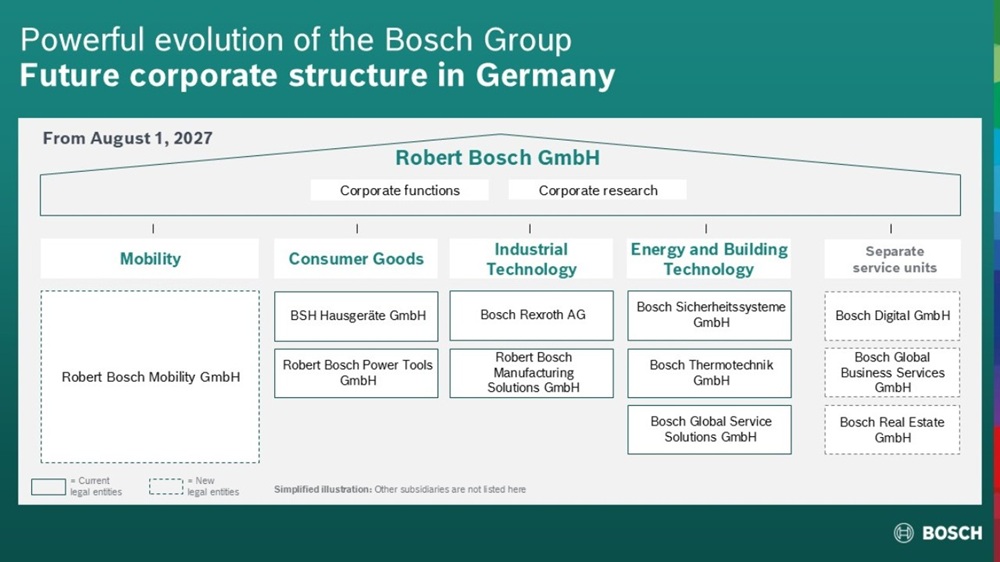
- Bosch restructuring will transfer 62,500 German associates.
- Four new legal entities are planned within Bosch Group.
- The new subsidiaries are scheduled to begin operations August 1, 2027.
Bosch Plans Major Restructuring of Its German Operations
Robert Bosch GmbH announced on October 22 that it plans to reorganize its corporate structure by transferring the activities of its Mobility business sector and three central service units in Germany to separate legal entities. The units involved are Bosch Digital, Global Business Services, and Global Real Estate. Under the planned arrangement, the four entities will operate as wholly owned subsidiaries within the Bosch Group, each established as a limited liability company under German law, known as a GmbH. Bosch said the entities would remain integral parts of the group despite their new legal forms, making the change a structural reorganization rather than an announced separation from the Bosch Group.
Implementation Timeline and New Subsidiary Structure
Bosch plans to implement the reorganization in stages by the end of 2027, with the new legal entities scheduled to begin operations on August 1, 2027. The transition will move the activities of the Mobility business sector and the three central service units into the new subsidiary structure. Bosch has presented the change as a way to strengthen customer focus, entrepreneurship, and operational flexibility while shortening everyday decision-making paths. The announcement does not indicate that the businesses will leave the Bosch Group; instead, they will continue as wholly owned subsidiaries. The staged implementation provides the framework for transferring the affected activities and associates while the revised corporate structure is put in place.
Approximately 62,500 Associates in Germany to Transfer
Approximately 62,500 associates in Germany are expected to transfer to the new subsidiaries as part of the restructuring, most of them from the Mobility business sector. Their employment contracts will transfer with them to the relevant new legal entities. Bosch said that the changes will affect the legal structure of the organization while keeping the subsidiaries within the group. The company’s future parent structure, Robert Bosch GmbH, will comprise the corporate headquarters and the central research and advanced engineering team. At present, more than 3,000 associates are involved in this headquarters and central research and advanced engineering structure, which is intended to support operating units in realizing their potential.
Future Role of Robert Bosch GmbH
Following the restructuring, Robert Bosch GmbH will focus on corporate headquarters and the central research and advanced engineering team. These functions will support the group’s operating units in unlocking their full potential, while the Mobility business sector and the three central service units will operate through their respective subsidiaries. The announcement positions the revised headquarters structure as a central support function within the broader Bosch Group. Bosch has not described the subsidiaries as independent businesses outside the group; it has confirmed that they will remain wholly owned and integral to the organization. The intended distinction is between the central corporate and research functions and the operating activities assigned to the new legal entities.
Bosch Mobility to Gain Greater Operational Focus
Under the proposed structure, Bosch Mobility will operate more closely as a separate subsidiary, with the aim of delivering integrated customer solutions worldwide. Bosch expects the structure to support faster decisions, simpler processes, and more focused investment in innovation and growth. The company also said that the revised organization would create opportunities for strategic partnerships and the development of new business models. These are stated objectives of the reorganization rather than confirmed outcomes already achieved. The planned changes place the Mobility business sector in a more distinct legal and operational structure while keeping it within the Bosch Group, allowing it to pursue its customer and business priorities under the new arrangement.
Expected Benefits of the Corporate Reorganization
Bosch said the restructuring is intended to enhance innovative capacity and competitiveness by strengthening customer focus, encouraging entrepreneurship, increasing flexibility, and shortening decision-making paths in day-to-day operations. Moving the affected activities into separate legal entities is expected to give the operating units a more focused structure while preserving their place within the group. For Bosch Mobility, the stated goals include more integrated customer solutions, simpler processes, and concentrated investment in innovation and growth. The company has also identified opportunities for strategic partnerships and new business models. These benefits describe the rationale behind the announced reorganization; the source announcement does not quantify expected financial gains or provide measured performance targets for the changes.
Key Details of Bosch’s Planned Reorganization
The announced plan combines a change in legal structure with a transfer of activities and employees, while retaining the affected entities within the Bosch Group. The following table summarizes the principal details stated in the announcement, including the business units involved, the approximate number of associates affected, and the intended implementation schedule. These details distinguish the planned legal changes from the benefits Bosch expects to pursue after the new structure takes effect. The dates and employee figures below reflect the announcement, and the company has described the overall implementation as a staged process rather than a single completed transfer.
Table: Bosch Restructuring Timeline and Scope
| Item | Announced Detail |
|---|---|
| Announcement date | October 22 |
| New entities | Four wholly owned subsidiaries |
| Planned start of operations | August 1, 2027 |
| Implementation deadline | By the end of 2027 |
| Associates transferring in Germany | Approximately 62,500 |
| Associates currently in headquarters and central research and advanced engineering | More than 3,000 |
What the Reorganization Means for Bosch Group Operations
The planned changes will separate selected operating activities and central service functions into four legal entities while maintaining group ownership. Bosch’s announcement emphasizes greater customer focus, flexibility, entrepreneurship, and faster operational decisions as the intended advantages of the revised structure. The Mobility business sector is expected to benefit from a closer operational focus, while corporate headquarters and central research and advanced engineering will remain within Robert Bosch GmbH. Approximately 62,500 associates in Germany are expected to move with their employment contracts to the new subsidiaries, most from Mobility. The transition is planned in stages, with the new entities scheduled to begin operations on August 1, 2027, and implementation continuing through the end of that year.
Industry Impact & Outlook
Bosch’s restructuring represents a significant organizational change for a major automotive supplier, particularly because most of the approximately 62,500 transferring associates are associated with its Mobility business sector. The new structure is intended to give Bosch Mobility greater operational focus and support quicker decisions, integrated customer solutions, and targeted investment in innovation and growth. Keeping the subsidiaries wholly owned within the Bosch Group preserves the group relationship while changing the legal structure through which selected activities operate. Customers, employees, and potential strategic partners will be among the stakeholders affected by implementation. The practical impact will depend on how the staged transfers are carried out and whether the intended improvements in flexibility, customer focus, and decision-making are realized after operations begin in August 2027.
Frequently Asked Questions
What restructuring has Robert Bosch GmbH announced?
Robert Bosch GmbH plans to transfer its Mobility business sector and three central service units in Germany into four separate legal entities. The units include Bosch Digital, Global Business Services, and Global Real Estate, alongside Mobility. Each entity is planned to become a wholly owned subsidiary within the Bosch Group under German limited liability company law. Bosch has emphasized that the new legal forms will not remove these entities from the group. The announced objective is to improve customer focus, entrepreneurship, flexibility, and decision-making while strengthening the organization’s ability to innovate and compete.
When will the new Bosch subsidiaries begin operating?
The four new legal entities are scheduled to begin operations on August 1, 2027, while the overall restructuring is planned to be implemented in stages by the end of 2027. This means the announced changes are not described as an immediate, single-step transfer. Activities and employees will move as part of the staged implementation. Bosch has presented the timeline as the framework for putting the revised legal structure into operation, with the affected entities continuing as wholly owned subsidiaries within the Bosch Group after the transition.
How many employees will be affected by the restructuring?
Approximately 62,500 associates in Germany are expected to transfer to the new subsidiaries, with most coming from the Mobility business sector. Their employment contracts will transfer with them to the relevant legal entities. Separately, Robert Bosch GmbH will comprise corporate headquarters and the central research and advanced engineering team, which currently concerns more than 3,000 associates. The announcement describes the employee transfers as part of the organizational restructuring and does not state that the transfers represent job cuts. The changes concern the legal and organizational structure through which the affected activities and associates will operate.
Will the new Bosch legal entities leave the Bosch Group?
No. Bosch confirmed that all four legal entities will remain an integral part of the Bosch Group despite operating under separate legal forms. They are planned to be wholly owned subsidiaries structured as limited liability companies under German law, known as GmbHs. The reorganization therefore changes the legal arrangement of the affected activities rather than announcing their sale or separation from the group. Bosch has described the new structure as a way to strengthen operational focus, flexibility, and competitiveness while retaining the subsidiaries within its broader corporate organization.
Why is Bosch reorganizing its Mobility business sector?
Bosch says the new structure is intended to help Mobility operate more closely as a separate subsidiary and provide integrated customer solutions worldwide. The company expects the arrangement to enable faster decisions, simpler processes, and more focused investment in innovation and growth. Bosch also identifies opportunities for strategic partnerships and the development of new business models. These are the stated aims of the reorganization, not guaranteed results. The Mobility business sector will remain within the Bosch Group, but its revised legal and operational structure is intended to give it a clearer focus on customers and business development.
What role will Robert Bosch GmbH have after the restructuring?
After the planned changes, Robert Bosch GmbH will comprise corporate headquarters and the central research and advanced engineering team. These functions are intended to support the group’s operating units in unlocking their full potential. The Mobility business sector and the three central service units will instead operate through separate legal entities that remain wholly owned Bosch Group subsidiaries. Bosch’s announcement places the central corporate and research functions within Robert Bosch GmbH while assigning the specified operating activities to the new entities. The transition is planned in stages, with the new legal entities scheduled to begin operations on August 1, 2027.
Click above to visit the official source.
Discussion
Join the conversation.