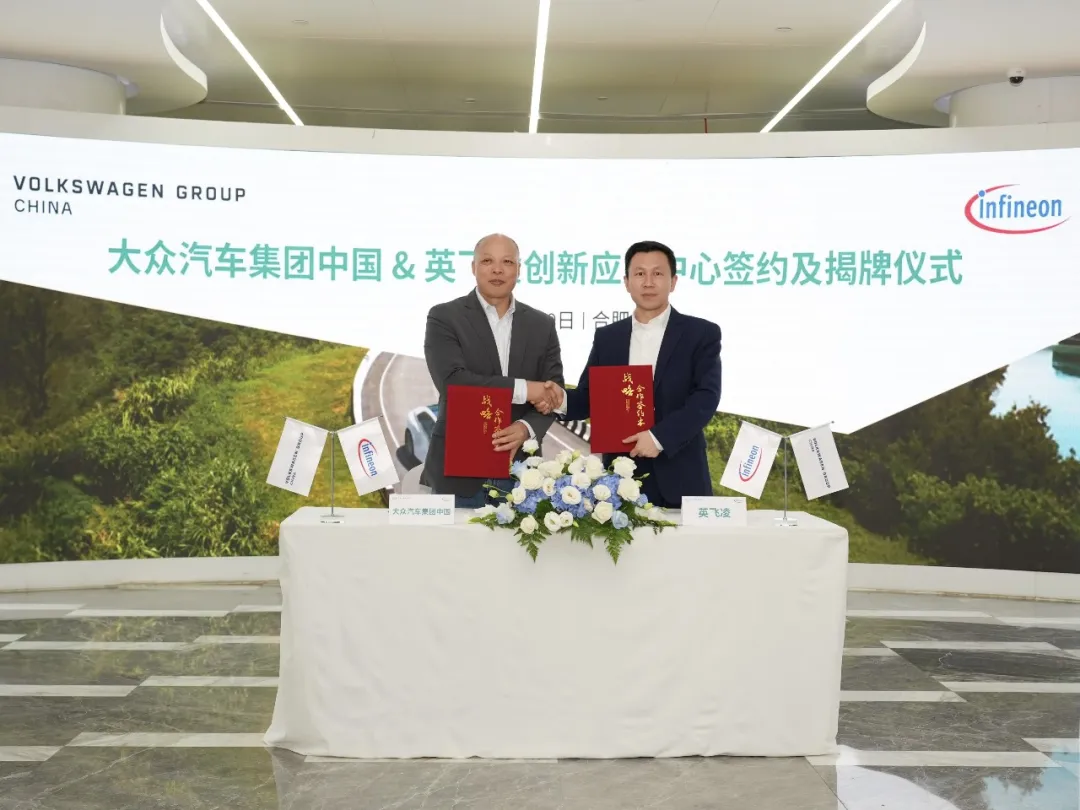
- Infineon establishes automotive innovation center with Volkswagen China.
- The center will support chip validation and mass production.
- Teams will develop solutions for next-generation vehicle platforms.
Infineon, CARIAD, and Volkswagen Group China Establish Innovation Center
Infineon Technologies AG (Infineon) has jointly established an Innovation Application Center in Hefei with research and development teams from CARIAD SE (CARIAD) and Volkswagen Group (China) Technology Co., Ltd. (VCTC), both part of Volkswagen Group China. The parties signed an agreement and officially unveiled the center, creating a collaborative framework for automotive semiconductor development. The initiative is designed to bring chip-level requirements and vehicle-level engineering closer together from the early stages of project development. By coordinating semiconductor specifications with vehicle requirements, the participants aim to support the development, validation, and mass-production implementation of solutions for Volkswagen Group China's next-generation vehicle platforms and China Electronic Architecture (CEA).
Collaborative Development From Chip Requirements to Mass Production
The Innovation Application Center will establish a collaborative mechanism covering semiconductor device requirements definition, reference design development, system-level validation, and implementation in mass production. This approach connects semiconductor development with vehicle engineering requirements early in the project lifecycle rather than treating chip selection and vehicle integration as separate activities. Infineon and the Volkswagen Group China teams will jointly develop solutions using Infineon's automotive-grade microcontrollers, automotive-grade power devices, and wide-bandgap semiconductor products. The work will focus on adapting these technologies for next-generation vehicle platforms and China Electronic Architecture (CEA), aligning component capabilities with the intended vehicle applications and system requirements.
Three Core Automotive Application Areas
The participating teams plan to conduct chip technology evaluations, reference design development, hardware-in-the-loop (HIL) testing, reliability validation, and failure analysis across three application areas: vehicle electrical/electronic (E/E) architectures, domain controllers, and onboard power supply systems. These activities provide a structured process for assessing semiconductor technologies and their suitability for vehicle-level applications. Reference designs can support consistent implementation, while HIL testing enables system behavior to be evaluated in a simulated operating environment. Reliability validation and failure analysis add further assessment steps to help identify potential weaknesses and evaluate component performance against application requirements. The announcement identifies these activities as planned areas of collaboration.
Infineon AURIX Microcontrollers and Automotive Power Modules
The center will also support the development of related solutions based on Infineon's AURIX series microcontrollers and automotive-grade power modules. These product families form part of the semiconductor technologies identified for collaborative development and application work. Their evaluation will take place within the broader program of reference design development, system-level validation, and vehicle integration. The announcement does not specify individual chip models, electrical ratings, performance targets, production volumes, or launch dates for the resulting solutions. Instead, it establishes the technology categories and engineering activities that the teams intend to address as they adapt semiconductor products to the requirements of Volkswagen Group China's next-generation platforms and CEA.
Integration With China Electronic Architecture
China Electronic Architecture (CEA) is one of the stated targets for the collaborative work, alongside Volkswagen Group China's next-generation vehicle platforms. The center's development process is intended to connect semiconductor device requirements with the needs of vehicle electrical/electronic architectures, domain controllers, and onboard power supply systems. The involvement of Infineon, CARIAD, and VCTC brings semiconductor technology development together with automotive research and development teams within Volkswagen Group China. The parties plan to use technology evaluations, reference designs, testing, reliability validation, and failure analysis to support the development of suitable solutions. The announcement does not provide a detailed CEA roadmap or identify specific vehicles that will use the resulting components.
Engineering Validation and Production Implementation
The planned workflow extends beyond initial chip evaluation to include reference design development, hardware-in-the-loop testing, reliability validation, and failure analysis, with implementation in mass production included in the center's collaborative remit. Linking these activities can help the participating teams assess semiconductor solutions against system requirements before their intended production use. The work is expected to address compatibility with vehicle architectures and the practical requirements of automotive applications. However, the announcement does not confirm that any specific solution has completed validation or entered production. It describes a collaborative development mechanism and planned technical activities rather than reporting completed product qualification, a production start, or a confirmed vehicle launch.
Roles of the Participating Organizations
The initiative brings together Infineon Technologies AG and research and development teams from CARIAD SE and VCTC, the latter two being part of Volkswagen Group China. Infineon contributes the automotive semiconductor technologies identified for the collaboration, including automotive-grade microcontrollers, power devices, wide-bandgap semiconductor products, AURIX series microcontrollers, and automotive-grade power modules. CARIAD and VCTC participate through their research and development teams as part of the joint center established in Hefei. The announcement describes the organizations as collaborating on requirements definition, reference designs, testing, validation, failure analysis, and production implementation. It does not disclose the agreement's financial terms, staffing levels, investment value, or division of project costs.
What the Announcement Confirms
The confirmed development is the establishment and official unveiling of the Innovation Application Center in Hefei, following an agreement signed by the participating parties. The announcement also identifies the intended semiconductor product categories, three application areas, and planned engineering activities. It does not disclose a launch schedule for individual solutions, specific production quantities, commercial milestones, or named vehicle programs. The planned use of Infineon's semiconductor technologies for next-generation vehicle platforms and China Electronic Architecture establishes the project's direction, while the stated validation activities indicate the technical work the teams intend to undertake. Further details about implementation and the resulting products have not been specified in the announcement.
Industry Impact & Outlook
The Hefei center creates a formal collaboration between a semiconductor supplier and Volkswagen Group China's research and development teams, with the potential to improve coordination between chip specifications and vehicle-system requirements. For automotive engineering, the focus on reference designs, HIL testing, reliability validation, and failure analysis could support more systematic assessment of semiconductor solutions before mass-production implementation. The work is particularly relevant to electronic architectures, domain controllers, and onboard power systems in the group's next-generation platforms and CEA. Its practical impact will depend on the results of the planned development and validation activities, the solutions ultimately selected, and their implementation in production vehicles. The announcement does not yet establish a timeline or confirm specific production outcomes.
Frequently Asked Questions
What did Infineon and Volkswagen Group China announce?
Infineon Technologies AG, CARIAD SE, and VCTC jointly established and officially unveiled an Innovation Application Center in Hefei to develop automotive semiconductor solutions. The parties signed an agreement to formalize the collaboration. The center will connect semiconductor requirements definition, reference design development, system-level validation, and mass-production implementation. Its work is intended to adapt Infineon's automotive-grade microcontrollers, power devices, and wide-bandgap semiconductor products for Volkswagen Group China's next-generation vehicle platforms and China Electronic Architecture.
Where is the Innovation Application Center located?
The Innovation Application Center is located in Hefei, China, where Infineon and research and development teams from CARIAD SE and VCTC have established their collaboration. The parties signed an agreement and officially unveiled the center. The announcement identifies Hefei as the center's location but does not disclose its physical address, facility size, staffing levels, operating budget, or planned expansion. Its stated purpose is to support collaborative automotive semiconductor development, validation, and preparation for implementation in mass production.
Which companies are participating in the collaboration?
The collaboration involves Infineon Technologies AG, CARIAD SE, and Volkswagen Group (China) Technology Co., Ltd., known as VCTC, with CARIAD and VCTC both part of Volkswagen Group China. The organizations are bringing semiconductor technologies and automotive research and development teams into a shared development framework. Their planned work includes requirements definition, reference design development, chip technology evaluation, system-level testing, reliability validation, and failure analysis. The announcement does not specify the agreement's financial terms or the precise allocation of resources among the participating organizations.
Which semiconductor technologies will the center work on?
The center will support collaborative solutions involving Infineon's automotive-grade microcontrollers, automotive-grade power devices, and wide-bandgap semiconductor products for next-generation vehicle platforms and China Electronic Architecture. The announcement also specifically identifies Infineon's AURIX series microcontrollers and automotive-grade power modules as foundations for related solution development. It does not name individual component models, provide detailed technical specifications, or announce finalized designs. The technologies are intended to be assessed and adapted through the center's planned engineering and validation activities.
What application areas and testing activities are planned?
The planned collaboration covers three application areas: vehicle electrical/electronic architectures, domain controllers, and onboard power supply systems. Across these areas, the teams intend to conduct chip technology evaluations, reference design development, hardware-in-the-loop testing, reliability validation, and failure analysis. These activities are intended to connect component requirements with vehicle-system needs and support evaluation before production implementation. The announcement describes the planned scope but does not report completed test results, final qualification decisions, or confirmation that specific semiconductor solutions have entered mass production.
When will the resulting semiconductor solutions enter mass production?
The announcement includes implementation in mass production within the center's collaborative development mechanism, but it does not provide a specific production start date for any resulting semiconductor solution. The stated activities include chip technology evaluations, reference design development, hardware-in-the-loop testing, reliability validation, and failure analysis. These steps are intended to support the development and assessment of solutions for next-generation vehicle platforms and China Electronic Architecture. Individual product schedules, production volumes, vehicle applications, and commercial launch dates have not been disclosed in the announcement.
Click above to visit the official source.
Discussion
Join the conversation.