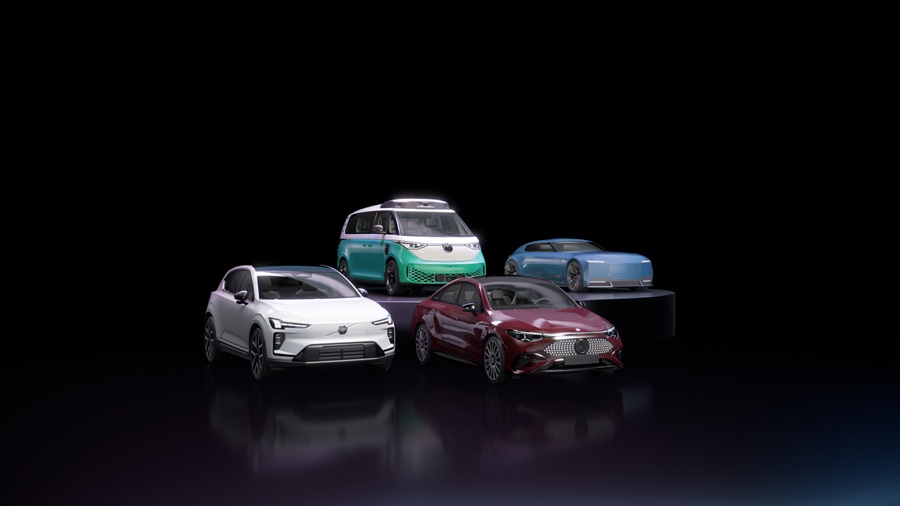
- NVIDIA autonomous driving partnerships expand across Europe's mobility sector. Bolt plans at least 25,000 Level 4-capable Lucid vehicles. Porsche's approach could cut repeated physical test drives by 90%.
NVIDIA Expands Autonomous Driving Partnerships Across Europe
On October 21, NVIDIA announced that European automakers and mobility providers, including Bolt, Lucid, Mercedes-Benz, Volkswagen Commercial Vehicles, and Einride, are showcasing autonomous mobility applications built around the NVIDIA Hyperion computing platform. The applications target Level 3 and Level 4 autonomous vehicles, along with future robotaxi fleets. The announcement highlights a range of development efforts covering passenger transportation, commercial freight, and automated mobility services. By supporting different vehicle types and autonomous driving software, Hyperion is positioned as a common computing and sensor architecture for developers working toward increasingly capable automated driving systems.
NVIDIA Hyperion Supports Multiple Autonomous Vehicle Applications
European automakers and mobility providers are developing autonomous passenger vehicles, robotaxis, and freight trucks using different approaches to automated driving. NVIDIA Hyperion uses a modular architecture designed to support these applications and is compatible with NVIDIA Alpamayo Stack software as well as autonomous driving software developed by other companies. This compatibility allows organizations to work with a shared computing and sensor foundation while developing systems for different vehicle platforms and operating environments. The announced initiatives span commercial deployment plans, vehicle-platform demonstrations, engineering and safety development, and data-processing methods intended to support autonomous vehicle development.
Bolt Plans a Large-Scale European Robotaxi Program
Bolt selected NVIDIA Alpamayo Stack software for its European robotaxi program, beginning with future Lucid vehicles built on the NVIDIA Hyperion platform. The companies plan to adapt the software to European road conditions and integrate it into vehicles from multiple automakers. Bolt plans to roll out at least 25,000 Level 4-capable Lucid vehicles equipped with NVIDIA Hyperion. The announcement describes a planned deployment rather than confirming that these vehicles are already operating. Its scale makes the program a significant part of the announced European autonomous mobility initiatives, while the software adaptation and multi-automaker integration remain important elements of the stated plan.
Volkswagen Commercial Vehicles Demonstrates Autonomous ID. Buzz AD
Volkswagen Commercial Vehicles is showcasing its autonomous ID. Buzz AD platform using NVIDIA Hyperion at GTC Berlin. The platform provides a common computing and sensor architecture intended to support different autonomous driving systems. This approach separates the shared vehicle technology foundation from the specific automated driving system that may be used with it. The demonstration illustrates how a common architecture can accommodate development across autonomous vehicle applications without requiring every system to use identical driving software. The announcement identifies the ID. Buzz AD as a platform being showcased; it does not establish a broader commercial deployment schedule or provide additional production details.
Volvo Cars and Mercedes-Benz Develop Autonomous Driving Technology
Volvo Cars is combining its vehicle safety systems and engineering expertise with NVIDIA Hyperion, Halos OS, and Alpamayo Stack. The stated objective is to help future Volvo vehicles navigate complex real-world conditions safely from their starting point to their destination. Mercedes-Benz is also working with NVIDIA to develop Level 3 and Level 4 autonomous driving technologies using Hyperion and Alpamayo Stack software. These initiatives bring computing architecture, automated driving software, and established vehicle engineering capabilities together. The announcement describes technology development efforts, rather than confirming that every planned capability is available in production vehicles or specifying launch dates for the relevant systems.
Einride Develops Its Next-Generation Autonomous Freight Truck System
Einride is developing its next-generation autonomous freight truck system using NVIDIA Hyperion, Halos, Alpamayo, and Cosmos technologies. The company intends to use these technologies to develop and test its driving system. The initiative extends the announced applications beyond passenger transportation and robotaxis into autonomous freight operations. Freight vehicles present a distinct application for automated driving systems, making the computing platform, software development tools, and testing process relevant to the development effort. However, the announcement does not provide a confirmed commercial launch date, a deployment volume, or detailed performance results for Einride's next-generation system.
German Research Initiative Targets Level 4 Public Transportation
TIER IV and the Technical University of Munich announced plans to use NVIDIA Hyperion to develop and validate Level 4 autonomous driving systems for public transportation in Germany. The initiative adds a public transportation application to the wider set of passenger vehicle, robotaxi, and freight projects described in the announcement. Development and validation are central to the stated objective, but the announcement does not specify a launch date, fleet size, or particular public transportation route. The planned work demonstrates how the same underlying computing platform can be applied to research and validation efforts for automated mobility systems intended for a different transportation setting.
Porsche Uses Data Tools to Accelerate Autonomous Driving Development
Porsche is using Voxel51, NVIDIA Cosmos Data Factory, and Omniverse NuRec on Microsoft Azure to convert vehicle fleet data into datasets for autonomous driving development. According to the announcement, this approach could reduce repeated physical test drives by up to 90% and shorten development cycles by up to 85%. These figures describe the reported potential of the approach, not guaranteed results for every development program. Converting fleet data into usable datasets can support the process of preparing information for autonomous driving development while reducing reliance on repeated physical driving sessions. The announcement does not provide further details about the measurement methodology or the conditions under which the maximum reductions would be achieved.
Uber and NVIDIA Develop an Autonomous Vehicle Data Factory
Uber and NVIDIA are developing a data factory using Cosmos to process and organize data for autonomous vehicle development. Their partnership also covers AI infrastructure, Hyperion-based vehicles, and Uber's global ride-hailing network. The data factory is intended to help organize the information used in developing autonomous driving systems, while the broader collaboration connects computing infrastructure and vehicle technology with a ride-hailing platform. The announcement does not specify a deployment timetable, the number of vehicles involved, or the precise markets in which the resulting systems will first operate. The initiative adds a mobility-platform dimension to NVIDIA's announced work with vehicle manufacturers and autonomous freight developers.
NVIDIA Introduces Halos SAFE for Autonomous Vehicle Safety Evidence
NVIDIA also introduced Halos SAFE, or Safety Assurance Framework for Evaluation, as a new framework within the NVIDIA Halos safety system. It combines simulation and physical testing to help developers generate measurable, traceable safety evidence for autonomous vehicles. The framework addresses the need to evaluate automated driving systems through a process that connects simulated scenarios with physical testing. Its stated purpose is to help developers produce evidence that can be measured and traced during safety evaluation. The announcement does not provide specific certification outcomes, quantified safety improvements, or confirmation that any particular vehicle has completed validation using Halos SAFE.
Industry Impact & Outlook
NVIDIA's expanding collaborations show how autonomous driving development increasingly depends on shared computing platforms, specialized software, data infrastructure, and structured safety evaluation across passenger vehicles, robotaxis, freight trucks, and public transportation. For automakers and mobility providers, common architectures may help support different systems, while Porsche's reported data-processing approach highlights the potential to reduce repeated physical testing and shorten development cycles. Bolt's planned fleet of at least 25,000 Level 4-capable Lucid vehicles represents a stated deployment ambition, not a confirmed operational fleet. The next meaningful indicators will be progress in software adaptation, system validation, commercial deployment, and the production of traceable safety evidence.
Frequently Asked Questions
What did NVIDIA announce about autonomous driving in Europe?
NVIDIA announced that European automakers and mobility providers are showcasing autonomous mobility applications based on its Hyperion computing platform. The initiatives cover Level 3 and Level 4 autonomous vehicles, robotaxis, freight trucks, and public transportation development. Participating organizations include Bolt, Lucid, Mercedes-Benz, Volkswagen Commercial Vehicles, and Einride, alongside other partners working on vehicle data and safety evaluation. The announcement also introduced Halos SAFE, a framework designed to help developers generate measurable and traceable autonomous vehicle safety evidence through simulation and physical testing.
What is the NVIDIA Hyperion platform used for?
NVIDIA Hyperion is a modular computing and sensor architecture intended to support autonomous driving applications across different vehicle types. The platform is compatible with NVIDIA Alpamayo Stack software and autonomous driving software developed by other companies. The announced applications include passenger vehicles, robotaxis, autonomous freight trucks, and systems being developed for public transportation. Its role is to provide a common technology foundation for different automated driving efforts. The announcement does not mean every vehicle using Hyperion has the same capabilities or that all associated projects have reached commercial deployment.
How many autonomous vehicles does Bolt plan to deploy?
Bolt plans to roll out at least 25,000 Level 4-capable Lucid vehicles equipped with NVIDIA Hyperion as part of its European robotaxi program. The initiative will begin with future Lucid vehicles built on the platform, and Bolt and its partners plan to adapt the software for European roads. The companies also intend to integrate the software into vehicles from multiple automakers. The announced number represents a deployment plan, not confirmation that 25,000 vehicles are already operating. The announcement does not provide a specific completion date for the planned rollout.
What autonomous driving technologies are Volvo Cars and Mercedes-Benz developing with NVIDIA?
Volvo Cars is combining its vehicle safety systems and engineering expertise with NVIDIA Hyperion, Halos OS, and Alpamayo Stack to help future vehicles navigate complex real-world conditions safely. Mercedes-Benz is working with NVIDIA on Level 3 and Level 4 autonomous driving technologies using Hyperion and Alpamayo Stack software. Both efforts bring vehicle engineering together with computing and software technologies. The announcement describes development initiatives rather than confirming that all planned capabilities are already available to customers. It does not specify production launch dates or provide detailed performance measurements for either company's systems.
How could Porsche's data approach affect autonomous vehicle development?
Porsche is using Voxel51, NVIDIA Cosmos Data Factory, and Omniverse NuRec on Microsoft Azure to convert vehicle fleet data into datasets for autonomous driving development. The announced approach could reduce repeated physical test drives by up to 90% and shorten development cycles by up to 85%. These are reported potential reductions, not guaranteed outcomes for every project. The approach focuses on turning fleet data into datasets that can support development work. The announcement does not provide the detailed methodology, baseline measurements, or operating conditions used to calculate those maximum reductions.
What is NVIDIA Halos SAFE, and why is it relevant?
NVIDIA Halos SAFE stands for Safety Assurance Framework for Evaluation and is a new framework within the NVIDIA Halos safety system. It combines simulation and physical testing to help developers generate measurable, traceable safety evidence for autonomous vehicles. This evidence-focused approach is intended to support the evaluation of automated driving systems through documented testing activities. Halos SAFE is part of NVIDIA's wider autonomous driving technology announcement, which includes computing platforms, software, and development tools. The announcement does not identify specific vehicles that have completed validation under the framework or claim that it guarantees regulatory approval.
Click above to visit the official source.
Discussion
Join the conversation.