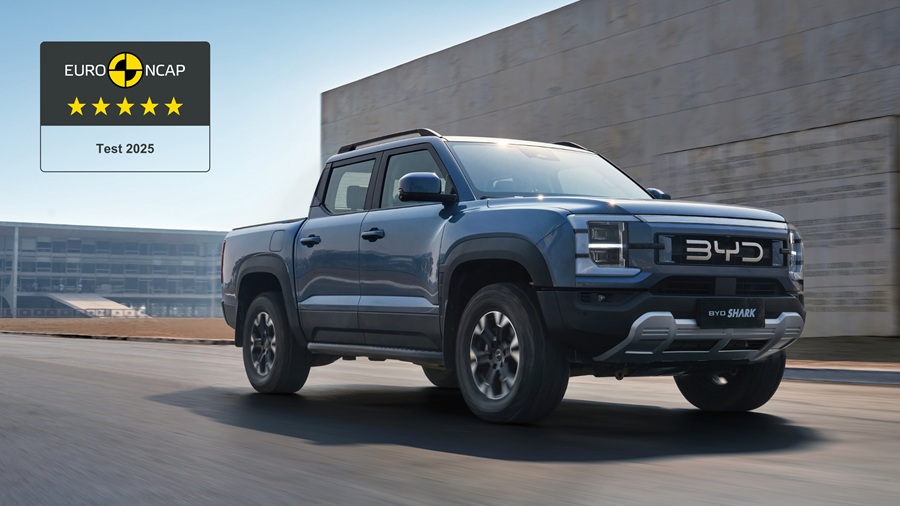
- BYD SHARK earns five-star Euro NCAP safety rating.
- Adult occupant protection scored 82%, while child protection reached 86%.
- Safety Assist scored 87% in Euro NCAP testing.
BYD SHARK DMO Earns Five-Star Euro NCAP Safety Rating
On October 15, BYD announced that its SHARK DMO pickup received a five-star safety rating in the latest Euro NCAP tests. The results reflect strong performance across several assessment areas, including frontal and side-impact protection, occupant safety, vulnerable road user protection, and driver assistance systems. The rating provides an independent assessment of the vehicle's safety performance under Euro NCAP's testing procedures. The published results also highlight the pickup's child presence detection system and autonomous emergency braking capabilities. These findings offer prospective buyers and automotive safety observers specific measures of the vehicle's performance across the assessed categories, rather than relying solely on the manufacturer's description of its safety features.
Adult and Child Occupant Protection Results
The BYD SHARK achieved an adult occupant protection score of 82% and a child occupant protection score of 86%. Euro NCAP's report highlighted good protection in frontal and side-impact tests, as well as the vehicle's performance in protecting child crash-test dummies. The child presence detection system was also recognized for alerting drivers when a child may have been left inside the vehicle. Together, these results identify occupant protection as an important part of the pickup's overall safety assessment. The two percentage scores represent separate assessment categories, providing a more detailed picture of its tested performance than the overall five-star rating alone.
Vulnerable Road User Protection and Safety Assist
The pickup recorded 74% in the Vulnerable Road Users category, which assesses safety performance relevant to people outside the vehicle, including cyclists and motorcyclists. Its autonomous emergency braking (AEB) system performed well in detecting cyclists and motorcyclists during the reported assessments. The BYD SHARK also scored 87% in Safety Assist, another key category in the Euro NCAP evaluation. These results highlight the role of driver assistance technology alongside structural crash protection. Although the scores indicate performance within the test program, they should not be interpreted as a guarantee that collisions will always be avoided or that every real-world driving situation will produce the same outcome.
Super Hybrid DMO Powertrain and Performance
The BYD SHARK uses the Super Hybrid DMO powertrain, which combines two electric motors to deliver a total system output of 436 PS and 650 Nm of torque. According to the supplied specifications, the pickup accelerates from 0 to 62 mph in 5.7 seconds. This powertrain configuration combines electric drive with a gasoline engine, bringing performance and hybrid operation together in one system. The stated output and acceleration figures describe the vehicle's performance capabilities, while the Euro NCAP scores address its tested safety performance. These are distinct aspects of the pickup and should be considered separately when evaluating its technical specifications and safety credentials.
Blade Battery, Gasoline Engine, and Combined Range
The Super Hybrid DMO system pairs a 32.2 kWh Blade Battery with a 1.5-liter turbocharged gasoline engine. BYD's supplied figures state a combined range of 419 miles when the battery is fully charged and the fuel tank is full. This range figure describes the combined operating capability of the hybrid system under the conditions represented by the stated specification; it does not establish how far the vehicle can travel using battery power alone. The battery capacity, engine configuration, total system output, and combined range together provide a snapshot of the pickup's powertrain design. The shared information does not specify the testing cycle or conditions used to determine the range figure.
Euro NCAP Results at a Glance
| Assessment or Specification | Reported Result |
|---|---|
| Overall Euro NCAP rating | Five stars |
| Adult occupant protection | 82% |
| Child occupant protection | 86% |
| Vulnerable Road Users | 74% |
| Safety Assist | 87% |
| Total system output | 436 PS |
| Torque | 650 Nm |
| Acceleration, 0–62 mph | 5.7 seconds |
| Blade Battery capacity | 32.2 kWh |
| Combined range with full battery and fuel tank | 419 miles |
What the Safety Rating Means for the BYD SHARK
The five-star result gives the BYD SHARK a positive independent safety assessment across the categories reported by Euro NCAP. Its scores distinguish occupant protection from vulnerable road user performance and Safety Assist, helping readers understand where the vehicle was assessed. The child presence detection feature and AEB performance are notable elements of the reported findings because they address different safety situations: potential risks involving a child left inside the vehicle and the detection of cyclists or motorcyclists. The supplied announcement does not include detailed test protocols, individual subtest results, market availability, or pricing, so those matters cannot be established from the information provided.
Industry Impact & Outlook
The BYD SHARK's five-star Euro NCAP rating may strengthen its safety credentials in markets where independent crash-test assessments inform pickup purchasing decisions. Its results also illustrate how occupant protection, child presence detection, and emergency braking performance contribute to a broader vehicle safety evaluation alongside powertrain capability and driving performance. For BYD, the published scores provide concrete evidence that can be considered by buyers and industry observers comparing safety performance across vehicles. The longer-term commercial impact will depend on factors not covered in the announcement, including market availability, pricing, local requirements, and customer response. Further model-specific information would be needed to assess those factors reliably.
Frequently Asked Questions
What Euro NCAP safety rating did the BYD SHARK receive?
The BYD SHARK DMO pickup received a five-star safety rating in the latest Euro NCAP tests announced by BYD on October 15. The assessment highlighted performance in frontal and side-impact tests, occupant protection, vulnerable road user protection, and Safety Assist. The overall rating summarizes results across the program's assessment areas, while individual category scores provide more detail about specific safety performance. The supplied announcement does not provide the complete test report or every individual subtest result, so further conclusions beyond the reported findings cannot be confirmed from this information alone.
What were the BYD SHARK's adult and child occupant protection scores?
The BYD SHARK scored 82% for adult occupant protection and 86% for child occupant protection in the reported Euro NCAP assessment. The report highlighted good protection in frontal and side-impact tests and praised the vehicle's protection for child crash-test dummies. It also recognized the child presence detection system, which alerts drivers if a child may have been left inside the vehicle. These figures represent separate occupant protection categories and should not be confused with the pickup's overall five-star rating or its scores in other assessment areas.
How did the BYD SHARK perform in Vulnerable Road Users and Safety Assist?
The BYD SHARK achieved 74% in the Vulnerable Road Users category and 87% in Safety Assist, according to the supplied Euro NCAP results. Its autonomous emergency braking system performed well in detecting cyclists and motorcyclists during the reported tests. These assessments address safety considerations beyond protection for people inside the vehicle, including technology intended to help respond to potential collisions involving vulnerable road users. The percentages describe the vehicle's performance in the specified test categories; they do not guarantee that its assistance systems will prevent every collision in real-world driving conditions.
What powertrain does the BYD SHARK use?
The BYD SHARK uses the Super Hybrid DMO powertrain, which combines two electric motors with a 1.5-liter turbocharged gasoline engine and a 32.2 kWh Blade Battery. The reported total system output is 436 PS, with 650 Nm of torque. This configuration brings electric motors and a gasoline engine together in a hybrid system. The supplied information describes the main powertrain components and output figures but does not provide additional details about operating modes, charging times, fuel consumption, or battery-only driving range. Those specifications should not be inferred from the stated system configuration.
How quickly does the BYD SHARK accelerate, and what is its combined range?
The BYD SHARK is reported to accelerate from 0 to 62 mph in 5.7 seconds and deliver a combined range of 419 miles with a full battery and fuel tank. The range figure applies to the combined hybrid system as described in the supplied announcement, rather than establishing the vehicle's battery-only range. The reported specifications also include a 32.2 kWh Blade Battery and a 1.5-liter turbocharged gasoline engine. The source does not state the range testing cycle or the conditions under which the acceleration and range figures were measured.
Does the five-star Euro NCAP rating guarantee that the BYD SHARK will prevent crashes?
No. A five-star Euro NCAP rating reflects the vehicle's performance in the program's safety assessments, but it does not guarantee that crashes will be prevented in every driving situation. The reported results include occupant protection scores, a Vulnerable Road Users score, and a Safety Assist score, while the AEB system performed well in detecting cyclists and motorcyclists during testing. Actual road safety also depends on driving conditions, driver behavior, and the circumstances of a potential collision. The supplied announcement reports test results, not a promise of risk-free operation.
Click above to visit the official source.
Discussion
Join the conversation.