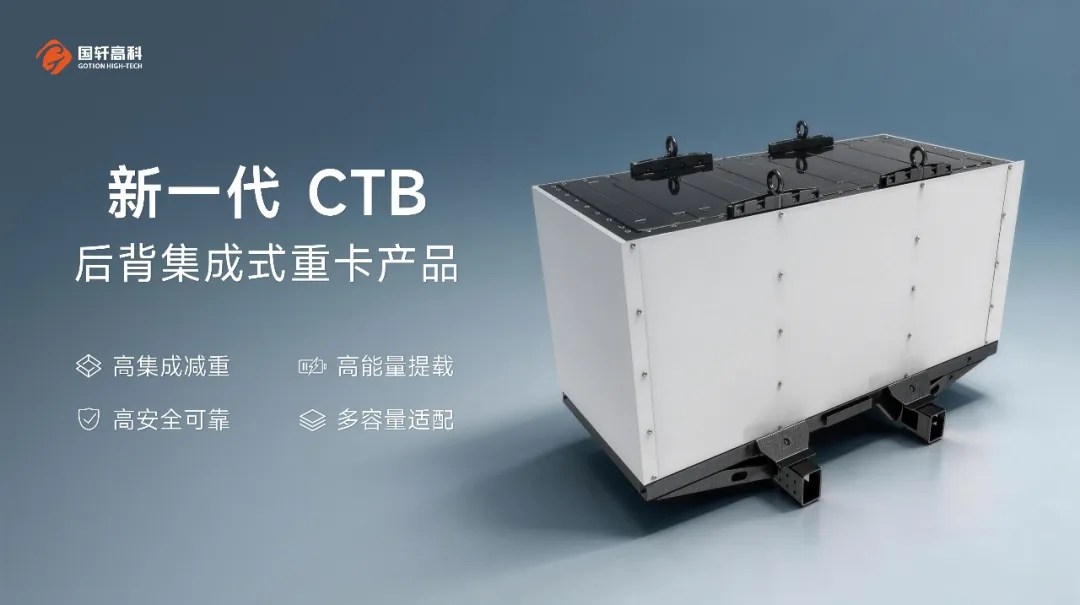
- Gotion High-Tech launches an integrated battery system for heavy trucks.
- The system reduces vehicle weight by approximately 400 kg.
- Battery capacities range from 400 kWh to 700 kWh.
Gotion High-Tech Launches Integrated Battery System for Heavy-Duty Trucks
Gotion High-Tech has announced a next-generation Cell-to-Bracket (CTB) rear-mounted integrated battery system designed for heavy-duty trucks. The system removes redundant frames and module-level structures used in conventional single-pack battery designs, integrating battery cells directly into a highly integrated bracket structure. This approach reduces the weight of the power battery system while freeing up vehicle space. The design focuses on improving packaging efficiency for heavy-duty commercial vehicles, where battery dimensions, energy storage capacity, and overall vehicle weight are important considerations for different transportation operations.
Battery Dimensions, Energy Density, and Weight Reduction
Compared with conventional single-pack solutions, the new battery system has a height of 943 mm, representing a 40% reduction. It achieves a volumetric energy density of 250 Wh/L and a system-level gravimetric energy density of more than 160 Wh/kg. According to the announcement, the system reduces overall vehicle weight by approximately 400 kg. These figures describe the stated performance of the integrated battery solution relative to conventional single-pack designs. The reduced height and structural integration are intended to make more efficient use of available vehicle space while retaining substantial energy storage capacity for heavy-duty truck applications.
Battery Capacity and Heavy-Truck Applications
The system is available in capacities ranging from 400 kWh to 700 kWh, allowing it to serve different heavy-duty transportation requirements. The announced applications include short-haul transportation and interprovincial trunk-line logistics. This capacity range gives the system flexibility across operating scenarios that require different amounts of onboard energy. The announcement does not specify individual vehicle models, driving ranges, charging times, or the precise operating conditions associated with each capacity. Those details would be needed to compare real-world performance across specific truck configurations and routes.
Thermal Management and Low-Temperature Operation
The battery system separates cooling circuits from electrical components and uses externally mounted coolant pipes. It also supports liquid cooling and heating to address battery thermal management requirements in low-temperature environments. An optional positive temperature coefficient (PTC) heater is available as part of the thermal management provisions. These features are intended to support temperature control under differing operating conditions while keeping the cooling circuits separate from electrical components. The announcement does not provide specific operating-temperature limits, heating power, cooling performance figures, or comparative test results, so those aspects cannot be quantified from the available information.
Vehicle-Level Durability Testing
Gotion High-Tech stated that the Cell-to-Bracket battery system has completed 6,000 km of vehicle-level durability road testing. This establishes that the product has undergone a reported road-testing program at the vehicle level. However, the announcement does not disclose the test route, environmental conditions, load profile, evaluation criteria, or detailed results. The reported distance should therefore be understood as a stated testing milestone rather than proof of performance under every possible operating condition. Further technical information would be needed to assess durability across specific heavy-duty truck applications and duty cycles.
Integrated Battery Design for Commercial Transportation
The system combines structural integration, high-capacity energy storage, and thermal management features in a rear-mounted package for heavy-duty trucks. By eliminating redundant frames and module-level structures, the design seeks to reduce battery-system weight and improve packaging efficiency. Its 400 kWh to 700 kWh capacity range addresses multiple transportation scenarios, from short-haul work to interprovincial logistics. The reported 943 mm height, 250 Wh/L volumetric energy density, more than 160 Wh/kg system-level gravimetric energy density, and approximately 400 kg vehicle-weight reduction provide the main quantitative indicators disclosed in the announcement. Vehicle-specific performance will depend on the final application and configuration.
Industry Impact & Outlook
For heavy-duty truck manufacturers and fleet operators, battery-system integration can affect vehicle packaging, payload considerations, and the suitability of electric trucks for different logistics routes. Gotion High-Tech's announced design combines a lower battery-system height with a stated vehicle-weight reduction and capacities covering several operating scenarios, making these characteristics relevant to commercial vehicle integration decisions. The completed 6,000 km durability road test is a reported development milestone, although broader assessment requires more information about testing conditions and results. Further details on vehicle compatibility, production availability, cost, charging performance, and real-world operating results would help determine how the system compares with alternative heavy-truck battery solutions.
Frequently Asked Questions
What is Gotion High-Tech's new Cell-to-Bracket battery system?
Gotion High-Tech's new Cell-to-Bracket system is a rear-mounted integrated battery solution developed for heavy-duty trucks, with battery cells integrated directly into a bracket structure. The design removes redundant frames and module-level structures used in conventional single-pack solutions. According to the announcement, this approach reduces the power battery system's weight and frees up vehicle space. The system is offered in capacities from 400 kWh to 700 kWh for applications that include short-haul transportation and interprovincial trunk-line logistics.
How much weight can the battery system reduce?
The announced system reduces overall vehicle weight by approximately 400 kg compared with the conventional battery solution described by the company. The design achieves this by eliminating redundant frames and module-level structures and integrating battery cells into a bracket structure. The announcement also reports a battery-system height of 943 mm, a 40% reduction relative to conventional single-pack solutions. These figures are company-reported specifications; the actual result in a vehicle may depend on its configuration and the battery system used for comparison.
What are the battery system's energy density figures?
The Cell-to-Bracket battery system has a stated volumetric energy density of 250 Wh/L and a system-level gravimetric energy density of more than 160 Wh/kg. Volumetric energy density describes energy relative to volume, while gravimetric energy density describes energy relative to weight. These metrics help characterize how efficiently the battery system packages stored energy. The announcement provides these figures alongside the reported height reduction and approximately 400 kg vehicle-weight reduction, but does not provide a full comparative dataset or detailed test methodology.
What battery capacities are available, and which applications are targeted?
The system is available in capacities ranging from 400 kWh to 700 kWh and is intended to accommodate different heavy-duty transportation requirements. The announced use cases include short-haul transportation and interprovincial trunk-line logistics. This range allows the battery solution to be considered for more than one operating scenario, although the announcement does not assign specific capacities to individual routes or truck models. It also does not state vehicle driving ranges, charging times, or payload outcomes for each configuration, so those details cannot be established from the announcement alone.
How does the system manage battery temperature?
The battery system separates cooling circuits from electrical components and uses externally mounted coolant pipes. It supports liquid cooling and heating to address thermal management requirements in low-temperature environments, with an optional positive temperature coefficient heater available. These provisions are designed to support battery temperature control across operating conditions. However, the announcement does not specify the supported temperature range, heating or cooling capacity, energy consumption for thermal management, or measured performance in extreme weather. Those details would be needed for a more complete technical assessment.
Has the battery system completed durability testing?
Yes. Gotion High-Tech reports that the Cell-to-Bracket battery system has completed 6,000 km of vehicle-level durability road testing. This indicates that the system has undergone a stated road-testing program, but the announcement does not disclose the test route, weather conditions, vehicle load, assessment criteria, or detailed findings. The distance alone does not establish performance across every operating environment or duty cycle. Additional test data and application-specific results would help manufacturers and fleet operators assess how the system performs under their intended heavy-duty truck operating conditions.
Click above to visit the official source.
Discussion
Join the conversation.