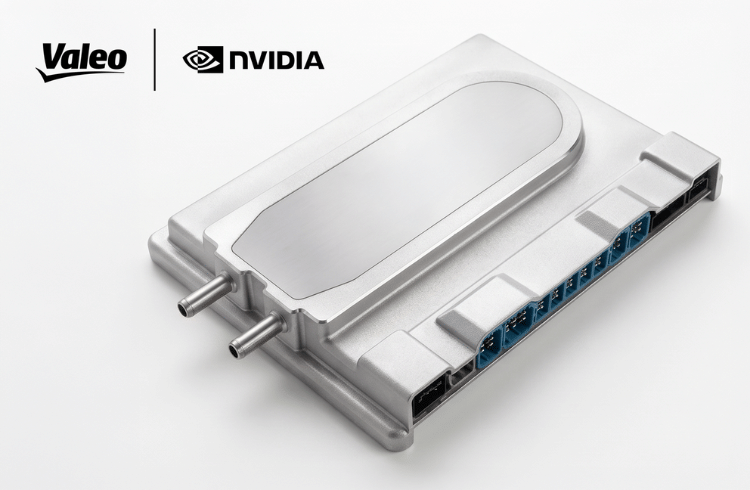
- Valeo develops NVIDIA-based platforms for autonomous driving.
- Dual NVIDIA DRIVE AGX Thor processors provide computing power and redundancy.
- The platforms target robotaxis, Level 4 driving, and commercial trucking.
Valeo and NVIDIA Develop Computing Platforms for Autonomous Vehicles
Valeo announced on Wednesday that it will develop and industrialize production-ready high-performance computing platforms based on the NVIDIA Hyperion reference architecture. The collaboration aims to accelerate the deployment of software-defined vehicles by translating NVIDIA's computing architecture into platforms designed for vehicle manufacturers. The integrated system combines sensor architecture, safety technology, and processing capabilities intended to support demanding autonomous-driving applications. The planned platforms are designed for Level 4 autonomous driving, driverless robotaxis, and commercial trucking. Through the partnership, Valeo will contribute its systems integration, functional safety, and manufacturing expertise to help turn the underlying computing architecture into hardware tailored to the requirements of global original equipment manufacturers.
How the NVIDIA Hyperion Architecture Supports Autonomous Driving
The planned computing platform integrates the NVIDIA Hyperion sensor architecture with the NVIDIA Halos safety framework. It uses dual NVIDIA DRIVE AGX Thor processors to deliver artificial intelligence computing power and system redundancy. These capabilities are intended to support the processing demands and safety requirements associated with Level 4 autonomous driving, including applications in driverless robotaxis and commercial trucks. The combination brings together sensor architecture, safety-focused technology, and high-performance computing in a platform designed for advanced vehicle systems. The announcement describes the intended architecture and applications, but does not specify final production dates, vehicle programs, computing benchmarks, or deployment volumes for the platforms.
Valeo's Role in Hardware Integration and Industrialization
Under the partnership, Valeo will apply its systems integration, functional safety, and manufacturing capabilities to convert NVIDIA's computing architecture into hardware suited to global automakers. This work is central to the industrialization effort because a reference architecture must be integrated into production-ready systems that meet vehicle manufacturers' technical and operational requirements. Valeo's contribution is intended to bridge the underlying computing design and the hardware needed for deployment in vehicles. The announcement positions the collaboration around both engineering integration and manufacturing, rather than computing architecture alone. It does not identify specific automakers that will adopt the resulting platforms or confirm individual vehicle launches.
Computing Power and Redundancy for Level 4 Driving
The architecture uses two NVIDIA DRIVE AGX Thor processors to provide AI computing capability and system redundancy for advanced autonomous-driving applications. The announced target applications include Level 4 autonomous vehicles, driverless robotaxis, and commercial trucking. These use cases place substantial demands on onboard computing and system design, making processing capability and redundancy important elements of the proposed platform. The NVIDIA Hyperion sensor architecture and NVIDIA Halos safety framework form additional parts of the integrated system. However, the announcement does not provide detailed processor performance figures, redundancy implementation details, safety validation results, or certification status. Those details would be needed to assess the final platform's specifications and readiness for particular production vehicles.
Leadership Perspective on Software-Defined Vehicles
Marc Vrecko, CEO of Valeo Brain Division, described the partnership as a way to integrate NVIDIA's computing capabilities into Valeo's next-generation platforms. He said, "By seamlessly integrating NVIDIA's advanced compute power into our next-generation platforms, we are delivering the flexible, centralized intelligence vehicle manufacturers require to redefine the driving experience and meet the evolving demands of tomorrow's intelligent vehicles." His statement emphasizes centralized computing and platform flexibility as important requirements for future vehicles. The collaboration is intended to help manufacturers develop software-defined vehicles using production-oriented computing hardware. The announcement does not provide further details about the commercial terms of the partnership, the timing of product availability, or the specific vehicle manufacturers expected to use the platforms.
What the Partnership Has Confirmed
The announcement establishes the main technical elements and intended applications of the collaboration, while leaving several commercialization details open. Valeo will develop and industrialize production-ready high-performance computing platforms based on the NVIDIA Hyperion reference architecture. The platform will integrate the NVIDIA Hyperion sensor architecture and NVIDIA Halos safety framework, alongside dual NVIDIA DRIVE AGX Thor processors. Its stated applications include Level 4 autonomous driving, driverless robotaxis, and commercial trucking. Valeo will contribute systems integration, functional safety, and manufacturing expertise. The announcement does not confirm customer contracts, production volumes, pricing, launch dates, or specific vehicle programs, so these details should not be treated as established outcomes of the partnership.
Industry Impact & Outlook
The collaboration brings together Valeo's integration and industrialization capabilities with NVIDIA's autonomous-driving computing architecture, addressing a key challenge for automakers seeking production-ready software-defined vehicle platforms. If the planned systems meet manufacturers' technical, safety, and production requirements, they could provide a route to integrating centralized AI computing into robotaxis, commercial trucks, and other Level 4 applications. The partnership also highlights the importance of combining computing hardware with sensor architecture, functional safety, and manufacturing expertise rather than treating processing power as a standalone solution. The next meaningful indicators will be confirmation of customer programs, platform validation, production timing, and deployment details, none of which were specified in the announcement.
Frequently Asked Questions
What did Valeo and NVIDIA announce?
Valeo announced a collaboration with NVIDIA to develop and industrialize production-ready high-performance computing platforms based on the NVIDIA Hyperion reference architecture. The goal is to accelerate the deployment of software-defined vehicles by combining computing architecture, sensor technology, safety technology, and Valeo's industrial capabilities. The platform integrates NVIDIA Hyperion sensor architecture and the NVIDIA Halos safety framework, with dual NVIDIA DRIVE AGX Thor processors. The announced target applications include Level 4 autonomous driving, driverless robotaxis, and commercial trucking. The announcement does not identify confirmed vehicle customers or provide a production launch date.
Which NVIDIA technologies are included in the planned platform?
The planned platform combines the NVIDIA Hyperion sensor architecture, the NVIDIA Halos safety framework, and dual NVIDIA DRIVE AGX Thor processors. Together, these components are intended to provide the computing capability and system redundancy required for the platform's targeted autonomous-driving applications. Hyperion provides the sensor architecture, while Halos is the safety framework identified in the announcement. The two DRIVE AGX Thor processors are intended to supply AI computing power and redundancy. The announcement does not include detailed performance benchmarks, hardware specifications, or independent validation results for the integrated production-ready platform.
What vehicle applications are the platforms designed to support?
The platforms are intended to support Level 4 autonomous driving, driverless robotaxis, and commercial trucking. These are the specific application areas identified in the announcement, which focuses on high-performance computing hardware for software-defined vehicles. The architecture combines sensor technology, a safety framework, and dual processors to address the computing and redundancy needs associated with these applications. However, the announcement does not identify particular vehicle models, operating environments, customer programs, or deployment locations. It therefore establishes the intended application scope but does not confirm that the platforms are already operating in commercial vehicles.
What will Valeo contribute to the partnership?
Valeo will contribute systems integration, functional safety, and manufacturing capabilities to help convert NVIDIA's computing architecture into hardware tailored to global original equipment manufacturers. Its role includes developing and industrializing production-ready high-performance computing platforms rather than simply adopting a reference architecture without further integration. These capabilities are intended to help connect the computing design with the requirements of vehicle manufacturers. The announcement does not detail the manufacturing sites, production capacity, customer-specific adaptations, or validation milestones involved. Those details remain unconfirmed, so the precise industrialization schedule and commercial scale of the program cannot yet be established.
Why are computing power and system redundancy important for these applications?
Level 4 autonomous driving, driverless robotaxis, and commercial trucking are the intended applications for a platform designed around substantial AI computing capability and system redundancy. The announced architecture uses dual NVIDIA DRIVE AGX Thor processors to address these requirements, alongside the NVIDIA Hyperion sensor architecture and NVIDIA Halos safety framework. These elements form the proposed integrated platform, but the announcement does not provide quantitative evidence about processing performance or explain the detailed redundancy design. It also does not report completed safety testing or certification. The stated design goals should therefore be distinguished from independently confirmed performance or deployment results.
When will the Valeo and NVIDIA platforms enter production?
The announcement says Valeo will develop and industrialize production-ready high-performance computing platforms, but it does not provide a specific production start date or commercial availability timeline. It also does not name confirmed automaker customers, identify vehicle launch programs, or disclose expected production volumes. The stated direction is to translate NVIDIA's reference architecture into hardware suitable for global vehicle manufacturers, supporting the targeted autonomous-driving applications. Further announcements would be needed to establish when the platforms will enter production, which vehicles will use them, and how broadly they will be deployed. Until those details are confirmed, a specific launch schedule cannot be stated.
Click above to visit the official source.
Discussion
Join the conversation.