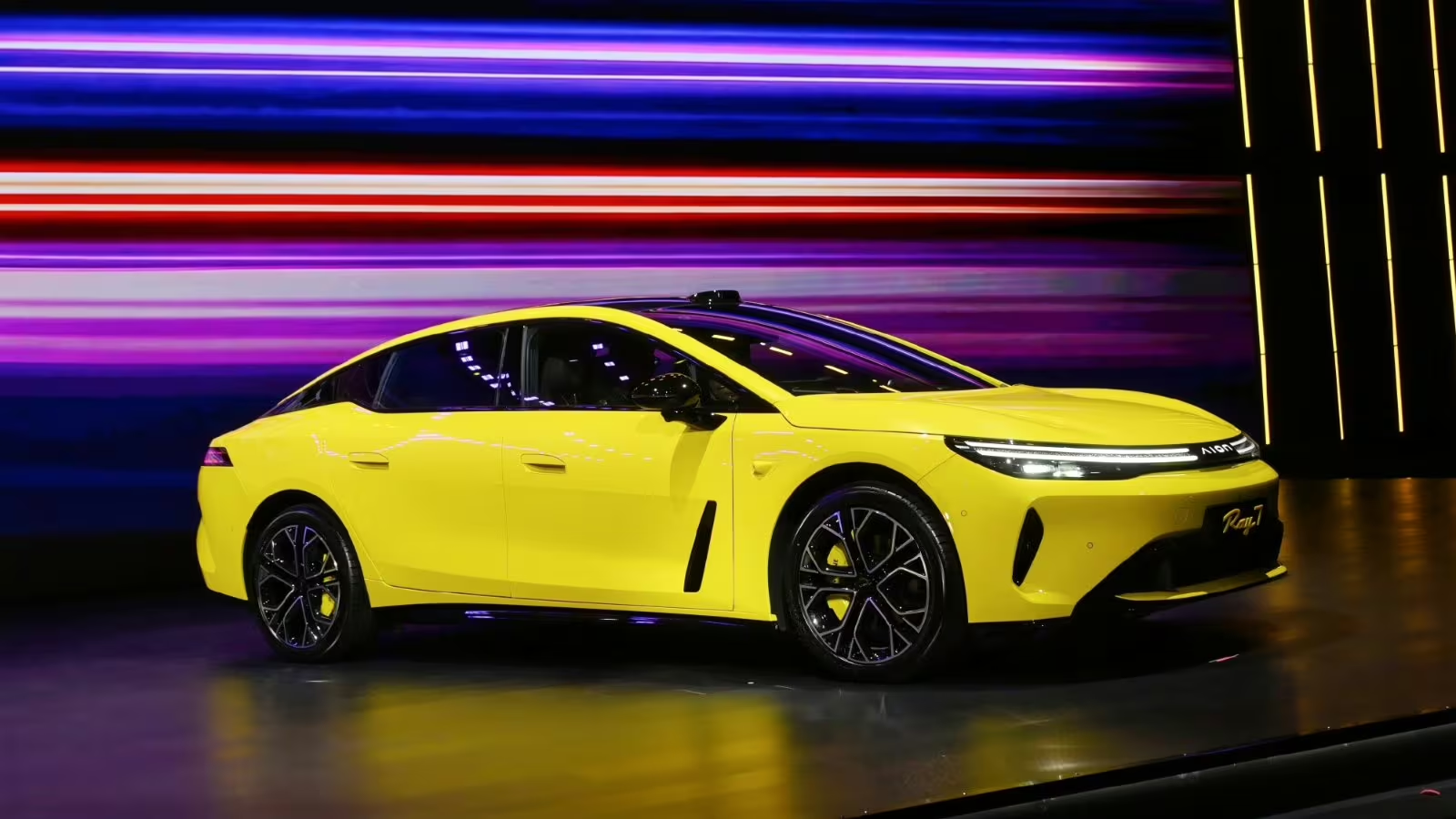
- GAC Aion Ray 7 pre-sales start at 128,800 yuan.
- The sedan offers two CLTC ranges: 530 and 702 kilometers.
- LiDAR-equipped variants feature 27 sensors and navigation-assisted driving.
GAC Aion Ray 7 Opens Pre-Sales With Two Range Options
GAC Aion, the electric vehicle unit of GAC (HKEX: 2238), has opened pre-sales for the GAC Aion Ray 7, a five-seat electric sedan targeting younger buyers, with prices starting at 128,800 yuan ($19,160). The model is offered in five variants, with pre-sales prices reaching 158,800 yuan. It is the first vehicle in Aion's new Ray series and the first to carry the brand's redesigned logo. The launch adds a new product to the company's efforts to attract younger consumers, following the series announcement in July and the Ray 7's first public display in August.
Exterior Dimensions and Cabin Features
The Ray 7 measures 4,960 millimeters long, 1,900 millimeters wide, and 1,455 millimeters tall, with a wheelbase of 2,920 millimeters. Its exterior combines fastback styling with semi-concealed door handles, giving the sedan a streamlined profile. The five-seat cabin includes a digital instrument cluster, a floating central touchscreen, wireless phone charging, and integrated front sport seats. These features support the model's positioning toward younger customers while providing a technology-focused interior. The supplied specifications describe the vehicle's dimensions and equipment, but do not establish additional details about cargo capacity, interior materials, or other cabin functions.
Ray 7 Prices, Trims, and CLTC Driving Range
The five-variant lineup is divided between two principal CLTC driving-range options: 530 kilometers and 702 kilometers. The 530-kilometer version is available in Driving Fun and LiDAR trims, priced at 128,800 yuan and 138,800 yuan, respectively. The 702-kilometer version has three trims, with prices spanning 138,800 yuan to 158,800 yuan. The top-priced variant costs 158,800 yuan. These are pre-sales prices, not confirmation of final retail pricing. The lineup gives buyers a choice between the two stated range configurations and different equipment levels, including LiDAR-based driver assistance on selected variants.
Battery Capacities and Electric Drive System
Every Ray 7 variant uses Huawei's DriveONE integrated electric drive system with a single rear-mounted motor. The 530-kilometer versions use a 45.58-kilowatt-hour lithium iron phosphate battery whose cells are supplied by Aion's Yinpai Battery unit. The 702-kilometer versions use a larger 62.98-kilowatt-hour lithium iron phosphate battery with cells supplied by CATL (HKEX: 3750), incorporating Aion's magazine battery safety technology. These battery capacities correspond to the two principal range configurations announced for pre-sales. The supplied information does not specify charging speeds, charging times, or battery warranty terms.
Energy Consumption and Acceleration Performance
The Ray 7's stated CLTC energy consumption is 9.7 kilowatt-hours per 100 kilometers for the 530-kilometer variants and 9.8 kilowatt-hours per 100 kilometers for the standard configuration of the 702-kilometer variants. All versions have a peak motor output of 180 kilowatts, equivalent to 241 horsepower, and maximum torque of 235 newton-meters. The 530-kilometer version accelerates from 0 to 100 kilometers per hour in 7.4 seconds, while the 702-kilometer version completes the same acceleration in 6.9 seconds. An optional high-performance package changes the stated CLTC range of the 702-kilometer variants to 600 kilometers.
LiDAR Sensors and Navigation-Assisted Driving
Three Ray 7 variants equipped with LiDAR offer navigation-assisted driving on urban roads and highways, with pre-sales prices starting at 138,800 yuan. The sensor package contains 27 sensors: one 192-channel LiDAR unit, three 4D millimeter-wave radars, 11 cameras, and 12 ultrasonic sensors. Aion says the driver-assistance algorithms share the same technological foundation as those used in WeRide (Nasdaq: WRD) Level 4 robotaxis. This statement describes a shared technological foundation; it does not mean that the Ray 7 itself offers Level 4 autonomous driving. The supplied announcement does not specify the full operating conditions or limitations of the navigation-assisted functions.
Braking Technology and Top-Trim Equipment
The top Ray 7 trim, priced at 158,800 yuan during pre-sales, exclusively features Huawei's DriveONE chip-level integrated drive-and-brake architecture and an EMB fully electric brake-by-wire system. The other four variants use a Onebox integrated braking control system. This equipment distinction separates the highest-priced version from the rest of the lineup and adds a specific braking-system difference beyond range and driver-assistance features. The announcement identifies the systems fitted to the variants but does not provide comparative stopping distances, independent braking test results, or further technical details about their operation.
GAC Aion Sales Recover as the New Sedan Arrives
The Ray 7 pre-sales launch comes as GAC Aion continues to record year-over-year sales growth. The brand sold 39,667 vehicles in September, an increase of 45.32% compared with the same month a year earlier. September marked the seventh consecutive month of year-over-year growth. From January through September, GAC Aion sold 283,747 vehicles, up 56.41% year over year. These figures provide context for the new sedan's arrival, although the supplied data does not state how many Ray 7 orders were received, how many vehicles will be delivered, or how much the model may contribute to future sales.
Industry Impact & Outlook
The Ray 7 expands GAC Aion's offering in China's electric passenger-car market with two stated range configurations, multiple price points, and higher-tier driver-assistance and braking equipment. Its battery sourcing from Yinpai Battery and CATL, combined with Huawei's electric-drive technology, illustrates the range of suppliers and systems involved in the vehicle's development. The launch also gives the brand another product to support its effort to attract younger customers while sales are growing year over year. The next meaningful indicators will be the final retail offering, customer response, and reported deliveries, none of which is established by the pre-sales announcement alone.
Frequently Asked Questions
What is the starting pre-sales price of the GAC Aion Ray 7?
The GAC Aion Ray 7 starts at 128,800 yuan, equivalent to approximately $19,160 in the supplied announcement, with five variants planned for pre-sales. The 530-kilometer Driving Fun version carries the entry price, while the 530-kilometer LiDAR trim is priced at 138,800 yuan. The three 702-kilometer variants range from 138,800 yuan to 158,800 yuan. These amounts are announced pre-sales prices, and the available information does not confirm whether final retail prices or equipment packages will differ.
What driving ranges are available for the Ray 7?
The Ray 7 is offered with two main CLTC driving-range ratings: 530 kilometers and 702 kilometers, depending on the variant and configuration selected. The 530-kilometer versions use a 45.58-kilowatt-hour lithium iron phosphate battery, while the standard 702-kilometer versions use a 62.98-kilowatt-hour battery. With the optional high-performance package, the stated CLTC range for the 702-kilometer variants becomes 600 kilometers. These are CLTC figures, and the supplied announcement does not provide equivalent range estimates under other testing procedures or real-world driving conditions.
Which batteries and electric drive system does the Ray 7 use?
Every Ray 7 variant uses Huawei's DriveONE integrated electric drive system, configured with a single rear-mounted motor, while battery capacity and cell suppliers vary by range version. The 530-kilometer variants use a 45.58-kilowatt-hour lithium iron phosphate battery with cells from Aion's Yinpai Battery unit. The 702-kilometer variants use a 62.98-kilowatt-hour lithium iron phosphate battery with cells supplied by CATL and incorporate Aion's magazine battery safety technology. The announcement does not state battery charging times, maximum charging power, or warranty coverage.
What driver-assistance hardware is included in the LiDAR variants?
The three LiDAR-equipped Ray 7 variants offer navigation-assisted driving on urban roads and highways and contain a total of 27 sensors for their driver-assistance systems. The listed hardware comprises one 192-channel LiDAR unit, three 4D millimeter-wave radars, 11 cameras, and 12 ultrasonic sensors. Aion says the algorithms share the same technological foundation as those used in WeRide Level 4 robotaxis. That description does not establish that the Ray 7 is a Level 4 autonomous vehicle, and the announcement does not detail every operating limitation or driver-supervision requirement.
How powerful is the Ray 7, and how quickly does it accelerate?
All Ray 7 variants have a peak motor output of 180 kilowatts, equivalent to 241 horsepower, and maximum torque of 235 newton-meters. According to the supplied specifications, the 530-kilometer version accelerates from 0 to 100 kilometers per hour in 7.4 seconds, while the 702-kilometer version reaches the same speed in 6.9 seconds. The optional high-performance package changes the stated CLTC range of the 702-kilometer variants to 600 kilometers. The announcement does not provide separate acceleration figures for that package.
How are GAC Aion's sales performing ahead of the Ray 7 launch?
GAC Aion reported sales of 39,667 vehicles in September, representing a 45.32% increase year over year and its seventh consecutive month of annual growth. From January through September, the brand sold 283,747 vehicles, up 56.41% compared with the same period a year earlier. These figures indicate continued sales growth ahead of the Ray 7's arrival. However, the supplied information does not identify Ray 7 order totals, delivery targets, or the model's expected contribution to the company's overall sales.
Click above to visit the official source.
Discussion
Join the conversation.