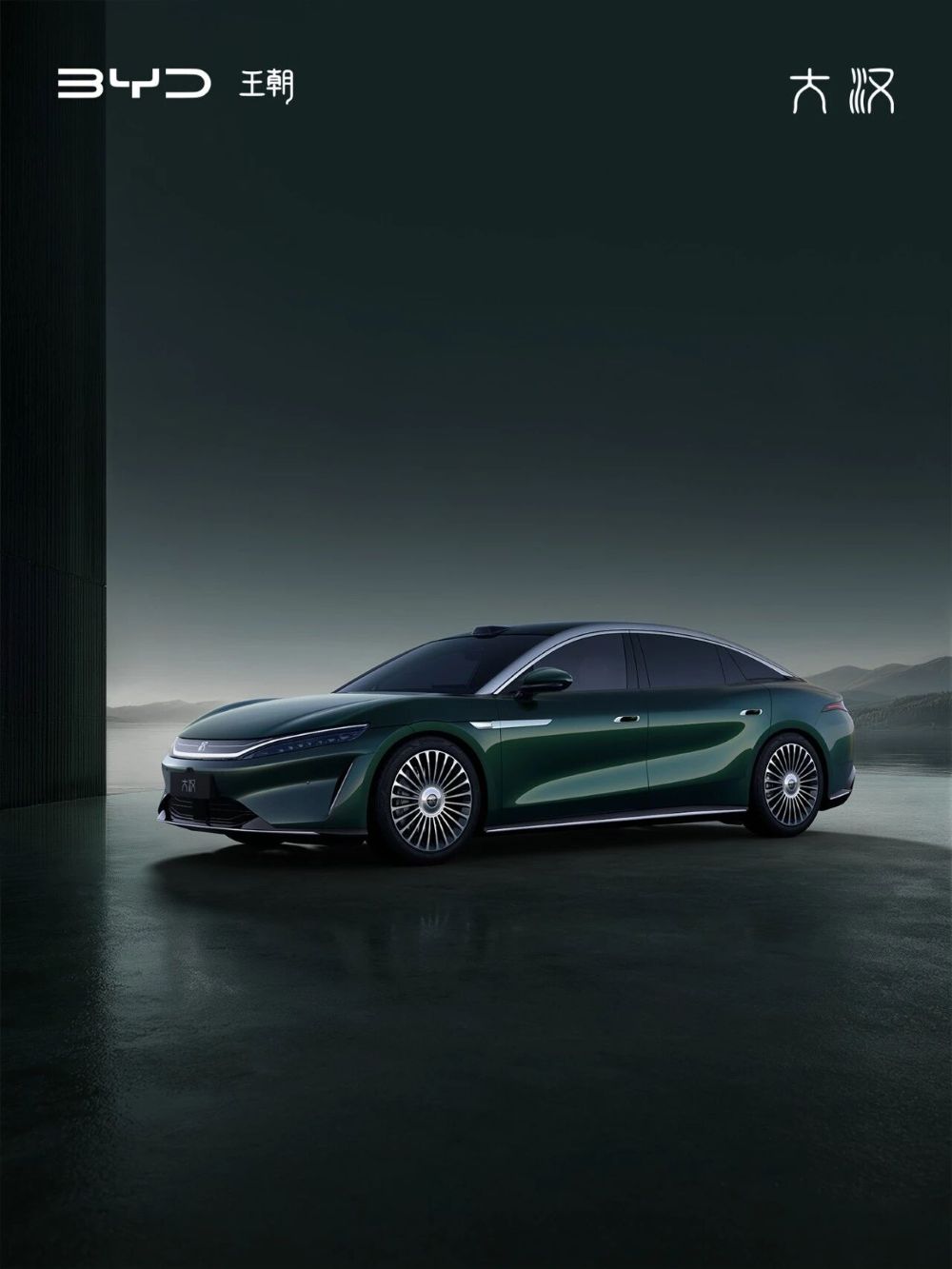
- BYD Da Han EV launches with up to 1,008 km range.
- Three variants are priced from CNY 235,900 to CNY 275,900.
- AWD version accelerates from zero to 100 km/h in 3.3 seconds.
BYD Launches the Da Han EV Flagship Electric Sedan
On October 13, BYD Company Limited announced the official launch of the all-new BYD Company Limited Da Han EV, a large flagship electric sedan available in rear-wheel-drive (RWD) and all-wheel-drive (AWD) configurations. The lineup comprises three variants priced from CNY 235,900 to CNY 275,900. The model combines a second-generation Blade Battery, long-distance electric driving capability, and support for Flash Charging. Higher-end variants also feature an advanced intelligent cockpit and a LiDAR-equipped driver assistance system. With different powertrain configurations, the sedan offers buyers a choice between extended driving range and stronger acceleration, while its equipment package emphasizes battery technology, digital interfaces, and intelligent driving functions.
Da Han EV Dimensions and Exterior Proportions
The Da Han EV measures 5,256 mm in length, 1,999 mm in width, and 1,510 mm in height, with a wheelbase of 3,130 mm. These dimensions establish its position as a large flagship sedan within BYD's passenger-car lineup. The long wheelbase and substantial overall length define the vehicle's proportions, while the available RWD and AWD configurations distinguish its powertrain offerings. The launch announcement identifies three variants across the lineup, with prices ranging from CNY 235,900 to CNY 275,900. These specifications provide the principal dimensional and pricing details for the newly launched electric sedan without implying additional equipment, interior-space measurements, or market availability beyond the information disclosed in the announcement.
Rear-Wheel-Drive Version Delivers Up to 1,008 km of CLTC Range
The Da Han EV RWD version uses a permanent magnet synchronous motor producing a maximum power output of 370 kW and peak torque of 500 Nm. BYD states that this configuration accelerates from zero to 100 km/h in 4.9 seconds and reaches a top speed of 240 km/h. Its battery is a 102.3 kWh second-generation Blade Battery, which supports a claimed CLTC electric-mode driving range of 1,008 km. The announced energy consumption figure is 11.5 kWh per 100 km. The RWD version also supports Flash Charging, adding a high-power charging capability to its long-range specification. The published range and energy-consumption figures use the CLTC test cycle and should be understood within that measurement framework.
All-Wheel-Drive Version Prioritizes Acceleration and Performance
The Da Han EV AWD version combines two electric motors: a front AC asynchronous motor rated at 200 kW and 410 Nm, and a rear permanent magnet synchronous motor rated at 370 kW and 500 Nm. Together, these motors provide the configuration's all-wheel-drive propulsion. BYD reports acceleration from zero to 100 km/h in 3.3 seconds and a maximum speed of 270 km/h. Like the RWD model, the AWD version uses a 102.3 kWh second-generation Blade Battery and supports Flash Charging. Its stated CLTC electric-mode range is 880 km, below the RWD version's 1,008 km figure. The two configurations therefore offer different combinations of range and acceleration, allowing buyers to compare the announced specifications according to their priorities.
Da Han EV Powertrain and Battery Specifications
The launch specifications highlight the differences between the two drivetrain configurations while confirming that both use the same nominal battery capacity. The RWD version employs one permanent magnet synchronous motor, whereas the AWD version combines front and rear motors of different types. Their reported acceleration, top speed, and CLTC range figures distinguish the performance characteristics of each configuration. Both versions support Flash Charging, which BYD identifies as part of the sedan's charging capability. The announcement does not provide charging times, peak charging power, or a detailed charging curve, so those measurements cannot be established from the disclosed information. The following table consolidates the principal specifications reported for the two versions.
Da Han EV RWD and AWD Specifications Compared
| Specification | RWD Version | AWD Version |
|---|---|---|
| Motor configuration | Rear permanent magnet synchronous motor | Front AC asynchronous motor and rear permanent magnet synchronous motor |
| Maximum motor power | 370 kW | Front: 200 kW; rear: 370 kW |
| Peak motor torque | 500 Nm | Front: 410 Nm; rear: 500 Nm |
| 0–100 km/h acceleration | 4.9 seconds | 3.3 seconds |
| Top speed | 240 km/h | 270 km/h |
| Battery capacity | 102.3 kWh | 102.3 kWh |
| Battery type | Second-generation Blade Battery | Second-generation Blade Battery |
| CLTC electric-mode range | 1,008 km | 880 km |
| Energy consumption | 11.5 kWh/100 km | Not specified in the announcement |
| Flash Charging support | Yes | Yes |
Intelligent Cockpit Features and DiLink 300 Technology
Higher-end variants of the Da Han EV feature the advanced version of BYD's DiLink 300 intelligent cockpit system. The equipment package includes a 3 nm AI cockpit chip and a 40-inch augmented reality head-up display (AR-HUD). These features form part of the sedan's digital cockpit offering, combining onboard computing hardware with a large-format augmented reality display. The announcement specifically identifies this advanced cockpit configuration for higher-end variants rather than confirming that every version receives identical equipment. No additional information is provided about the chip's processing performance, the AR-HUD's displayed content, or the availability of individual cockpit functions across all three variants. The disclosed specifications nevertheless establish intelligent cockpit technology as a key component of the flagship sedan's equipment package.
God's Eye-B Intelligent Driving System With LiDAR
For intelligent driving, the Da Han EV comes standard with the God’s Eye-B Intelligent Driving System LiDAR Version, according to the launch announcement. Its listed sensing hardware includes one high-performance LiDAR unit and twelve ultrasonic radars. Supported functions include City Navigation on Autopilot (CNOA), All-scenario Parking Assist (APA), and parking-space-to-parking-space navigation assistance (PTP). These capabilities cover specified navigation and parking assistance functions, supported by the vehicle's intelligent sensing equipment. The announcement does not establish that every function operates under all road, weather, or traffic conditions, nor does it provide a complete description of the system's operational limits. The listed equipment and features define the driver assistance capabilities disclosed for the newly launched sedan.
Pricing and Positioning in China's Electric Sedan Market
The Da Han EV launches with three variants priced between CNY 235,900 and CNY 275,900. Its specifications combine a large sedan body, a 102.3 kWh second-generation Blade Battery, and a choice of RWD or AWD propulsion. The RWD configuration emphasizes the longest announced CLTC range, while the AWD version delivers quicker acceleration and a higher stated top speed. Higher-end versions add the advanced DiLink 300 cockpit system, a 40-inch AR-HUD, and the specified LiDAR-based intelligent driving equipment. These characteristics position the model as a technology-focused flagship electric sedan in China. The announcement does not provide sales targets, delivery schedules, or comparative pricing data for competing models, so its commercial performance cannot yet be determined from the launch details alone.
Industry Impact & Outlook
The Da Han EV expands BYD's flagship electric sedan offering with a combination of long claimed CLTC range, high-output motor configurations, Flash Charging support, and advanced cockpit and driver assistance technologies. Its RWD and AWD alternatives allow the company to address different priorities within the same model lineup, from driving range to acceleration. In China's competitive electric vehicle market, the announced specifications provide clear product attributes through which buyers may compare the sedan with other premium electric cars. The real-world significance of its range, charging capability, and assistance systems will depend on operating conditions, charging infrastructure, and the performance of the production vehicles. Pricing, customer response, and subsequent market results will help establish the model's commercial impact.
Frequently Asked Questions
1. What is the launch price of the BYD Da Han EV?
The BYD Da Han EV launched in China with three variants priced from CNY 235,900 to CNY 275,900, according to the October 13 announcement. The disclosed price range covers the newly introduced flagship electric sedan lineup, which is available in rear-wheel-drive and all-wheel-drive configurations. The announcement does not specify the individual price of each variant, so a precise price breakdown cannot be established from the available information. Buyers comparing the configurations can use the published powertrain, battery, range, and equipment specifications alongside the announced overall price range.
2. What is the maximum driving range of the BYD Da Han EV?
The BYD Da Han EV RWD version has a stated CLTC electric-mode driving range of 1,008 km, the highest figure announced for the lineup. It uses a 102.3 kWh second-generation Blade Battery and has a published energy-consumption figure of 11.5 kWh per 100 km. The AWD version has a stated CLTC range of 880 km with the same battery capacity. These figures are based on the CLTC test cycle and should not automatically be treated as guaranteed real-world driving distances under every driving condition.
3. How powerful are the Da Han EV RWD and AWD versions?
The RWD version uses a permanent magnet synchronous motor rated at 370 kW and 500 Nm, while the AWD version combines a 200 kW front AC asynchronous motor with a 370 kW rear permanent magnet synchronous motor. The RWD model accelerates from zero to 100 km/h in 4.9 seconds and reaches 240 km/h. The AWD model completes the same acceleration benchmark in 3.3 seconds and reaches 270 km/h. Both versions use a 102.3 kWh second-generation Blade Battery and support Flash Charging.
4. What battery does the BYD Da Han EV use?
Both the rear-wheel-drive and all-wheel-drive versions of the BYD Da Han EV use a 102.3 kWh second-generation Blade Battery, according to the launch specifications. The RWD version has a stated CLTC electric-mode range of 1,008 km, while the AWD version is rated at 880 km. Both configurations also support Flash Charging. The announcement does not disclose charging duration, maximum charging power, or a detailed battery chemistry specification, so those details cannot be confirmed from the published launch information. The stated battery capacity and range figures distinguish the two configurations' disclosed energy-storage and driving-range characteristics.
5. What intelligent driving features are available in the Da Han EV?
The Da Han EV is announced with the God’s Eye-B Intelligent Driving System LiDAR Version as standard equipment, together with one high-performance LiDAR unit and twelve ultrasonic radars. Its supported functions include City Navigation on Autopilot, All-scenario Parking Assist, and parking-space-to-parking-space navigation assistance. These features cover navigation and parking assistance, but the announcement does not detail every operating condition, limitation, or availability requirement. Drivers should not interpret the feature names as confirmation that the system can operate autonomously in every environment. The disclosed equipment identifies the principal intelligent driving hardware and functions included in the sedan's launch specification.
6. What cockpit technology does the BYD Da Han EV offer?
Higher-end variants of the BYD Da Han EV feature the advanced version of the DiLink 300 intelligent cockpit system, incorporating a 3 nm AI cockpit chip and a 40-inch augmented reality head-up display. The announcement identifies these components as part of the model's digital cockpit equipment. It does not confirm that the same advanced cockpit configuration is available on every variant, nor does it specify detailed chip performance or all supported display functions. Buyers comparing the three versions should therefore distinguish the confirmed higher-end equipment from features whose availability across the complete lineup has not been specified in the launch announcement.
Click above to visit the official source.
Discussion
Join the conversation.