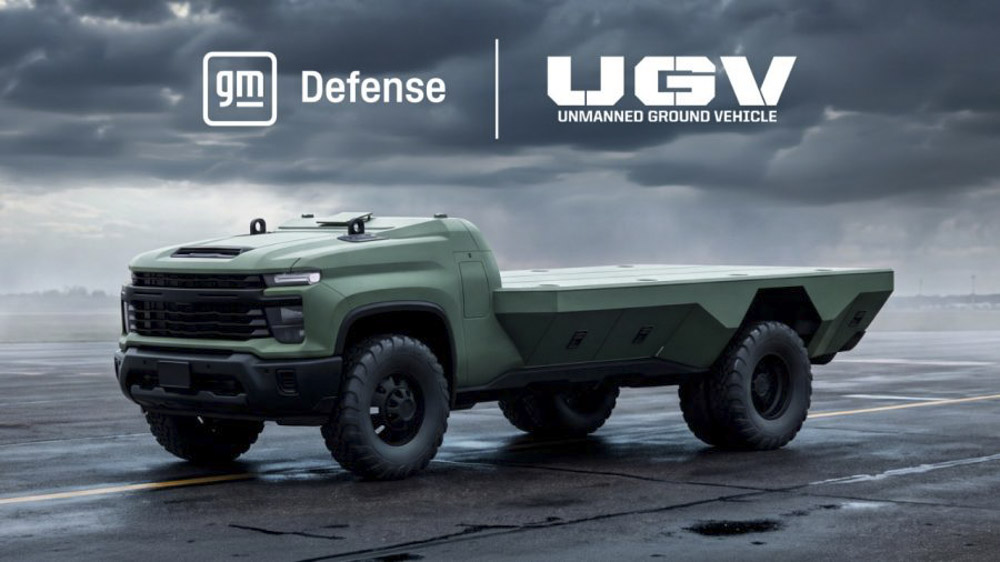
- GM Defense showcases new UGV concept and EPIQ Hybrid prototype.
- UGV functional trials are targeted for 2027.
- ISV-U program expansion now approaches 12,000 vehicles.
GM Defense Showcases Unmanned Ground Vehicle and EPIQ Hybrid Prototype
On October 12, GM Defense LLC, a subsidiary of General Motors, showcased developments in its global business at the Association of the United States Army (AUSA) Annual Meeting and Exposition. The presentation included an Unmanned Ground Vehicle (UGV) concept based on a Chevrolet Silverado 3500HD dual-rear-wheel skateboard architecture, an EPIQ Hybrid expeditionary energy storage prototype, and an update on the Infantry Squad Vehicle Utility program. The UGV concept is intended to support silent logistics and casualty evacuation, with functional trials targeted for 2027. The other demonstrations highlighted expeditionary power capabilities and the company's expanding military vehicle program, reflecting GM Defense's focus on mobility and energy solutions for defense customers.
Chevrolet Silverado-Based UGV Targets Military Logistics and Casualty Evacuation
The GM Defense UGV concept uses a Chevrolet Silverado 3500HD dual-rear-wheel skateboard architecture as its underlying vehicle platform. The concept is designed to support silent logistics and casualty evacuation, two applications relevant to military operations where vehicle movement, equipment transport, and the movement of injured personnel can be important. GM Defense has targeted 2027 for functional trials, meaning the concept's planned testing milestone lies in the future rather than representing a completed trial or confirmed operational deployment. The announcement does not specify the vehicle's payload capacity, autonomous operating capabilities, propulsion specifications, or detailed trial schedule. Those technical and program details remain unconfirmed in the supplied information.
EPIQ Hybrid Prototype Demonstrates Expeditionary Energy Storage
GM Defense also showcased the EPIQ Hybrid prototype, described as a customer-inspired expeditionary energy storage system paired with an onboard generator. The system is rated at 60 kW and 100 kWh and is intended to lower thermal and noise signatures in austere environments. These characteristics are relevant to expeditionary settings where energy availability and the detectability of equipment may influence how power systems are used. The prototype combines energy storage with onboard generation rather than being described as a standalone battery system. The announcement does not provide further details about operating duration, generator specifications, charging methods, or measured reductions in thermal and acoustic signatures, so those performance figures cannot be established from the available information.
Infantry Squad Vehicle Utility Program Expands Significantly
GM Defense reported that the U.S. Army's initial order of 649 Infantry Squad Vehicle Utility (ISV-U) units has been expanded to nearly 12,000 vehicles. The company said it developed the program through self-funding, demonstrating its approach to investing in vehicle development before receiving the subsequent large-scale demand described in the announcement. The ISV-U program is a major element of the company's military mobility activities, with the reported expansion indicating a substantially larger planned vehicle requirement than the initial order. The source does not specify a delivery timetable for the nearly 12,000 vehicles, the detailed procurement schedule, or the precise distribution of units across individual military formations.
Prototype Assessments Helped Shape the Five-Soldier ISV-U Variant
GM Defense stated that it delivered seven early prototypes at no cost to the U.S. Army for unit-level military assessments. Following this stage, the company engineered a versatile five-soldier variant of the Infantry Squad Vehicle Utility. The variant is now expected to serve 39 active-duty and National Guard mobile brigades. The sequence described by GM Defense connects early prototype evaluation with the development of a vehicle configuration intended for a broader set of military users. However, the announcement does not provide detailed assessment results, individual brigade delivery schedules, or the specifications of the five-soldier configuration beyond its stated capacity. The reported expectation identifies the intended scope of service rather than confirming that every brigade has already received vehicles.
GM Defense Highlights Military Mobility and Expeditionary Energy Capabilities
The vehicles and energy systems presented at the AUSA Annual Meeting and Exposition address different requirements within the military operating environment. The UGV concept is intended for silent logistics and casualty evacuation, while the EPIQ Hybrid prototype combines energy storage with onboard generation to reduce thermal and noise signatures in austere settings. The ISV-U program update, meanwhile, concerns a vehicle platform expected to serve active-duty and National Guard mobile brigades. Together, these announcements illustrate the range of GM Defense's showcased capabilities, spanning unmanned vehicle concepts, expeditionary energy equipment, and military transport. The source does not establish that the three programs share a common technical architecture or procurement schedule.
Industry Impact & Outlook
GM Defense's announcements highlight opportunities for defense suppliers to adapt established vehicle architectures and develop specialized energy systems for military applications. The planned 2027 UGV functional trials provide a future milestone for assessing the concept's intended logistics and casualty evacuation roles, while the EPIQ Hybrid prototype demonstrates a separate approach to expeditionary energy requirements. The reported expansion of the ISV-U program to nearly 12,000 vehicles also signals a substantial scale of expected demand for military mobility equipment. For suppliers and military users, the next relevant developments will include further testing, program execution, and clarification of delivery schedules and system performance. The supplied announcement does not confirm trial outcomes or completion of the projected vehicle expansion.
Frequently Asked Questions
What did GM Defense showcase at the AUSA Annual Meeting and Exposition?
GM Defense showcased an unmanned ground vehicle concept, the EPIQ Hybrid expeditionary energy storage prototype, and an update on its Infantry Squad Vehicle Utility program. The UGV concept uses a Chevrolet Silverado 3500HD dual-rear-wheel skateboard architecture and is intended for silent logistics and casualty evacuation. The EPIQ Hybrid combines energy storage with an onboard generator, while the ISV-U update covered expansion from an initial order of 649 units to nearly 12,000 vehicles. These announcements were presented on October 12 at the AUSA Annual Meeting and Exposition.
What is the GM Defense UGV concept designed to do?
The GM Defense Unmanned Ground Vehicle concept is designed to support silent logistics and casualty evacuation using a Chevrolet Silverado 3500HD dual-rear-wheel skateboard architecture. The company has targeted 2027 for functional trials, which remain a future milestone rather than a completed testing result. The announcement does not specify the concept's payload capacity, autonomous functions, propulsion system, or exact trial dates. Its stated applications indicate a focus on military support tasks, but additional technical details and trial results would be needed to establish its operational capabilities.
What are the specifications of the EPIQ Hybrid prototype?
The EPIQ Hybrid prototype is a customer-inspired expeditionary energy storage system rated at 60 kW and 100 kWh and paired with an onboard generator. GM Defense presented it as a solution intended to lower thermal and noise signatures in austere environments. The combination of stored energy and onboard generation is central to the system's stated configuration. However, the announcement does not provide measured reductions in noise or thermal signatures, operating duration, generator output specifications, or detailed deployment requirements. Those performance characteristics therefore remain unconfirmed in the supplied information.
How has the U.S. Army's ISV-U vehicle program expanded?
GM Defense reported that the U.S. Army's initial order of 649 Infantry Squad Vehicle Utility units has expanded to nearly 12,000 vehicles. The company said it developed the program through self-funding, then delivered seven early prototypes at no cost for unit-level military assessments. It subsequently engineered a versatile five-soldier variant expected to serve 39 active-duty and National Guard mobile brigades. The announcement does not provide a complete procurement timeline, delivery schedule, or confirmation that the full projected vehicle quantity has already been delivered.
How many soldiers can the ISV-U variant accommodate?
The ISV-U variant developed by GM Defense is configured to accommodate five soldiers, according to the company's announcement. The variant followed the delivery of seven early prototypes to the U.S. Army for unit-level military assessments at no cost to the Army. GM Defense stated that the five-soldier configuration is expected to serve 39 active-duty and National Guard mobile brigades. The available information does not detail the vehicle's full dimensions, payload capacity, equipment configuration, or brigade-by-brigade delivery schedule, so those specifications cannot be confirmed from the announcement.
When are functional trials planned for the GM Defense UGV?
GM Defense has targeted 2027 for functional trials of its unmanned ground vehicle concept, which is based on a Chevrolet Silverado 3500HD dual-rear-wheel skateboard architecture. The concept is intended to support silent logistics and casualty evacuation. The stated year identifies the company's target for planned testing, not evidence that trials have begun or that the vehicle has completed operational evaluation. The announcement does not provide specific trial dates, locations, evaluation criteria, or expected completion milestones. Further program information would be needed to establish how the testing will proceed.
Click above to visit the official source.
Discussion
Join the conversation.