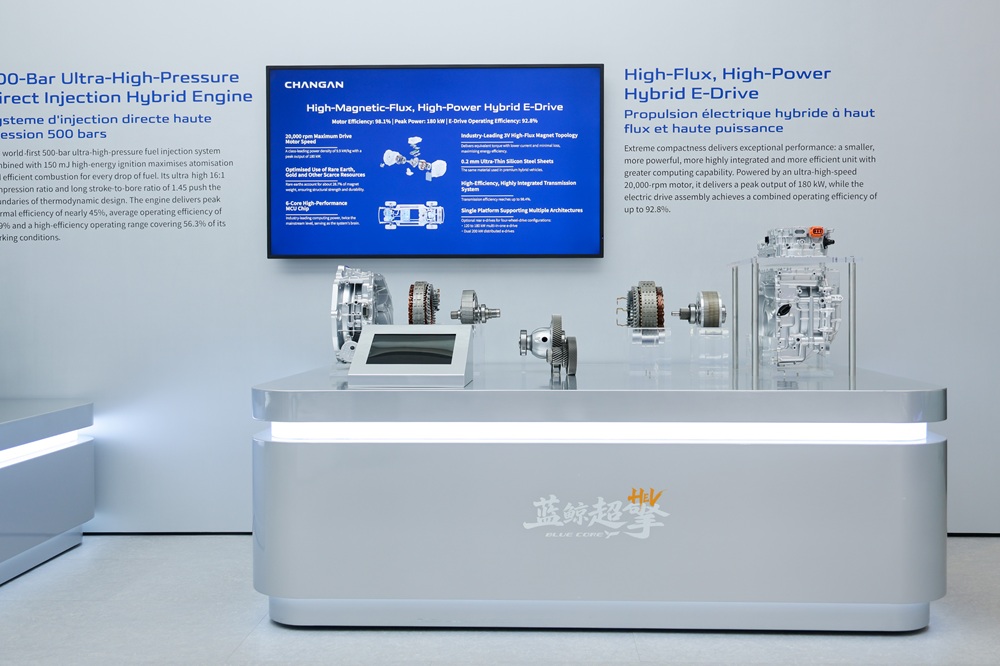
- Changan Automobile showcased hybrid and safety technologies in Paris.
- CS55 BlueCore HEV made its first appearance outside China.
- SDA Pilot trained on over 20 million driving clips.
Changan Showcases Hybrid, Battery Safety, and Driving Technologies at Paris Motor Show
On October 13, Changan Automobile presented developments in powertrain technology, battery safety, and intelligent driving assistance at the Paris Motor Show. The company said its approach focuses on combining efficient power, intuitive technology, and safety to address the everyday mobility needs of European customers. Its presentation featured three key areas: the CS55 BlueCore HEV hybrid system, Golden Shield Battery technology, and the SDA Pilot intelligent driving assistance system. Together, these developments highlight Changan's efforts to integrate electrified propulsion, battery monitoring, and advanced driving technology into its vehicle portfolio. The company also indicated that SDA Pilot will need adaptation and validation for European road conditions.
CS55 BlueCore HEV Makes Its First Appearance Outside China
Changan presented the CS55 BlueCore HEV at the Paris Motor Show, marking the hybrid model's first appearance outside China. Its next-generation hybrid electric vehicle architecture integrates the engine, electric drive, battery, and intelligent controls into a coordinated powertrain system. The setup includes adaptive energy management and cloud-based route planning to help manage propulsion according to driving conditions. In urban traffic, the system prioritizes electric drive to deliver responsive, smooth, and quiet performance. At higher speeds, efficient direct drive from the engine reduces energy conversion losses, while the electric motor provides additional adjustments. This operating strategy is designed to balance urban driving characteristics with efficiency during faster journeys.
Golden Shield Battery Technology Focuses on Safety and Efficiency
Changan's Golden Shield Battery technology is being developed around four priorities: long service life, safety, high efficiency, and fast charging. Its iBC digital battery management system provides continuous, round-the-clock safety monitoring. The technology also combines battery cells from CATL with ongoing safety validation and continuous monitoring to support protection during everyday use. These elements bring together battery hardware, digital management, and validation processes within Changan's stated approach to battery safety. The announcement does not specify charging times, battery capacity, cell chemistry, or quantified durability results. Consequently, the presentation establishes the technology's development priorities and monitoring approach without providing enough information to compare its measured performance with competing battery systems.
SDA Pilot Uses AI-Based Driving Architecture and Extensive Training Data
Changan's SDA Pilot intelligent driving assistance system uses an end-to-end architecture integrating a vision-language-action model with a world model. According to the company, the system was trained on more than 20 million clips of high-quality human driving data to strengthen its understanding of complex traffic situations and improve decision-making capabilities. SDA Pilot also incorporates dual redundancy engineered to Level 3 requirements. These elements describe the system's architecture, training foundation, and redundancy design, but the announcement does not establish that the technology has received Level 3 regulatory approval or is commercially available for unrestricted use. Changan said it looks forward to adapting and validating the technology for European road conditions.
European Adaptation and Validation Remain Important Next Steps
Changan's presentation addressed European customers, but the company identified further adaptation and validation as necessary for SDA Pilot under European road conditions. This distinction matters because driving assistance technologies must be assessed against the road environments and operating conditions in which they are intended to function. The announcement did not provide a European deployment date, specify launch markets, or identify completed regional validation results. Similarly, the CS55 BlueCore HEV's first appearance outside China does not, by itself, confirm a European sales launch. The presentation therefore demonstrates Changan's intention to introduce its technologies to a wider audience while leaving important commercialization and validation details unconfirmed.
Industry Impact & Outlook
Changan's Paris Motor Show presentation illustrates how automakers are combining hybrid powertrain efficiency, battery safety management, and increasingly sophisticated driving assistance to address diverse customer needs. For the European market, the CS55 BlueCore HEV's international debut provides visibility for Changan's hybrid technology, while Golden Shield Battery emphasizes monitoring and safety as part of electrified vehicle development. SDA Pilot's planned adaptation and validation also highlights the work required before advanced driving systems can be tailored to regional road conditions. The practical significance will depend on subsequent validation results, vehicle availability, and further technical disclosures, none of which were specified in the announcement. These developments establish areas of technological focus rather than confirmed commercial outcomes.
Frequently Asked Questions
What technologies did Changan Automobile present at the Paris Motor Show?
Changan Automobile presented developments in hybrid powertrains, battery safety, and intelligent driving assistance at the Paris Motor Show on October 13. Its showcase featured the CS55 BlueCore HEV, Golden Shield Battery technology, and the SDA Pilot driving assistance system. The company said these technologies aim to combine efficient power, intuitive technology, and safety for everyday journeys. It also highlighted plans to adapt and validate SDA Pilot for European road conditions. The announcement did not confirm specific European launch dates or commercial availability for the technologies presented.
What is the CS55 BlueCore HEV?
The CS55 BlueCore HEV is a hybrid electric vehicle presented by Changan Automobile at the Paris Motor Show, marking its first appearance outside China. Its next-generation architecture integrates an engine, electric drive, battery, and intelligent controls. The system uses adaptive energy management and cloud-based route planning to adjust its operation to driving conditions. In urban traffic, it prioritizes electric drive for smooth and quiet performance, while engine direct drive at higher speeds reduces energy conversion losses. The electric motor provides additional adjustments as part of the hybrid system's operating strategy.
How does the CS55 BlueCore HEV manage energy?
The CS55 BlueCore HEV uses adaptive energy management and cloud-based route planning to coordinate its engine and electric drive according to driving conditions. In urban traffic, the system prioritizes electric propulsion to support responsive, smooth, and quiet operation. At higher speeds, efficient direct drive from the engine helps reduce energy conversion losses, while the electric motor makes additional adjustments. This strategy is intended to balance driving refinement and energy efficiency across different conditions. Changan's announcement does not provide fuel-consumption figures, battery capacity, or quantified efficiency improvements for the hybrid system.
What is Changan's Golden Shield Battery technology?
Golden Shield Battery is Changan's battery technology initiative centered on long service life, safety, high efficiency, and fast charging. It incorporates an iBC digital battery management system that provides round-the-clock safety monitoring. The technology also combines CATL battery cells with ongoing safety validation and continuous monitoring to support protection during everyday use. These elements represent the company's stated approach to battery management and safety. However, the announcement does not provide specific battery capacities, charging durations, cell chemistry, durability measurements, or comparative test results that would establish its performance against other battery technologies.
What is the SDA Pilot intelligent driving assistance system?
SDA Pilot is Changan's intelligent driving assistance system, built around an end-to-end architecture that integrates a vision-language-action model with a world model. The company says its training uses more than 20 million clips of high-quality human driving data to strengthen understanding of complex traffic situations and decision-making capabilities. The system also incorporates dual redundancy engineered to Level 3 requirements. These descriptions concern its architecture, training, and redundancy design. The announcement does not establish regulatory approval, unrestricted autonomous driving capability, or commercial deployment, and Changan has identified European adaptation and validation as future work.
What does Level 3 engineering mean for SDA Pilot?
Changan states that SDA Pilot incorporates dual redundancy engineered to Level 3 requirements as part of its intelligent driving assistance architecture. Dual redundancy indicates that the design incorporates redundant elements, although the announcement does not explain their precise configuration or operation. The reference to Level 3 requirements should not be interpreted as confirmation that the system has received regulatory approval or is authorized for Level 3 operation on public roads. Changan has said it intends to adapt and validate SDA Pilot for European road conditions. Further technical and regulatory information would be needed to establish its eventual operating scope.
Will Changan introduce SDA Pilot in Europe?
Changan has indicated that it looks forward to adapting and validating SDA Pilot for European road conditions, but it has not announced a confirmed European deployment date in the supplied information. The system uses an end-to-end architecture combining a vision-language-action model and a world model, with training based on more than 20 million clips of human driving data. Regional adaptation and validation remain important next steps before any specific European application can be confirmed. The announcement does not identify launch countries, commercial availability, or completed validation results, so a market introduction timeline remains unconfirmed.
Click above to visit the official source.
Discussion
Join the conversation.