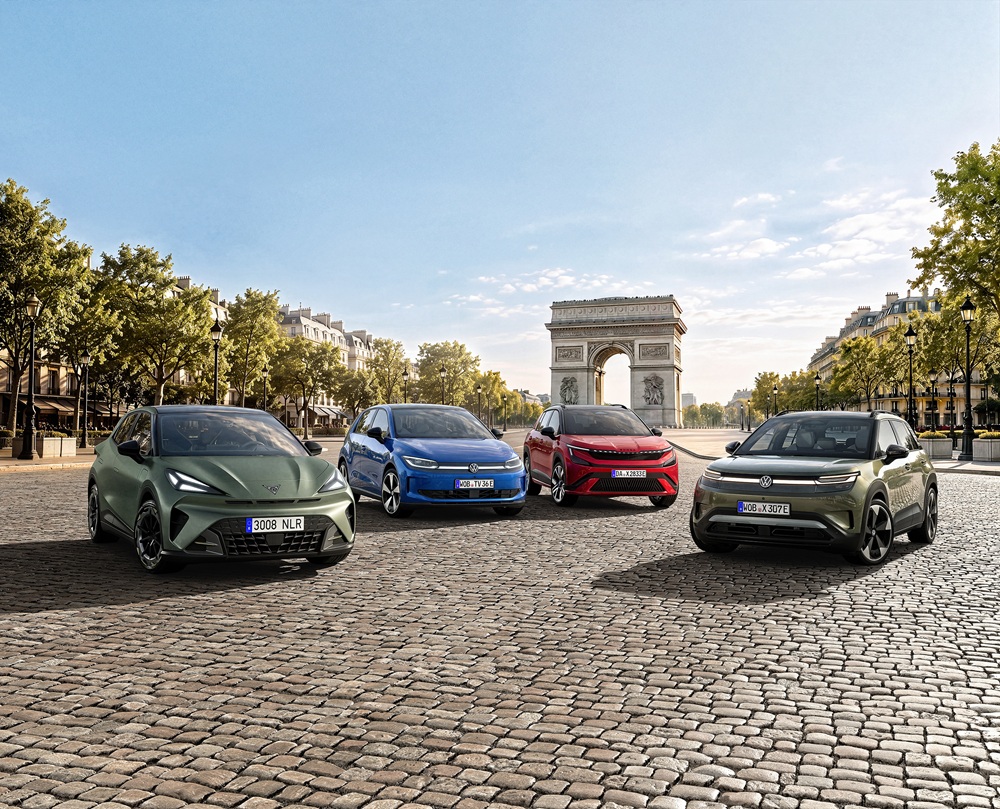
- VW Group Electric Urban Car Family shares over 80% of components.
- Four models will be produced in Martorell and Pamplona, Spain.
- Shared development could save VW Group EUR 600 million.
VW Group Unveils Four Shared Electric Urban Cars Ahead of Paris Motor Show
On October 11, Volkswagen Group presented its Electric Urban Car Family ahead of the 2026 Paris Motor Show, demonstrating how European manufacturing and shared technologies can support the development of competitive, affordable electric vehicles. The lineup brings together four models for the first time: the Volkswagen Group ID. Polo and ID. Cross, the Skoda Epiq, and the CUPRA Raval. More than 80% of their components and technologies are shared across the vehicles, while production is planned at facilities in Martorell and Pamplona, Spain. The strategy is designed to reduce development and manufacturing costs while preserving the individual design identities of the participating brands.
Four Electric Models Share More Than 80% of Components and Technologies
The Electric Urban Car Family demonstrates Volkswagen Group's approach to combining technical commonality with distinct brand identities. The ID. Polo and ID. Cross represent Volkswagen's contribution, while Skoda brings the Epiq and CUPRA contributes the Raval. Although the four vehicles share more than 80% of their components and technologies, each retains its own exterior design and interior finish. This arrangement allows the Group to pursue economies of scale without making the vehicles visually or experientially identical. The common technical foundation is intended to support more affordable electric cars while enabling the brands to address different customer preferences and maintain their respective market positions.
Spanish Production Supports the Shared EV Development Strategy
Production of the four electric urban models takes place in Martorell and Pamplona, Spain, according to the Group's announcement. Locating production within its European manufacturing network supports the broader strategy of combining shared vehicle technologies with regional production capabilities. The approach is intended to reduce costs by limiting duplicated development work and making greater use of common components across multiple models. At the same time, the Group aims to preserve the individual positioning of Volkswagen, Skoda, and CUPRA through differentiated styling and interior treatments. The company also called for European regulations that support electric vehicle growth, local manufacturing, and fair competition, connecting its product strategy with its wider industrial priorities.
AI-Powered Design Tools Aim to Reduce Development Time and Costs
Volkswagen Group Design is adopting shared processes and artificial intelligence-powered tools to accelerate vehicle development. These tools can transform sketches into realistic images and videos, helping designers visualize colors and materials across different settings. According to the Group, this approach can reduce design time and costs by up to one-third. The tools are intended to make design workflows more efficient while helping teams evaluate visual concepts earlier in the development process. Combined with the use of shared technologies across the four vehicles, these methods support the Group's effort to shorten development cycles without eliminating the distinct styling and interior characteristics that differentiate each brand's models.
Shared Components Target EUR 600 Million in Development Savings
Volkswagen Group expects to save EUR 600 million across development by sharing components that are not specific to individual brands. The strategy focuses on reducing duplicated engineering work and reusing common technologies where doing so makes technical and commercial sense. Rather than applying an identical design to all four vehicles, the Group separates shared underlying components from brand-specific elements that influence each model's identity. This balance is intended to improve development efficiency while retaining meaningful differences among the Volkswagen ID. Polo, ID. Cross, Skoda Epiq, and CUPRA Raval. The stated savings target reflects the expected financial benefit of common development, although the announcement does not provide a detailed breakdown of the projected savings by model or development activity.
Organizational Changes Focus Investment on Higher-Value Technologies
Beyond vehicle engineering, Volkswagen Group is simplifying its products, processes, and organizational structure to accelerate decisions and concentrate investment on technologies and businesses that offer greater value. The company plans to expand the use of shared platforms and vehicle components while increasing the application of artificial intelligence in hardware and software development. These measures are intended to reduce repeated work, shorten development times, and bring new technologies to customers more quickly. The strategy also seeks to preserve the character and market position of each brand, making shared engineering an efficiency measure rather than a move toward uniform products. The Group's broader objective is to coordinate development more effectively across its operations while supporting its European electric vehicle ambitions.
European Regulations and Local Production Remain Strategic Priorities
Volkswagen Group has called for European regulations that encourage electric vehicle growth, local production, and fair competition. The position aligns with its plans to manufacture the four electric urban models in Spain and use common technologies to improve development efficiency. The Group's approach combines product engineering, manufacturing, organizational simplification, and AI-assisted design within a single strategy. However, the announcement does not specify proposed regulatory changes or identify particular laws that should be revised. Its stated priorities are broader: establish conditions that support electric vehicle adoption and European manufacturing while allowing automakers to compete effectively. The planned expansion of shared platforms, components, and development tools is intended to reinforce these objectives as new technologies reach customers.
Industry Impact & Outlook
Volkswagen Group's shared electric urban car strategy illustrates how automakers can seek lower development costs without removing brand differentiation. Sharing more than 80% of components and technologies across four models, alongside a projected EUR 600 million in development savings, could strengthen the Group's ability to compete in the affordable electric vehicle segment. Spanish production also reinforces the importance of European manufacturing within its plans, while AI-assisted design offers a potential route to shorter development cycles. The commercial significance will depend on how effectively the Group delivers the expected efficiencies and translates them into competitive vehicles. Its calls for supportive European regulations further indicate that manufacturing conditions, market competition, and the pace of EV adoption will remain important factors shaping the strategy's results.
Frequently Asked Questions
Which vehicles are included in Volkswagen Group's Electric Urban Car Family?
Volkswagen Group's Electric Urban Car Family consists of four models: the Volkswagen ID. Polo, ID. Cross, Skoda Epiq, and CUPRA Raval. The Group presented all four together on October 11, ahead of the 2026 Paris Motor Show. The vehicles share more than 80% of their components and technologies, but each retains its own design and interior finish. This combination is intended to reduce development costs while allowing Volkswagen, Skoda, and CUPRA to maintain their individual brand identities and market positions.
How much technology do the four electric urban cars share?
The four electric urban cars share more than 80% of their components and technologies, according to Volkswagen Group. This common technical foundation is intended to reduce duplicated engineering work and improve development efficiency across the lineup. Despite the high level of component sharing, the Volkswagen ID. Polo, ID. Cross, Skoda Epiq, and CUPRA Raval retain distinct exterior designs and interior finishes. The announcement does not provide a component-by-component breakdown, but it identifies shared technologies as a central part of the Group's strategy for developing competitive and affordable electric vehicles.
Where will Volkswagen Group produce the four electric urban models?
Volkswagen Group identified Martorell and Pamplona in Spain as the production locations for its four electric urban models. The manufacturing approach forms part of a wider strategy that combines shared technologies with European production capabilities. By using common components across the lineup, the Group aims to reduce duplicated development work and associated costs while retaining distinct vehicle identities. The announcement does not specify the production allocation for each individual model, manufacturing volumes, or production start dates, so those details cannot be established from the information provided.
How much does Volkswagen Group expect to save through shared development?
Volkswagen Group expects to save EUR 600 million across development by sharing components that do not need to be specific to individual brands. The company also says its AI-powered design approach can reduce design time and costs by up to one-third. These figures describe two aspects of the Group's efficiency strategy: common components reduce duplicated engineering, while AI-assisted tools help designers create and evaluate visual concepts more efficiently. The announcement does not provide a detailed financial breakdown explaining how the EUR 600 million target is distributed across models or development activities.
How will artificial intelligence support Volkswagen Group's vehicle development?
Volkswagen Group Design is using AI-powered tools to accelerate design workflows and help teams visualize vehicle concepts more efficiently. The tools can transform sketches into realistic images and videos and allow designers to examine colors and materials in different settings. According to the Group, this approach can reduce design time and costs by up to one-third. The company intends to expand AI use across hardware and software development as part of its broader efficiency strategy. The announcement does not identify specific AI systems or quantify their individual contributions to the projected savings.
Why is Volkswagen Group calling for supportive European electric vehicle regulations?
Volkswagen Group is calling for European regulations that support electric vehicle growth, local production, and fair competition. These priorities align with its plans to manufacture the four electric urban models in Spain and improve development efficiency through shared technologies. The company also intends to simplify its processes and focus investments on technologies and businesses that offer greater value. Although the announcement identifies the regulatory principles it supports, it does not specify particular legislative changes or regulations. Its stated position emphasizes the importance of conditions that allow electric vehicle adoption and European manufacturing to develop while preserving competitive market conditions.
Click above to visit the official source.
Discussion
Join the conversation.