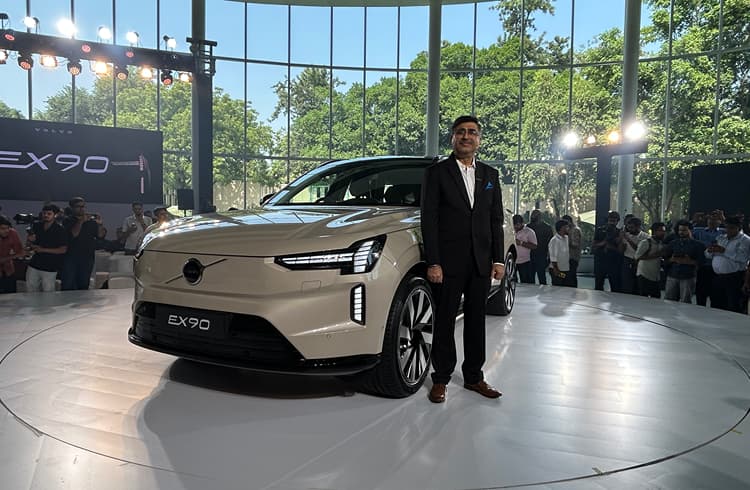
- Volvo EX90 India launch brings 625km claimed range.
- The 106kWh battery supports charging speeds up to 350kW.
- Bookings before December 31, 2026, include a 65% buyback guarantee.
Volvo EX90 Debuts in India's Luxury Electric SUV Segment
Volvo India has launched the Volvo EX90 India launch offering at an ex-showroom price of ₹1.26 crore, establishing the all-electric SUV as the brand's flagship model in the country. The six-seat vehicle marks Volvo's first entry into India's three-row luxury electric SUV segment and replaces the petrol-powered XC90 at the top of the company's local lineup. Its introductory price is ₹27.2 lakh higher than that of the model it effectively supersedes. The launch reflects a shift in the manufacturer's product strategy toward fully electric luxury vehicles, targeting buyers who want substantial cabin space, premium equipment, and long-distance capability without a conventional combustion engine.
The new electric SUV enters a relatively small but increasingly competitive market for premium, three-row electric vehicles. Its principal rivals include the Kia EV9, priced at ₹1.30 crore, and the Mercedes-Benz EQS SUV 580, priced at ₹1.49 crore, with all prices stated on an ex-showroom basis. At ₹4 lakh below the Kia and ₹23 lakh below the Mercedes-Benz, the EX90 occupies the lowest price position among these three models. This pricing gives Volvo a distinct point of comparison in the segment, although purchase decisions will also depend on driving range, seating comfort, equipment, charging access, and buyers' preferences for each brand.
Battery, Powertrain, and Performance Specifications
The electric SUV uses a 106kWh battery pack connected to a dual-motor all-wheel-drive system that produces 456hp and 670Nm of torque. Volvo claims acceleration from 0 to 100kph in 5.5 seconds and an electronically limited top speed of 180kph. These figures place its performance broadly in line with petrol-powered performance SUVs in the same price bracket. The combination of two electric motors and all-wheel drive provides power to both axles, while the large battery is intended to support the vehicle's substantial size and long-distance touring role. Together, these specifications position the SUV as a premium family vehicle with a strong emphasis on performance and everyday usability.
Volvo quotes a WLTP-certified driving range of 625km on a full charge. In a real-world test conducted, the vehicle returned approximately 5.5km/kWh, translating into an estimated range of around 580km. That estimate is based on the reported test efficiency and battery capacity, rather than a guarantee of the distance every owner will achieve. Actual consumption and range can vary with driving speed, traffic, terrain, temperature, passenger and luggage loads, and climate-control use. If the reported efficiency proves repeatable in everyday driving, it could make intercity journeys more practical by reducing the frequency of charging stops compared with vehicles that deliver substantially shorter distances between charges.
800V Architecture and Charging Capabilities
The vehicle is built on Volvo's 800V SPA2 platform, an electrical architecture designed to support higher charging speeds than many electric vehicles using 400V systems. It supports DC fast charging at up to 350kW, with Volvo claiming that charging from 10% to 80% takes approximately 22 minutes under suitable conditions. The actual charging duration will depend on factors such as charger output, battery temperature, the vehicle's state of charge, and the charging curve. Consequently, the maximum supported power should not be interpreted as a constant charging rate throughout the session. The architecture and stated charging performance nevertheless provide an important technical advantage for buyers considering frequent long-distance travel.
For home charging, the package includes an 11kW AC wallbox under the introductory offer, and Volvo quotes approximately 11 hours for a full charge using this equipment. This overnight charging option is broadly typical for a large-battery electric SUV and may suit owners who have suitable parking and electrical infrastructure at home. DC fast charging serves a different purpose, allowing drivers to replenish the battery during longer journeys when compatible high-power stations are available. The distinction matters because access to a 350kW-capable public charger is not guaranteed on every route. Buyers should therefore consider their regular driving distances, home-charging arrangements, and the availability of suitable public infrastructure.
Exterior Design and Dimensions
The exterior follows Volvo's restrained design language, emphasizing clean surfaces rather than extensive decorative detailing. At the front, T-shaped LED headlamps incorporate a pixel-style daytime running light pattern, while slim, vertically oriented fog lamps sit alongside them. The conventional grille is replaced by a closed front panel carrying the Volvo emblem, with a trapezoidal lower air intake providing the main opening in the fascia. These elements give the electric SUV a recognizable appearance without relying on the traditional grille treatment associated with combustion-powered vehicles. The overall design prioritizes visual simplicity, consistent with the manufacturer's established approach to premium vehicle styling.
Viewed from the side, the SUV has an upright silhouette intended to accommodate a spacious passenger compartment. Its wheelbase measures 2,985mm, and 21-inch alloy wheels are standard equipment. Ground clearance is 210mm under the standard ride-height setting and can increase to 250mm through the standard air suspension system. The suspension can also lower the vehicle at higher speeds to support stability and efficiency. This adjustable setup gives the SUV flexibility across different driving conditions while helping manage its tall body and substantial dimensions. For owners, the combination of ground-clearance adjustment and a long wheelbase is relevant to both everyday maneuverability and comfort during longer journeys.
At the rear, C-shaped LED tail-lamps are connected visually by a horizontal black strip, while additional LED accents flank the rear windshield. The tailgate displays the full Volvo wordmark rather than relying solely on a separate logo badge. Buyers can choose from six exterior colors: Crystal White, Denim Blue, Mulberry Red, Onyx Black, Sand Dune, and Vapour Grey. These choices provide a range of finishes without changing the vehicle's underlying specification. Combined with the minimalist front fascia and upright profile, the rear lighting and full-width visual treatment maintain a consistent design across the SUV, distinguishing it through restrained detailing rather than an aggressively styled exterior.
Interior Design, Displays, and Cabin Technology
The cabin follows a minimalist design philosophy, combining two-tone Nappa leather upholstery, brushed aluminum trim, and a dashboard with very few physical buttons. Most vehicle functions are consolidated into a vertically oriented 14.5-inch touchscreen, which manages systems including climate control, media, and navigation. A separate 9-inch display provides the driver's instrument information. This arrangement creates a screen-focused operating environment, although it also makes the central display an important part of routine interaction with the vehicle. The interior's material selection and digital interfaces support its premium positioning, while the overall layout prioritizes a clean appearance and centralized control of the SUV's principal functions.
The second row uses captain's chairs that can slide and recline, providing individual seating positions for passengers. However, these seats do not offer powered adjustment, ventilation, heating, or massage functions, even though the front seats have those features. Rear window sunshades are also absent. Access to the third row is through the gap between the second-row seats, making the arrangement more suitable for children or adults on shorter journeys than for frequent long-distance travel by full-sized passengers. These limitations are important for families evaluating the six-seat layout, particularly when rear passengers regularly travel long distances or expect comfort equipment comparable to that available in the front compartment.
Cargo Capacity and Practical Storage
The luggage compartment provides 324 liters of capacity when all three seating rows are in use, increasing to 690 liters when the third row is folded flat. A separate 46-liter front storage compartment adds space for items that owners may prefer to keep apart from the main luggage area. This additional compartment is possible because the electric platform does not require a conventional engine in the front. The figures illustrate the trade-off inherent in a three-row SUV: retaining all passenger seats limits rear cargo capacity, while folding the rearmost row provides more room for luggage. Buyers should assess the available space against their usual passenger count and travel requirements.
A panoramic sunroof with switchable transparency is another notable cabin feature. Occupants can change the glass between clear and opaque at the touch of a button, allowing them to adjust the amount of visible light passing through the roof. This function adds flexibility to the passenger environment without requiring a conventional manually operated cover. Alongside the storage arrangements and configurable seating, it contributes to the vehicle's emphasis on passenger comfort and convenience. However, the sunroof's presence does not eliminate the need to evaluate seating space and luggage requirements directly, especially for households that expect to use all three rows regularly during family outings or longer trips.
Standard Equipment and Safety Features
The standard equipment list includes a 25-speaker Bowers & Wilkins audio system, four-zone climate control, and nine airbags. The SUV also comes with a suite of advanced driver assistance systems, wireless Apple CarPlay and Android Auto, a 360-degree camera, and auto park assist. Additional equipment includes a digital key, wireless phone charging, and a cabin air purifier. Together, these features cover entertainment, cabin comfort, smartphone integration, parking assistance, and occupant protection. Their inclusion provides a broad technology package at the stated price, although the precise functions available through individual driver assistance systems should be distinguished from assumptions about autonomous driving capability or the vehicle's performance in every possible road situation.
The combination of multiple airbags, driver assistance technology, and a surround-view camera is relevant to buyers using a large luxury SUV in varied driving environments. The camera and parking assistance functions can help with maneuvering in confined spaces, while the cabin's four-zone climate control allows separate temperature settings for different occupants. Wireless smartphone connectivity reduces dependence on wired connections, and the digital key adds another access option. The audio system and air purifier further expand the convenience offering. For prospective owners comparing premium electric SUVs, this equipment should be considered alongside charging capability, usable passenger space, rear-seat comfort, and luggage capacity rather than treated as a substitute for evaluating the vehicle's overall suitability.
Price, Rivals, and Introductory Ownership Benefits
The vehicle is priced at ₹1.26 crore ex-showroom and is available to book immediately. The launch offer applies to customers who complete their bookings before December 31, 2026. Eligible buyers receive an 11kW home charger, a three-year service package, and an assured buyback guarantee covering 65% of the vehicle's value after three years. These benefits address several elements of the ownership decision, including home-charging equipment, scheduled servicing, and uncertainty about future resale value. The buyback provision is particularly relevant in a market where questions about the long-term residual values of electric vehicles can influence purchasing decisions. Customers should review the applicable terms and conditions before relying on the guarantee.
Luxury Electric SUV Prices in India
The three models highlighted in this comparison occupy different price positions within India's emerging market for large, premium electric SUVs. The EX90 has the lowest stated ex-showroom price of the group, followed by the Kia EV9 and then the Mercedes-Benz EQS SUV 580. The differences are useful starting points for comparing the vehicles, but they do not establish which model offers the best overall value for a particular buyer. Equipment, seating requirements, driving range, charging access, brand preference, and ownership costs also affect the decision. The following comparison preserves the stated prices for all three models.
| Model | Ex-Showroom Price |
|---|---|
| Volvo EX90 | ₹1.26 crore |
| Kia EV9 | ₹1.30 crore |
| Mercedes-Benz EQS SUV 580 | ₹1.49 crore |
Against the Kia EV9, the EX90 carries a ₹4 lakh lower ex-showroom price, while the difference compared with the Mercedes-Benz EQS SUV 580 is ₹23 lakh. These gaps establish its relative entry price among the three named competitors but do not account for differences in equipment, financing, insurance, taxes, or ownership arrangements. The three vehicles also need to be assessed according to individual priorities, including seating comfort, passenger and luggage needs, driving performance, and access to charging facilities. For buyers considering a large electric SUV, comparing the full ownership proposition is more useful than relying on purchase price alone.
Volvo's Expanding Electric Vehicle Strategy in India
The introduction of the EX90 marks a significant development in Volvo India's product lineup because the company is replacing its previous flagship position with a fully electric model. Rather than simply adding another electric vehicle alongside the XC90, the launch changes the powertrain associated with the top of the local range. The move also places Volvo directly within a segment where the Kia EV9 and Mercedes-Benz EQS SUV 580 are established alternatives. The resulting competition is based not only on brand credentials but also on battery capacity, charging performance, cabin configuration, equipment, and pricing. The EX90's stated range and fast-charging capability are central to that comparison.
India's three-row luxury electric SUV market remains limited in volume, but the segment has attracted growing interest from buyers seeking substantial passenger space and long driving range. The new model combines a large battery, a six-seat configuration, and a broad standard-equipment package, while its introductory ownership benefits address charging setup, servicing, and residual-value concerns. These provisions may help some prospective customers evaluate the transition to a fully electric flagship. Nevertheless, real-world range, access to high-power public charging, rear-seat comfort, and the practical use of all three rows remain important considerations. The vehicle's appeal will ultimately depend on how these characteristics match the requirements of individual households.
Industry Impact & Outlook
The EX90's arrival strengthens competition in India's premium electric SUV segment by giving buyers another three-row option with a large battery, high-power DC charging, and an introductory buyback guarantee. Its lower stated price relative to the Kia EV9 and Mercedes-Benz EQS SUV 580 creates a clear comparison point, while the replacement of Volvo's petrol-powered flagship signals a change in the brand's local product strategy. For manufacturers, the launch underscores the importance of combining vehicle technology with practical ownership support when targeting buyers who remain attentive to resale values and charging access. The next meaningful indicators will be customer uptake, the usability of charging infrastructure on actual travel routes, and how the vehicle's claimed efficiency translates into everyday ownership.
Frequently Asked Questions
What is the ex-showroom price of the Volvo EX90 in India?
The Volvo EX90 is priced at ₹1.26 crore ex-showroom in India, positioning it below the Kia EV9 and Mercedes-Benz EQS SUV 580. The stated price makes it the lowest-priced model among these three premium electric SUVs. Its introductory package also includes an 11kW home charger, a three-year service package, and an assured buyback guarantee for qualifying bookings completed before December 31, 2026. Buyers should confirm the applicable offer conditions and account for additional purchase costs when calculating the total amount required to own the vehicle.
What are the battery capacity, claimed range, and charging time?
The electric SUV uses a 106kWh battery and has a claimed WLTP driving range of 625km, with DC fast charging supported at up to 350kW. Volvo states that charging from 10% to 80% takes approximately 22 minutes under suitable conditions. An 11kW AC wallbox can fully charge the battery in approximately 11 hours, according to the company. A real-world test returned around 5.5km/kWh and an estimated range of approximately 580km, although actual results can vary with driving conditions and energy consumption.
How does the EX90 compare with the Kia EV9 and Mercedes-Benz EQS SUV 580?
The EX90 is priced at ₹1.26 crore, compared with ₹1.30 crore for the Kia EV9 and ₹1.49 crore for the Mercedes-Benz EQS SUV 580. These differences make the Volvo the least expensive of the three based on their stated ex-showroom prices. The vehicles should also be compared on passenger comfort, equipment, charging capabilities, range, and luggage capacity. The EX90 offers six seats, a 106kWh battery, and claimed DC charging capability of up to 350kW. The most suitable choice depends on individual requirements and the complete ownership proposition.
Click above to visit the official source.
Discussion
Join the conversation.