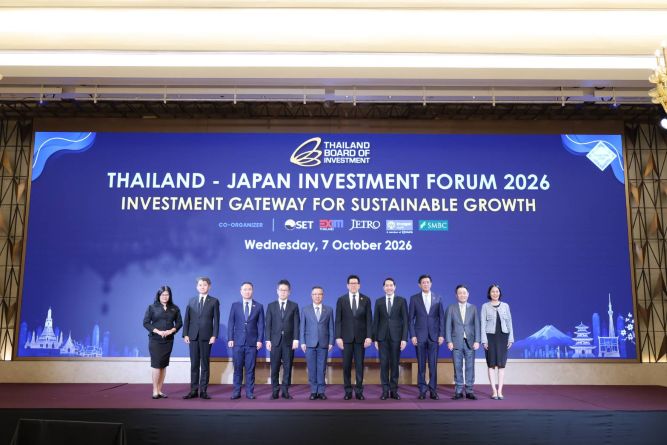
- Thailand Japan investment 2026 applications exceed $11.72 billion.
- Japanese companies submitted applications for 1,380 projects.
- Future automotive remains among Thailand's seven priority sectors.
Japanese Investment Applications in Thailand Exceed $11.7 Billion
Thailand Japan investment 2026 has reached more than USD 11.72 billion, with Japanese companies submitting applications covering 1,380 projects from 2021 through the middle of 2026, according to Thailand's Board of Investment (BOI). The applications represent a broad investment base across sectors identified as important to Thailand's future economic development. The BOI is focusing on high-growth industries including semiconductors, advanced electronics, robotics and clean energy, while future automotive is also included among Thailand's seven priority sectors. The investment activity highlights the continued role of Japan in Thailand's industrial and technology development.
Thailand and Japan Expand Investment Cooperation
At the Thailand-Japan Investment Forum 2026 in Bangkok, Thailand's Deputy Prime Minister and Finance Minister said the two countries would expand investment cooperation in response to technological advances, the energy transition and other global changes. The forum provides a platform for discussing how investment ties can adapt as industries undergo technological and energy-related transformation. The focus on emerging sectors alongside established industrial activities indicates that cooperation between Thailand and Japan is being positioned around both current manufacturing capabilities and future-oriented areas of economic development.
Japanese Automakers Pursue Multiple Powertrain Paths
Japanese automakers operating in Thailand are pursuing a multi-pathway strategy that includes hybrid vehicles, internal-combustion vehicles and battery electric vehicles for regional exports, according to the JETRO Bangkok President. This approach reflects the coexistence of different powertrain technologies within the regional automotive market and the need for manufacturers to serve multiple vehicle and export requirements. Thailand remains an important production base for Japanese automakers, while the combination of hybrid, internal-combustion and battery electric technologies provides manufacturers with several pathways as the automotive sector responds to technological changes and the broader energy transition.
BOI to IPO Program Supports Capital Access
The BOI has also partnered with the Stock Exchange of Thailand on a program called “BOI to IPO,” which is designed to facilitate capital-market access for Japanese joint ventures and domestic suppliers. The initiative adds a financing dimension to Thailand's broader investment strategy by connecting eligible businesses with potential capital-market opportunities. For Japanese joint ventures and local suppliers, improved access to capital markets could support future business development and investment activities. The program also complements Thailand's effort to strengthen investment cooperation with Japan while supporting companies participating in the country's evolving industrial ecosystem.
Priority Sectors Extend Beyond Automotive
Thailand's investment focus extends beyond automotive activity to several technology-intensive and energy-related sectors. The BOI is emphasizing semiconductors, advanced electronics, robotics and clean energy as high-growth areas, while future automotive remains one of the country's seven priority sectors. This combination places traditional industrial cooperation alongside newer areas of strategic investment. Japanese companies with activities across manufacturing and technology can therefore participate in multiple areas of Thailand's development agenda. The scale of applications recorded through mid-2026 also demonstrates the breadth of Japanese business engagement across the country's priority investment landscape.
Industry Impact & Outlook
The investment activity strengthens the role of Thailand as a regional manufacturing and technology base while giving Japanese companies opportunities across automotive, electronics, robotics, semiconductor and clean-energy sectors. The automotive strategy is particularly significant because manufacturers are maintaining multiple powertrain options rather than relying on a single technology pathway. Continued cooperation through the investment forum and the BOI to IPO program could further connect Japanese investors, joint ventures and domestic suppliers with Thailand's evolving industrial priorities. The practical impact will depend on how announced applications progress into actual projects and how companies adapt their investments to technological and energy-transition requirements.
Frequently Asked Questions
How much investment have Japanese companies applied for in Thailand?
Japanese companies submitted investment applications worth more than USD 11.72 billion for 1,380 projects recorded from 2021 through mid-2026, according to the BOI. The applications span multiple sectors, with Thailand emphasizing semiconductors, advanced electronics, robotics and clean energy as high-growth areas. Future automotive is also one of the country's seven priority sectors. The investment activity demonstrates the scale of Japanese business participation in Thailand and includes projects connected with manufacturing, technology and the country's broader industrial and energy-transition priorities.
Click above to visit the official source.
Discussion
Join the conversation.