- Honda wireless road charging testing starts from FY2027.
- System targets power transfer levels up to 150 kW.
- Road tests will evaluate durability, safety, and performance.
Honda and Partners Develop Wireless Charging Road Technology
Honda R&D Co., Ltd., the research and development subsidiary of Honda Motor, has jointly developed underlying technology for a magnetic coupling wireless power transfer road system with Taisei Corporation and Taisei Rotec Corporation. The Honda wireless road charging system is designed to enable electric vehicles to receive power wirelessly while traveling on roads. The three companies have been researching the system since 2025 and plan to begin demonstration testing from Japanese fiscal year 2027, which starts April 1, 2027. The development targets practical use of dynamic wireless power transfer technology, particularly in logistics and transportation applications where continuous charging during vehicle operation could provide significant benefits.
Three Companies Combine Specialized Technologies
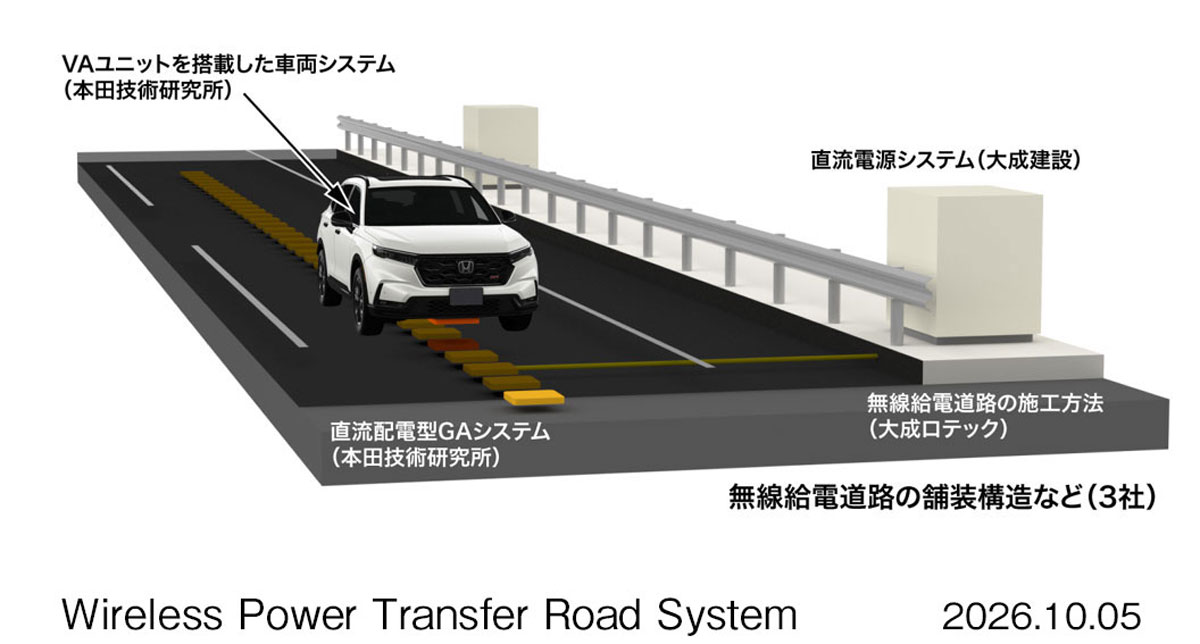
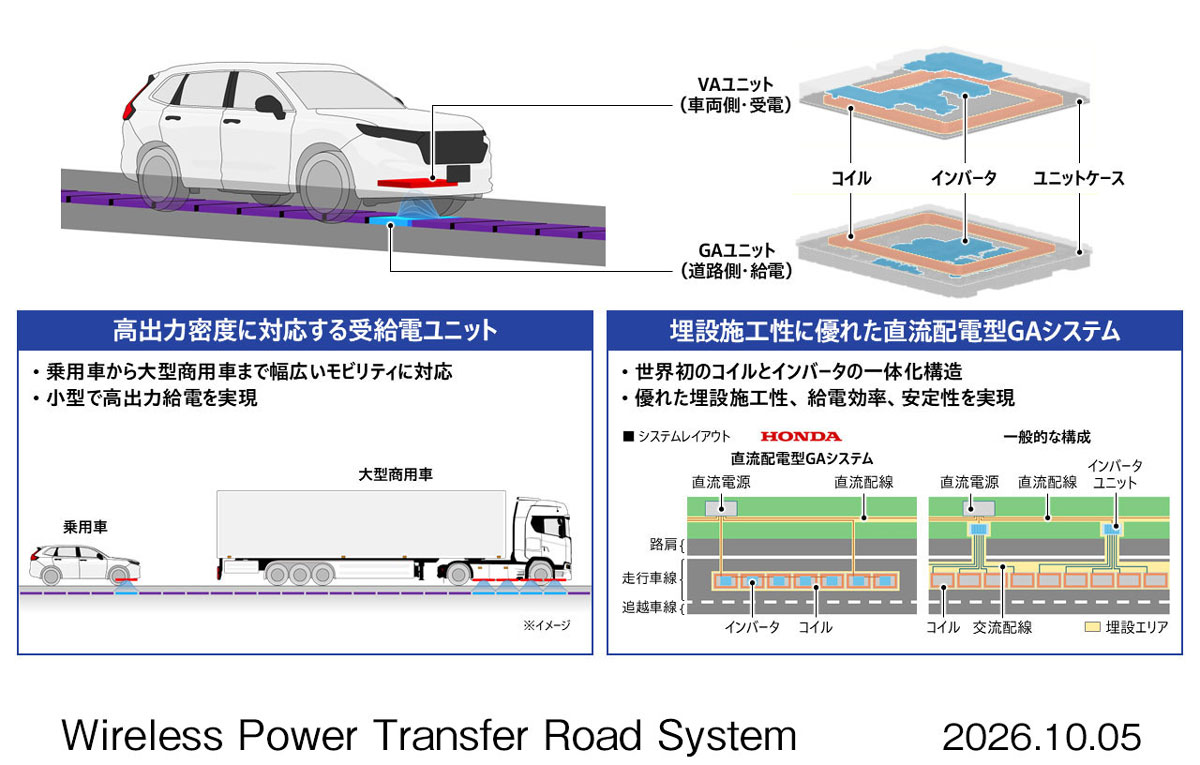
The jointly developed system combines technologies contributed by Honda R&D Co., Ltd., Taisei Corporation, and Taisei Rotec Corporation. Honda is providing high-power-density power receiver and transmitter units compatible with DC power distribution, while Taisei is contributing a high-response DC power supply system. Taisei Rotec is applying its technology for embedding equipment into road structures. By combining these capabilities, the companies are developing a road-based wireless power transfer system intended to support EV operation without requiring conventional plug-in charging during movement.
Road Infrastructure Must Handle Heavy Vehicle Loads
Real-world deployment of wireless power transfer roads requires more than efficient energy transmission. The infrastructure must withstand repeated loading from large commercial vehicles while maintaining the required power transfer performance. The companies therefore developed ground assembly units and pavement structures designed to withstand large commercial vehicle traffic. The system also needs to transfer substantial electrical power to vehicles traveling at high speeds. These requirements make structural durability, electrical performance, installation practicality, and future equipment upgrades important considerations in developing a commercially viable dynamic wireless power transfer road system.
DC Distribution Supports Stable Power Transfer
A key element of the system is its DC distribution structure, which is designed to provide highly efficient and stable power supply. The architecture is intended to support the high-power requirements associated with wireless energy transfer while integrating with equipment embedded within the roadway. The companies are also focusing on practical road and equipment structures that can simplify installation and future upgrading. This approach is intended to address the infrastructure challenges involved in deploying wireless charging equipment directly within roads while maintaining the structural characteristics needed for vehicles to travel safely over the installation.
Demonstration Roadway Planned for Late 2026
The next development phase will involve construction of a test drive roadway at the Future Technology Field for Taisei Group, with construction scheduled to begin in late 2026. The three companies plan to use the roadway for multiple evaluations, including long-term durability testing through loading tests with actual vehicles. They will also conduct dynamic wireless power transfer performance tests and evaluate measures intended to address electromagnetic field leakage. These activities are designed to verify both the system's power transfer capabilities and the safety and structural performance of the ground assembly units installed within the roadway.
Testing Will Target High-Power Commercial Vehicle Applications
After the initial testing phase, Honda and its partners plan to continue developing the road-based wireless power transfer technology toward real-world operation. The companies intend to verify performance at high power output levels of up to 150 kW, with potential applications for large commercial vehicles. They also plan to assess the reliability of wireless power transfer for vehicles traveling at high speeds. These evaluations are important because commercial transportation applications require consistent energy transfer under demanding operating conditions, while road-embedded equipment must continue performing reliably under vehicle loads and repeated use.
Honda to Showcase Dynamic Wireless Power Transfer Initiatives
Honda also plans to showcase its research and development initiatives involving dynamic wireless power transfer at multiple industry events. One of the planned appearances is Japan Mobility Show Bizweek, scheduled for October 13-16. The demonstrations and technology presentations will provide an opportunity to highlight the development direction of wireless charging infrastructure and its potential role in future electric transportation. The initiative reflects Honda's effort to advance wireless power transfer beyond stationary charging and toward systems that can provide energy while vehicles are moving, particularly in applications where continuous vehicle operation is an important consideration.
Industry Impact & Outlook
The development could be particularly relevant to commercial transportation, where charging downtime and vehicle utilization are important operational considerations. A road-embedded wireless power transfer system capable of supporting high-power operation could eventually complement conventional charging infrastructure if durability, safety, electromagnetic compatibility, installation practicality, and high-speed transfer performance are demonstrated successfully. The planned testing in Japan will therefore be important for establishing whether the technology can progress from development into practical transportation applications. Large commercial vehicles are a key potential use case, while future deployment would depend on technical validation, infrastructure requirements, and the feasibility of integrating such systems into suitable road environments.
Frequently Asked Questions
What is Honda's wireless road charging system?
Honda's wireless road charging system is a magnetic coupling wireless power transfer system designed to charge electric vehicles while they are moving. Honda R&D Co., Ltd., Taisei Corporation, and Taisei Rotec Corporation have jointly developed underlying technology for the system since 2025. The approach combines Honda's high-power-density power receiver and transmitter units, Taisei's high-response DC power supply system, and Taisei Rotec's road-embedded equipment technology. The companies plan demonstration testing from Japanese fiscal year 2027 as they work toward practical dynamic wireless power transfer applications.
How much power will the system eventually be tested at?
The companies plan to verify wireless power transfer performance at power output levels of up to 150 kW during further development of the system. This level is being considered for potential applications involving large commercial vehicles, which can require substantial energy during operation. The testing program will also examine whether wireless power transfer remains reliable when vehicles travel at high speeds. These evaluations are intended to establish the system's performance under conditions that more closely resemble demanding real-world logistics and transportation applications.
When will Honda begin testing the wireless charging road?
Demonstration testing of the jointly developed system is planned from Japanese fiscal year 2027, which begins April 1, 2027, while a dedicated test drive roadway is scheduled for construction starting in late 2026. The roadway will be used for durability evaluations involving actual vehicles, dynamic wireless power transfer performance testing, and assessments of measures addressing electromagnetic field leakage. The companies will use these activities to evaluate structural safety and power transfer performance before continuing development toward potential real-world operation of the technology.
Click above to visit the official source.
Discussion
Join the conversation.