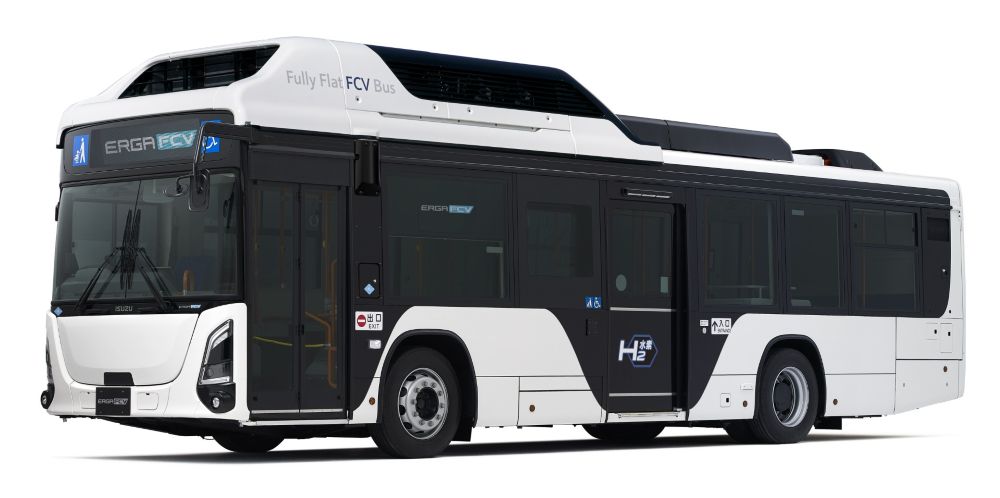
- Isuzu ERGA FCV launches as hydrogen fuel cell bus.
- Hydrogen refueling takes approximately 10 minutes.
- The bus delivers over 300 km driving range.
Isuzu Launches Its First Hydrogen Fuel Cell Route Bus
On October 5, Isuzu Motors Limited announced the launch of the Isuzu ERGA FCV, a hydrogen-powered heavy-duty fuel cell route bus designed to expand the company’s zero-emission vehicle lineup. The introduction addresses the energy policies of national and local governments and the operational needs of bus operators while supporting the decarbonization of public transportation. The ERGA FCV is the first fuel cell bus introduced by Isuzu and was jointly developed with Toyota Motor Corporation. The program combines Isuzu’s experience in bus planning, development, and body design with Toyota’s fuel cell system technology, creating a heavy-duty route bus based on the ERGA EV platform launched in 2024.
Vehicle Dimensions and Joint Development
Based on the fully flat-floor ERGA EV, the hydrogen fuel cell model retains an architecture intended to support accessibility and practical route-bus operation. Isuzu Motors Limited was responsible for vehicle planning, development, and body design, while Toyota developed the fuel cell system. The vehicle measures 10,545 mm in length, 2,485 mm in width, and 3,440 mm in height, with a 4,990 mm wheelbase. The fuel cell system and high-pressure hydrogen tanks are compactly mounted on the roof, allowing the interior floor to remain fully flat. This configuration provides accessibility comparable to the ERGA EV while accommodating the components required for hydrogen-powered operation.
Hydrogen System Enables Fast Refueling and Zero CO₂ Driving
The ERGA FCV generates electricity through a chemical reaction between hydrogen stored in its tanks and oxygen from the air inside the fuel cell stack. The resulting electricity powers the vehicle’s motor, while the system emits water and no CO₂ during driving. The bus uses a fuel cell stack with a maximum output of 113 kW and three 157-liter high-pressure hydrogen tanks. Hydrogen refueling takes approximately 10 minutes, addressing one of the challenges associated with energy replenishment for battery-electric vehicles. Like an EV, the fuel cell bus also provides quiet, low-vibration operation, while its hydrogen storage arrangement supports a fully flat passenger floor.
Battery, Motors and Driving Range
Alongside its fuel cell system, the bus is equipped with an 88 kWh lithium-ion battery and two electric motors. The motors provide a combined maximum output of 220 kW, with each motor delivering 110 kW. Combined torque reaches 970 Nm, supplied as 485 Nm from each motor. This powertrain configuration gives the heavy-duty route bus a driving range of more than 300 km. The combination of hydrogen fuel cell generation, onboard battery storage, and electric propulsion allows the vehicle to maintain zero CO₂ emissions while driving while providing the range and refueling characteristics required for route-bus applications.
Safety and Accessibility Features
The bus incorporates several systems designed to improve safety for drivers, passengers, and other road users. Its Front Blind Spot Monitor detects pedestrians and cyclists ahead of the vehicle and alerts the driver. The Emergency Driving Stop System works with the Driver Status Monitor to detect when a driver becomes incapacitated, automatically decelerate the vehicle, and bring it to a stop. After stopping, the parking brake is automatically engaged, including when the vehicle is on a slope. An optional one-touch wheelchair securing system is also available to reduce the workload for passengers and drivers during wheelchair boarding and securing.
Emergency Power Supply Capability
Beyond passenger transportation, the vehicle includes an external power supply function that allows it to operate as an emergency power source during disasters and other emergencies. This capability expands the potential utility of the fuel cell bus beyond normal route operations by allowing the vehicle to support power needs when required. Combined with its hydrogen-based propulsion system, quiet operation, flat interior floor, and more than 300 km driving range, the vehicle is designed to address both transportation and emergency-use requirements. Its development therefore connects zero-emission mobility with additional operational functionality for public transportation applications.
Industry Impact & Outlook
The launch strengthens hydrogen fuel cell technology as an option for heavy-duty public transportation, particularly where operators need zero-emission driving together with relatively short energy replenishment times. For Japan, the vehicle aligns with government and local energy policies while giving bus operators another pathway alongside battery-electric buses. The joint development also demonstrates how manufacturers can combine vehicle and fuel cell expertise to address commercial-vehicle requirements. Future adoption will depend on factors such as operator needs, hydrogen availability, route requirements, and supporting infrastructure, but the ERGA FCV expands the range of zero-emission technologies available for public transportation.
Frequently Asked Questions
What is the Isuzu ERGA FCV?
The Isuzu ERGA FCV is a hydrogen-powered heavy-duty fuel cell route bus developed jointly by Isuzu and Toyota for zero-emission public transportation applications. It uses a 113 kW fuel cell stack, three 157-liter high-pressure hydrogen tanks, an 88 kWh lithium-ion battery, and two electric motors with a combined maximum output of 220 kW. The bus can travel more than 300 km and can be refueled with hydrogen in approximately 10 minutes. During driving, it emits water rather than CO₂ and also provides quiet, low-vibration operation.
Click above to visit the official source.
Discussion
Join the conversation.