
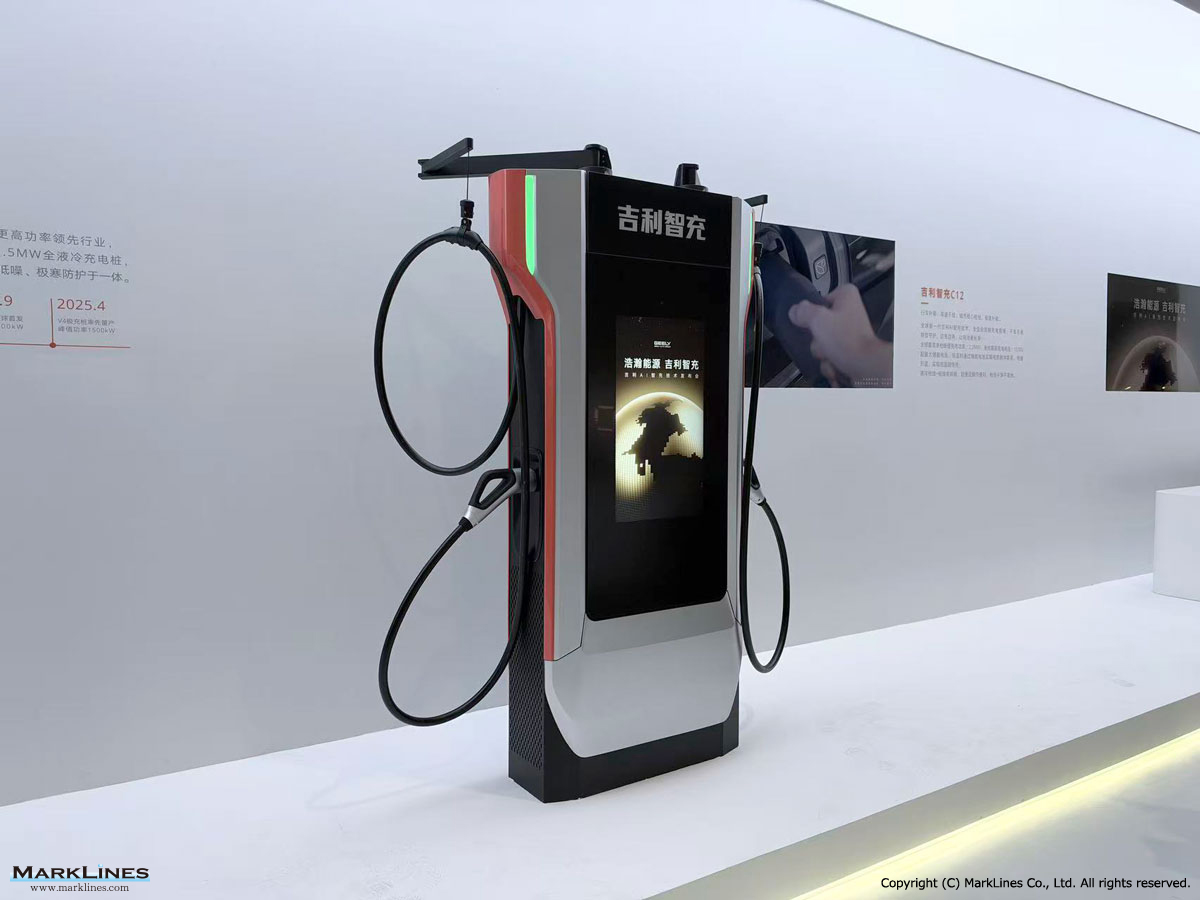
- Geely Smart Charging reaches 2,250kW peak power.
- Lynk & Co 10 reaches 70% in 4.5 minutes.
- Geely plans over 22,000 charging stations by 2027.
Geely Introduces 2,250kW AI-Powered Smart Charging
On September 23, Geely Auto officially introduced Geely Smart Charging, its next-generation AI-powered charging technology, at an event held at the Geely Global All-Domain Safety Center in Ningbo. The company said the system delivers peak charging power of up to 2,250kW through a single charging connector, marking what it described as the first time such a level has been achieved in the industry. The technology is designed to address safety, charging capacity and infrastructure-distribution challenges as ultra-fast charging becomes increasingly important for new energy vehicles. Geely Smart Charging combines artificial intelligence, battery monitoring, charging infrastructure coordination and automated charging technologies to support faster and safer charging across different user and vehicle conditions.
AI Model Coordinates Battery and Charging Conditions
As charging power increases, the chemical characteristics of lithium iron phosphate batteries can make conventional high-power fast charging more vulnerable to elevated temperatures, overheating, battery damage and accelerated degradation. Geely Auto and StepFun jointly developed Xingrui PowerMind, described as the industry's first all-domain energy AI model, to address these challenges. The model can combine users' driving scenarios and charging habits with real-time battery-health information and charging-station conditions. It then supports intelligent scheduling and coordination between the vehicle and charger. This approach is intended to provide faster and safer charging while also improving the intelligence of the overall charging process rather than relying solely on higher charging power.
Three Core Functions Support Smart Charging
Geely Smart Charging incorporates three core functions: AI Smart Charging, AI Auto Charging and AI Ultra-Fast Charging. AI Smart Charging uses Xingrui PowerMind's battery-life prediction technology to monitor battery temperature, lithium plating and other conditions in real time while dynamically optimizing charging strategies for individual batteries. Geely's lithium-ion pulse restoration technology is designed to repair battery damage caused by fast charging and increase battery cycle life by more than 20%. AI Auto Charging adds automated hardware, while AI Ultra-Fast Charging focuses on achieving substantially shorter charging times under real-world conditions. Together, the three functions address battery management, charging automation and high-power charging performance.
Automated Charging Robots Expand Home Charging Options
For automated charging, Geely plans to successively launch two new home charging robot products: a 20kW home charging robot and a 7kW underbody auto-charging robot. The systems are designed to automatically charge a vehicle according to a preset state-of-charge, or SOC, level, reducing the need for users to manually initiate and manage charging. The two products extend Geely Smart Charging beyond conventional fixed charging equipment by introducing automated vehicle-charging interaction in residential applications. The approach is intended to simplify the charging process while maintaining the ability to charge vehicles according to predefined battery requirements and user preferences.
Ultra-Fast Charging Delivers Shorter Real-World Charging Times
Real-world testing at room temperature demonstrated the charging performance targeted by Geely's AI Ultra-Fast Charging system. The Lynk & Co 10 charged from 10% to 70% SOC in an average of 4 minutes 30 seconds, while charging from 10% to 97% SOC required an average of 8 minutes 40 seconds. Geely said the average battery temperature remained below 55°C throughout the charging process. These results combine high charging power with active management of battery conditions, addressing one of the central challenges associated with increasingly rapid charging. The testing therefore highlights both charging speed and temperature management as important elements of the technology's real-world performance.
Geely Plans Major Charging Network Expansion
Geely plans to expand its charging infrastructure significantly by the end of 2027, targeting more than 22,000 charging stations and more than 100,000 charging connectors. The planned network includes more than 15,000 Geely Smart Charging stations and more than 50,000 smart charging connectors. Beyond that initial expansion, Haohan Energy, a Geely subsidiary, plans to build more than 150,000 charging stations and more than 600,000 charging connectors. Geely says that with each connector serving an average of 20 vehicles, the broader network would have capacity to serve more than 12 million vehicles per day, including 100,000 Geely Smart Charging stations. The expansion is intended to address charging availability and distribution as adoption of new energy vehicles grows.
ShenDun Golden Battery Adds Higher Charging Rates
Alongside the charging technology, Geely introduced the next-generation ShenDun Golden Battery Ultra Short Blade Battery series in two battery sizes measuring 395mm and 370mm. The 395mm version supports a peak charging rate of 12C, while the 370mm version supports a peak charging rate of 6C. Geely said the 370mm battery is the first of the series to be installed in the new Geely Galaxy E5. In real-world testing at room temperature, the vehicle equipped with the 370mm version achieved a 10%-70% SOC charge in 8 minutes 25 seconds. The battery developments complement the company's charging strategy by combining higher charging rates with the physical packaging characteristics of the Ultra Short Blade Battery series.
Industry Impact & Outlook
Geely's charging strategy connects high-power charging, AI-based battery management, automated charging and large-scale infrastructure deployment into a single technology approach, potentially increasing the importance of coordination between vehicles, batteries and charging networks. The planned expansion could also broaden access to high-speed charging while creating additional requirements for charging capacity, battery thermal management and infrastructure deployment. For Geely and its related brands, the combination of 2,250kW peak charging capability, AI charging controls and higher-rate batteries provides a framework for pursuing shorter charging times without relying on charging power alone. The next steps will center on deployment of the charging stations, charging robots and battery technologies described by the company.
Frequently Asked Questions
What is Geely Smart Charging?
Geely Smart Charging is an AI-powered charging technology introduced by Geely Auto that combines battery monitoring, intelligent charging control, automated charging and ultra-fast charging capabilities. The system uses the Xingrui PowerMind energy AI model to evaluate driving scenarios, charging habits, battery health and charging-station conditions. Geely says its technology can deliver peak charging power of up to 2,250kW through one connector, while its AI Smart Charging function dynamically adjusts charging strategies. The system also includes automated home charging robots and ultra-fast charging technology designed to improve charging speed, battery management and user convenience.
Frequently Asked Questions
How fast did the Lynk & Co 10 charge?
The Lynk & Co 10 charged from 10% to 70% SOC in an average of 4 minutes 30 seconds during real-world testing at room temperature. Geely also reported an average charging time of 8 minutes 40 seconds for a 10%-97% SOC session. Throughout the charging process, the average battery temperature remained below 55°C. These results were presented as part of Geely Smart Charging's AI Ultra-Fast Charging demonstration and show the system's ability to combine rapid charging with active monitoring of battery temperature during high-power charging.
Click above to visit the official source.
Discussion
Join the conversation.