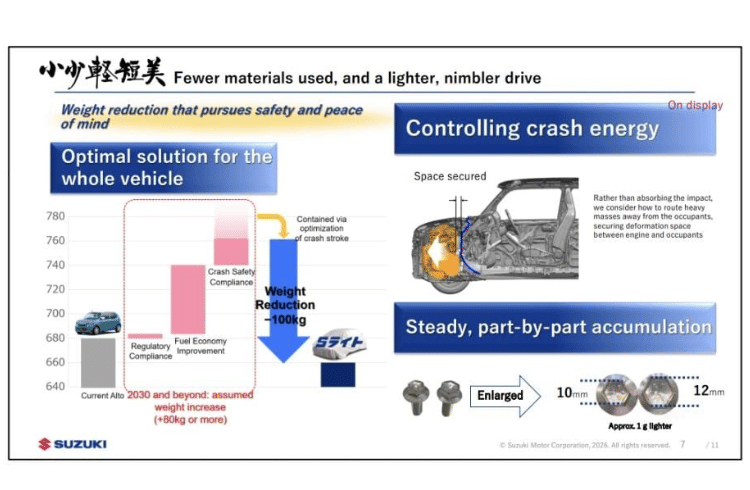
- Suzuki 120 kg Weight Reduction targets lighter vehicles.
- Crash deformation management can reduce reinforcement needs.
- Suzuki has a clear path to 100 kg.
Suzuki Targets Lower Vehicle Weight Through Crash Management
Suzuki 120 kg Weight Reduction plan centers on a different approach to vehicle safety: managing crash deformation rather than relying primarily on additional structural reinforcement. Suzuki Motor Corporation says it has identified a clear path to a 100 kg vehicle weight reduction by 2030 and is studying measures that could extend the reduction to as much as 120 kg. The work focuses on creating sufficient deformation space between the engine and occupants while controlling how the body absorbs and directs collision forces. The objective is to meet safety requirements while limiting the mass and cost that can result from simply making the structure stronger.
Crash Stroke Becomes Central to Weight Reduction
The automaker says engineers are examining the crash stroke, the distance and manner in which the vehicle structure deforms during an impact. Instead of treating body strength as the only route to improved crash performance, the development effort considers how the structure can use available space more effectively. Suzuki is studying changes such as moving the engine forward, then optimizing the vehicle's structure and component layout as a whole. This approach is intended to preserve occupant space during a collision while avoiding unnecessary material and reinforcement. The company also says it is reviewing the materials, individual parts and specifications used throughout the vehicle.
Cross-Functional Engineering Supports Vehicle Optimization
The development effort spans multiple engineering functions rather than being limited to body design. Suzuki says its body, powertrain, electrical and production teams are pooling their expertise to identify opportunities across the complete vehicle. That cross-functional approach is important because changes to one component or system can affect packaging, manufacturing, safety performance and vehicle mass elsewhere. The company is also examining high-strength materials and individual component specifications as part of the broader optimization process. By considering the vehicle as an integrated system, Suzuki aims to reduce weight without compromising the performance requirements that govern its future models.
Safety Requirements Make Weight Control More Difficult
Weight has become a more difficult engineering target as vehicles incorporate additional equipment and face increasingly demanding safety requirements. Suzuki says simply adding structural reinforcement can increase both mass and cost, creating a tradeoff that becomes harder to manage as vehicle content grows. Its alternative is to consider crash-force absorption and load paths from the beginning of vehicle development. The strategy therefore connects body structure, packaging and materials rather than treating crash protection as a separate reinforcement exercise. The company has not identified a specific production vehicle or disclosed the baseline vehicle against which its 100 kg reduction target will be measured.
Lower Mass Supports Powertrain Efficiency
The weight strategy also connects directly with Suzuki's focus on powertrain efficiency. A lighter vehicle requires less energy to move, which can support lower energy consumption across different propulsion systems. For battery-electric vehicles, reducing vehicle mass could help Suzuki achieve a required driving range without increasing battery size, an approach that fits the company's emphasis on appropriately sized batteries. The same principle can benefit vehicles using gasoline or hybrid powertrains by reducing the energy required during operation. Japan remains a key engineering base for Suzuki's technology development, while the strategy is intended to support products for different markets and propulsion requirements.
100 kg Path and 120 kg Study Remain Development Targets
Suzuki's development work is intended to support future gasoline, hybrid and electric models while retaining the company's focus on compact, efficient vehicles. The company has described the 100 kg reduction as a clear development path and the 120 kg figure as an area under further study, rather than as a confirmed production specification for a particular vehicle. That distinction is important because the final result will depend on future engineering decisions, component choices, safety validation and production requirements. The program shows how weight reduction can be pursued through vehicle-wide optimization, including crash management, packaging, materials and component design, instead of relying on reinforcement alone.
Industry Impact & Outlook
The broader industry significance is the potential to make safety, efficiency and cost targets less dependent on adding vehicle mass. If Suzuki can validate its approach in production programs, its crash-management strategy could provide another route for automakers seeking lighter vehicles while accommodating additional equipment and electrified powertrains. The most relevant next steps will be further engineering validation, selection of production applications and confirmation that the targeted reductions can be achieved alongside required safety performance and manufacturing constraints. For Suzuki Motor Corporation, the work also reinforces a development philosophy in which body structure, powertrain packaging, materials and production considerations are optimized together.
Frequently Asked Questions
How much vehicle weight does Suzuki plan to reduce by 2030?
Suzuki has identified a clear path to reducing vehicle weight by 100 kg by 2030 and is studying additional measures that could increase the reduction to as much as 120 kg. The targets are based on vehicle-wide engineering changes rather than simply adding or removing individual components. Suzuki is examining crash deformation, component placement, materials, specifications and structural layout while maintaining required safety performance. The company has not identified a specific production vehicle or disclosed the baseline vehicle that will be used to measure the 100 kg reduction target, so the figures remain development targets rather than confirmed production specifications.
Click above to visit the official source.
Discussion
Join the conversation.