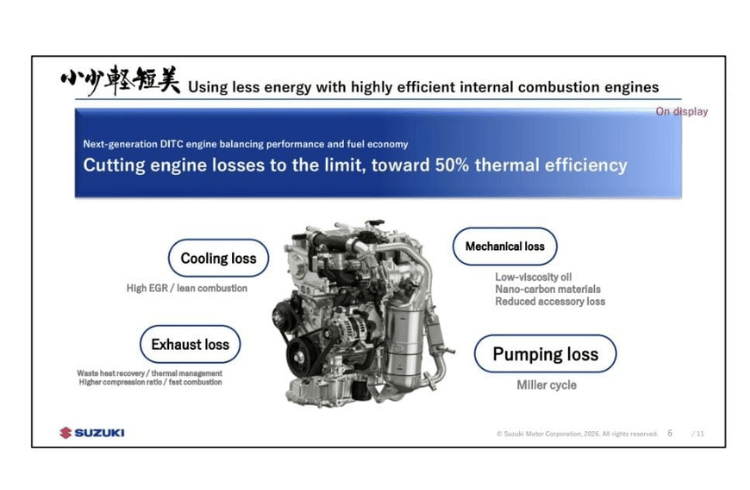
- Suzuki DITC engine targets stronger performance and efficiency.
- India is a named growth market for DITC.
- Suzuki targets 50% thermal efficiency in research.
Suzuki Develops New Direct-Injection Turbocharged Engine
Suzuki DITC engine development is focused on combining stronger performance with lower fuel consumption in growth markets that include India. Suzuki Motor Corporation identified the direct-injection turbocharged engine, referred to as DITC in its technology briefing, as one of the technologies being prepared for future vehicles. The company specifically named India as one of the markets connected with the project, but it has not disclosed the engine's displacement, power output, or first production application. The development therefore represents a new combustion-engine technology under preparation, while important specifications and vehicle-level details remain undisclosed by Suzuki.
Powertrain Strategy Expands Across Different Technologies
The DITC project is part of a broader powertrain strategy in which Suzuki Motor Corporation is continuing work on combustion engines alongside hybrid and electric-vehicle technologies. The company's approach calls for different powertrains to be used in different markets according to local energy supplies, infrastructure conditions, and customer requirements. In India, Suzuki is also investing in CNG and biogas technologies, making improvements to gasoline-engine efficiency another part of its market-specific approach. The new turbocharged engine could therefore add another combustion-powertrain option to Suzuki's future vehicle portfolio.
Research Targets Higher Thermal Efficiency
Separately from the DITC production project, Suzuki has outlined a broader research objective for combustion engines: moving beyond the current thermal-efficiency range of around 40% and working toward 50%. Thermal efficiency describes the portion of fuel energy that an engine converts into useful power. Suzuki's research builds on work conducted for the Z12E engine and examines several sources of energy loss, including heat carried away through cooling and exhaust, friction within the engine, and the energy required to draw air into the engine. The company has cited lean combustion, waste-heat recovery, and lower-viscosity oil as technologies under study.
Production Specifications and Application Remain Undisclosed
Suzuki has not stated whether the technologies investigated in its thermal-efficiency research will be incorporated into the production DITC engine. It also has not identified the vehicle that will receive the new engine or provided a timetable for production. The absence of those details means the current information establishes the development program and its intended market direction without confirming the engine's size, output, launch timing, or specific vehicle application. For Maruti Suzuki, an India-focused turbocharged engine project could provide another powertrain option as the company expands its product portfolio in the Indian market.
Engine Development Supports Market-Specific Powertrain Choices
The project highlights Suzuki's continued development of internal-combustion technology even as the company broadens its work across hybrids and electric vehicles. Its stated strategy is to match powertrain technologies with conditions in individual markets rather than rely on a single solution across all regions. For India, that approach includes work involving gasoline engines, CNG, and biogas, while the DITC program adds a direct-injection turbocharged option to the technologies under preparation. The eventual role of the engine will depend on specifications, vehicle application, production timing, and how Suzuki aligns the technology with local customer and infrastructure requirements.
Industry Impact & Outlook
The DITC program could broaden Suzuki's powertrain choices in India by combining turbocharging and direct injection with its wider efforts to improve combustion efficiency. For the Indian market, the significance of the project will depend on how the engine's eventual specifications, fuel economy, performance, and application fit Suzuki's product strategy. The research target of 50% thermal efficiency also shows that combustion-engine development remains an active technical area alongside electrification. The next major developments to watch are the engine's disclosed specifications, its first vehicle application, and any production timeline provided by Suzuki.
Frequently Asked Questions
What is Suzuki's DITC engine?
The DITC engine is a direct-injection turbocharged combustion engine that Suzuki is developing for future vehicles and growth markets including India. Suzuki has identified the technology in its technology briefing but has not yet disclosed its engine size, power output, or first model application. The company is pursuing the project alongside hybrid and electric powertrain development, reflecting its strategy of using different technologies according to market conditions. Suzuki has also outlined separate research aimed at raising combustion-engine thermal efficiency from around 40% toward 50% through several potential efficiency improvements.
Click above to visit the official source.
Discussion
Join the conversation.