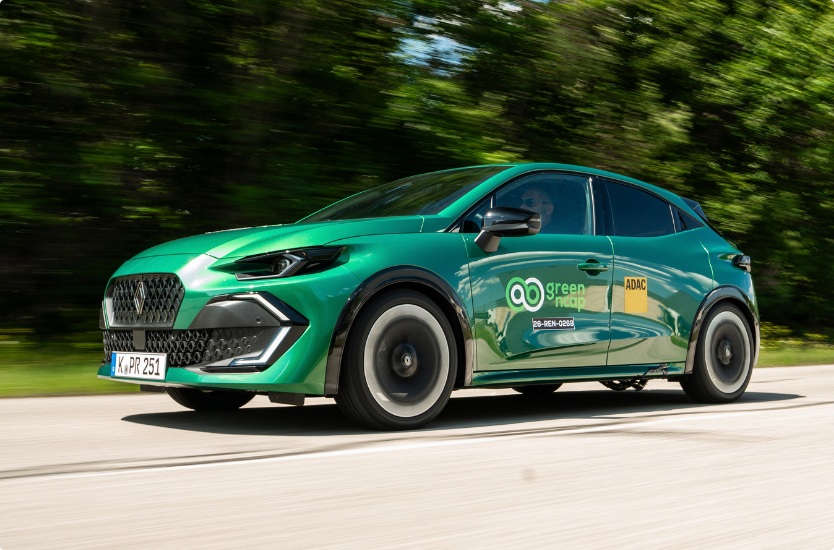
- Green NCAP tested seven cars for sustainability.
- Kia EV4 scored 90% with five stars.
- K4 recorded 257 g CO₂-eq./km lifecycle emissions.
On September 24, Green NCAP evaluated seven passenger cars spanning electric, hybrid, diesel, and gasoline powertrains to assess their environmental performance. The tested lineup comprised Renault Clio TCe 115 Techno, Kia EV4 Earth electric, MAZDA 6e 258 Takumi electric, Renault Symbioz E-Tech Full Hybrid 160, MG MG3 1.5 gasoline, VW Tiguan 2.0 TDI Elegance, and Kia K4 1.6 T-GDI Spirit. Results showed substantial differences among the vehicles, with sustainability scores ranging from 46% to 90%. The assessments covered factors including clean-air performance, energy efficiency, greenhouse-gas impact, fuel consumption, emissions behavior, and lifecycle emissions, providing a comparative view across different propulsion technologies.
Seven Cars Show Wide Sustainability Score Differences
The results showed a clear spread in environmental performance across the seven tested models. The Kia EV4 Earth electric achieved the highest result, receiving a five-star sustainability rating and a 90% score. The MAZDA 6e 258 Takumi electric followed with a 4.5-star rating and an 85% score. Renault's Clio TCe 115 Techno and Symbioz E-Tech Full Hybrid 160 each received 3.5 stars, with scores of 62% and 64%, respectively. The MG MG3 1.5 reached 51%, while the VW Tiguan 2.0 TDI Elegance and Kia K4 1.6 T-GDI Spirit each received 2.5 stars, scoring 48% and 46%.
Electric Models Lead the Sustainability Results
The two electric vehicles in the assessment delivered the strongest overall scores. The Kia EV4 Earth, equipped with an 81.4 kWh battery, achieved 90% and five stars, supported by an energy-efficient aerodynamic design and good real-world driving range in cold conditions. The MAZDA 6e 258 Takumi received 85% and 4.5 stars, with its aerodynamic design and efficient powertrain helping reduce environmental impact. The vehicle also maintained consistent energy consumption across different temperatures. These results placed both battery-electric models above the hybrid and combustion-powered vehicles evaluated in the same testing exercise.
Renault Models Highlight Different Powertrain Results
The two Renault models demonstrated how different powertrains can produce different environmental performance results within the same automaker's lineup. The Clio TCe 115 Techno earned 62%, with scores of 6.8 out of 10 for Clean Air, 7.1 for Energy Efficiency, and 4.9 for Greenhouse Gases. Notably, it achieved its 3.5-star sustainability rating without hybrid or electric assistance. The Symbioz E-Tech Full Hybrid 160 scored 64% and also received 3.5 stars, recording 4.2 l/100 km in warm-weather laboratory testing. Its consumption increased to 7.4 l/100 km at minus 7°C and 6.8 l/100 km during faster highway driving.
Gasoline and Diesel Cars Show Higher Environmental Burdens
The combustion-powered vehicles recorded lower sustainability scores than the electric models and showed specific environmental limitations. The MG MG3 1.5 received three stars and a 51% score, recording 5.8 l/100 km in real-world driving while producing higher particle and carbon monoxide emissions during cold starts. The VW Tiguan 2.0 TDI Elegance earned 2.5 stars and 48%, although its diesel engine effectively controlled exhaust emissions and achieved an 8.7 out of 10 exhaust-emissions score. Its fossil-fuel use nevertheless contributed to lifecycle emissions of 246 g CO₂-eq./km, illustrating the distinction between tailpipe control and total environmental impact.
Kia K4 Records the Highest Lifecycle Emissions
The Kia K4 1.6 T-GDI Spirit recorded the lowest overall sustainability score in the group at 46%, corresponding to a 2.5-star rating. Its lifecycle emissions reached 257 g CO₂-eq./km, with fossil-fuel use and production outside Europe identified as major contributors. The result contrasts with the EV4's 90% score and demonstrates how lifecycle assessment can capture environmental effects beyond direct exhaust emissions. The comparison also shows why evaluating vehicle sustainability requires consideration of energy use, emissions, operating conditions, and production-related impacts rather than relying on a single exhaust-emissions measurement.
Environmental Performance Across the Tested Models
The seven-vehicle assessment produced a broad range of results across propulsion systems, operating conditions, and environmental indicators. Electric models occupied the top two positions by overall score, while the hybrid Renault Symbioz and gasoline Renault Clio achieved intermediate results. The MG MG3, diesel Tiguan, and gasoline K4 recorded lower scores, with the latter two also posting substantial lifecycle-emissions figures. The findings do not indicate that one individual metric determines sustainability performance; instead, the results combine multiple measurements to reflect differences in clean-air performance, energy efficiency, greenhouse-gas emissions, real-world consumption, temperature effects, and lifecycle environmental impact.
Environmental Scores and Ratings Across Seven Tested Cars
The following comparison brings together the sustainability ratings and key measurements reported for each tested vehicle. The figures show the overall sustainability score alongside the available supporting results, including Clean Air, Energy Efficiency, Greenhouse Gases, fuel consumption, exhaust-emissions performance, and lifecycle emissions. Because the original assessment did not provide every measurement for every vehicle, only the reported values are included rather than estimating or filling missing fields. This preserves the distinctions between the different testing categories and keeps the comparison aligned with the reported results.
| Vehicle | Sustainability Rating | Score | Key Reported Result |
|---|---|---|---|
| Renault Clio TCe 115 Techno | 3.5 stars | 62% | Clean Air 6.8/10; Energy Efficiency 7.1/10; Greenhouse Gases 4.9/10 |
| Kia EV4 Earth | 5 stars | 90% | 81.4 kWh; good cold-weather real-world range |
| MAZDA 6e 258 Takumi | 4.5 stars | 85% | Consistent energy consumption across temperatures |
| Renault Symbioz E-Tech Full Hybrid 160 | 3.5 stars | 64% | 4.2 l/100 km warm; 7.4 l/100 km at -7°C |
| MG MG3 1.5 | 3 stars | 51% | 5.8 l/100 km real-world consumption |
| VW Tiguan 2.0 TDI Elegance | 2.5 stars | 48% | Exhaust emissions 8.7/10; 246 g CO₂-eq./km lifecycle emissions |
| Kia K4 1.6 T-GDI Spirit | 2.5 stars | 46% | 257 g CO₂-eq./km lifecycle emissions |
Industry Impact & Outlook
The assessment highlights the growing importance of evaluating vehicle environmental performance across the full range of operating and lifecycle factors rather than focusing exclusively on tailpipe emissions. The results show how electric vehicles can achieve higher overall sustainability scores while combustion and hybrid models can still display meaningful strengths in individual areas such as exhaust-emissions control or fuel efficiency. For automakers, testing that incorporates temperature conditions, real-world consumption, and lifecycle emissions can provide additional benchmarks for powertrain development. For consumers and policymakers, comparable measurements can also clarify how propulsion choices and production characteristics affect environmental performance across different vehicle categories.
Frequently Asked Questions
What did Green NCAP's September 24 testing assess?
The September 24 assessment compared seven passenger cars across electric, hybrid, diesel, and gasoline powertrains using several environmental performance measures. These included clean-air performance, energy efficiency, greenhouse-gas impact, fuel consumption, exhaust emissions, real-world behavior, temperature effects, and lifecycle emissions. Scores ranged from 46% for the Kia K4 1.6 T-GDI Spirit to 90% for the Kia EV4 Earth electric. The results also showed differences between direct emissions performance and broader lifecycle environmental impacts, providing a more comprehensive comparison of the tested vehicles' sustainability characteristics.
Click above to visit the official source.
Discussion
Join the conversation.