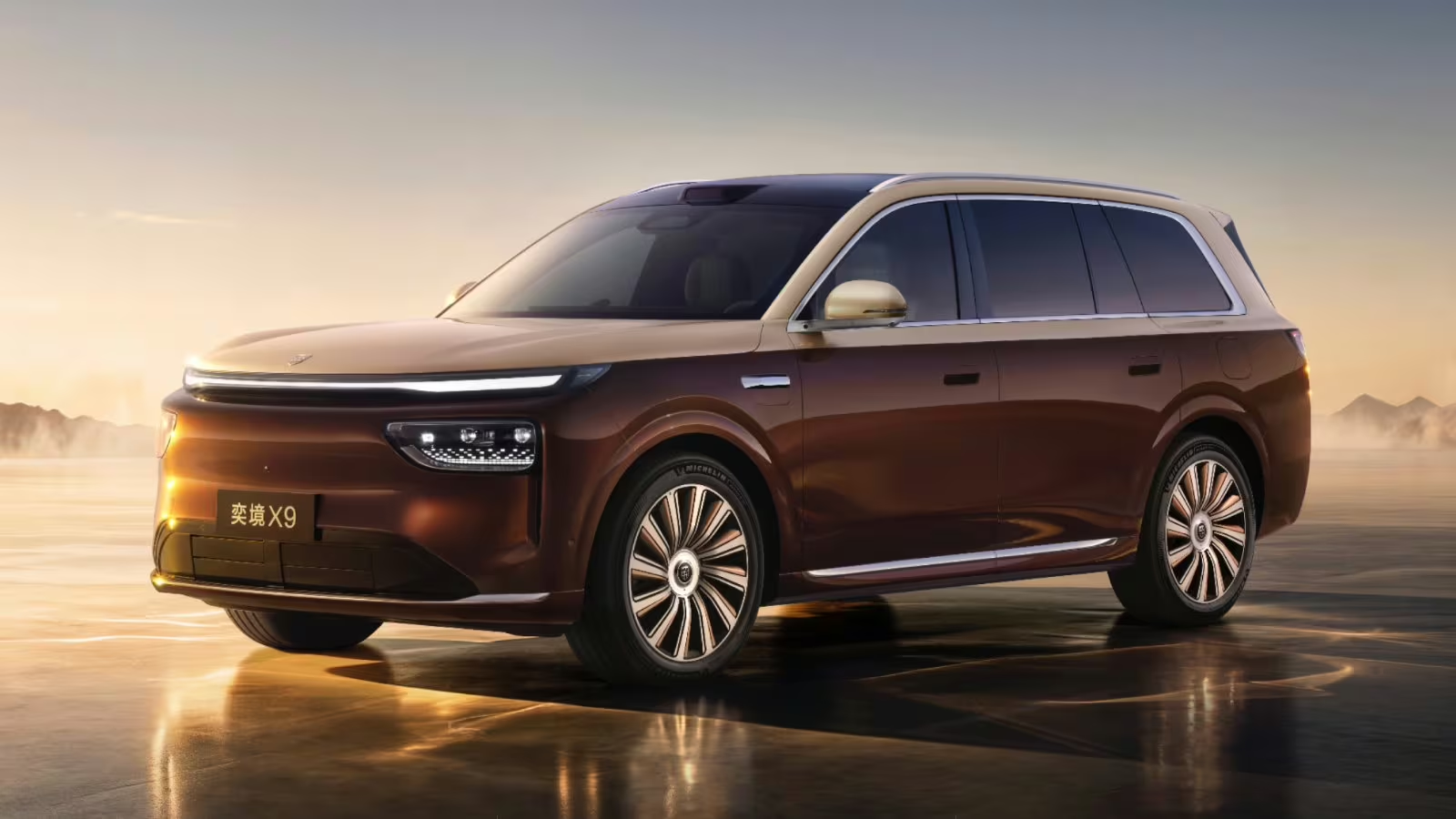
- Epicland X9 launches as Huawei-backed joint-brand flagship.
- The SUV offers up to 1,410 km CLTC range.
- Huawei technology comes standard across the lineup.
Epicland X9 has launched as the first vehicle from the joint brand established by Dongfeng Motor and Huawei, expanding Huawei's automotive presence beyond its Harmony Intelligent Mobility Alliance operations. The extended-range electric SUV carries limited-time prices from 279,800 yuan ($41,460) to 359,800 yuan, versus regular pricing of 289,800 yuan to 369,800 yuan. Positioned as a large three-row, six-seat family flagship, the vehicle is aimed at established competitors including the Aito M9 and Li Auto's Li L9, while combining extended-range propulsion with Huawei's charging, driver-assistance, cockpit, chassis and sensing technologies.
Pricing and Market Positioning
The launch follows pre-sales that began on August 18 at 299,800 yuan, with the company previously reporting more than 20,000 orders during the first 24 hours. The launch pricing therefore provides a temporary reduction from the regular range while positioning the SUV in a premium segment populated by large family-oriented models. Its stated competitors include the Aito M9 and Li Auto's Li L9, giving the new vehicle a direct role in the expanding market for large electrified SUVs that combine passenger capacity, long-distance driving capability and advanced in-vehicle technology.
Dimensions and Interior Capacity
The SUV measures 5,301 mm long, 2,015 mm wide and 1,820 mm high, with a 3,120 mm wheelbase. Despite its three-row, six-seat configuration, it provides 484 liters of cargo capacity when all six seats are occupied. The vehicle's dimensions support its positioning as a large family SUV, while the seating configuration prioritizes passenger capacity without eliminating usable luggage space. These specifications place emphasis on the combination of interior utility and full-passenger occupancy that defines the vehicle's intended family-focused role.
800-Volt Charging and Range
Built around an 800-volt electrical platform, the SUV can replenish its battery from 20% to 80% in 18 minutes. Buyers can select battery packs rated at 74.29 kWh or 51.46 kWh, with battery-only CLTC range reaching as high as 465 km. When the battery is fully charged and the fuel tank is full, the vehicle reaches a combined CLTC range of up to 1,410 km, while its maximum combined WLTC range is 1,120 km. The different testing cycles provide separate reference points for the vehicle's stated long-distance capability.
Powertrain and Performance
The propulsion system uses a 1.5-liter turbocharged range extender capable of producing a maximum 95 kW. The two-wheel-drive configuration uses a 300 kW, or 402 hp, electric motor, while all-wheel-drive versions provide combined motor outputs of either 350 kW or 450 kW. The highest-output version can accelerate from 0 to 100 km/h in 4.81 seconds. This powertrain structure combines electric drive with a gasoline-powered range extender, allowing the vehicle to use battery power for daily driving while retaining an extended total operating range.
Huawei Driver Assistance and Cockpit Technology
Huawei's Qiankun ADS 5 driver-assistance system is standard across the lineup, accompanied by an 896-channel dual-optical-path imaging-grade LiDAR. The highest-specification version adds four LiDAR sensors in total, including three additional high-precision solid-state units. Inside the cabin, Huawei's HarmonySpace 6 cockpit system is paired with two adjoining 17.2-inch 3.4K displays. The combination gives the SUV a technology-focused interior and makes advanced sensing and digital cockpit functionality standard elements of the vehicle rather than equipment limited solely to a top configuration.
Chassis Technology and Maneuverability
The chassis uses Huawei's Qiankun Chitu platform and incorporates dual-chamber air suspension with electronically controlled dampers. Rear-wheel steering further supports maneuverability by reducing the vehicle's minimum turning radius to 5.3 meters. Together, these systems address ride control and low-speed handling in a large SUV measuring more than 5.3 meters in length. The chassis configuration also reinforces the vehicle's premium positioning by combining electronically managed suspension hardware with rear-wheel steering and the broader technology package supplied through Huawei's automotive business.
Upcoming Battery-Electric Model
The brand's product expansion will continue with a battery-electric SUV based on a 1,000-volt platform. Pre-sales for that model are scheduled to begin in November, followed by deliveries starting in December. The planned vehicle will therefore extend the brand's technology strategy beyond the extended-range configuration introduced with its first model. The move also indicates that the partnership intends to establish a broader electrified product portfolio rather than relying on a single large SUV, although further specifications for the upcoming battery-electric vehicle were not provided in the launch information.
Huawei's Expansion Through New Joint Brands
The launch came one day after Aistaland, another brand jointly developed by Huawei and GAC Group, introduced its second model, the GX7, on September 23. The closely timed launches illustrate the expansion of Huawei's automotive activities through partnerships with local automakers outside the Harmony Intelligent Mobility Alliance. Epicland and Aistaland were developed through Huawei's Qiankun business and their respective automaker partnerships. Neither brand is part of the Huawei-led HIMA alliance, establishing a separate route for Huawei's automotive technology to reach vehicles and brands developed with manufacturing partners.
Epicland X9 Specifications and Launch Details
The principal specifications show how the new SUV combines extended-range propulsion, rapid charging, large dimensions and Huawei-developed electronic systems. The following figures summarize the key launch information, including the two battery capacities, available drive configurations, range figures and the scheduled expansion of the product lineup.
| Specification | Detail |
|---|---|
| Regular Price | 289,800–369,800 yuan |
| Limited-Time Price | 279,800–359,800 yuan |
| Dimensions | 5,301 × 2,015 × 1,820 mm |
| Wheelbase | 3,120 mm |
| Seating | 6 seats, 3 rows |
| Battery Options | 74.29 kWh and 51.46 kWh |
| Maximum CLTC Battery Range | 465 km |
| Maximum CLTC Combined Range | 1,410 km |
| Maximum WLTC Combined Range | 1,120 km |
| Range Extender | 1.5-liter turbocharged unit, 95 kW |
| Drive Outputs | 300 kW, 350 kW or 450 kW |
| 0–100 km/h | 4.81 seconds, top specification |
| Charging Platform | 800 volts |
| 20–80% Charging | 18 minutes |
| Cargo Capacity | 484 liters with all six seats occupied |
| Upcoming BEV Platform | 1,000 volts |
Industry Impact & Outlook
The launch broadens Huawei's automotive commercialization model by combining its Qiankun technology with local automaker partnerships outside HIMA, while adding another large electrified SUV to the competitive market in China. The planned 1,000-volt battery-electric model could further expand the brand's technology offering when pre-sales begin in November. For competitors, the combination of extended-range capability, rapid charging, advanced LiDAR hardware and Huawei software creates another technology-focused entrant in the large family SUV segment. The closely timed launch with Aistaland also shows that Huawei's automotive expansion is occurring through multiple partnership structures rather than a single branded alliance.
Frequently Asked Questions
What is the Epicland X9?
The Epicland X9 is an extended-range electric SUV and the first vehicle launched by the joint brand created by Dongfeng Motor and Huawei. It has three rows and six seats, uses an 800-volt platform, and offers battery-only CLTC range of up to 465 km. Its combined range reaches as high as 1,410 km under the CLTC cycle when the battery is fully charged and the fuel tank is full. Huawei technology is integrated throughout the vehicle, including Qiankun ADS 5, LiDAR sensing, HarmonySpace 6 and the Qiankun Chitu chassis platform.
What technology does the SUV use?
The SUV combines Huawei-developed systems across driver assistance, sensing, cockpit electronics and chassis control. Qiankun ADS 5 is standard, while an 896-channel dual-optical-path imaging-grade LiDAR is included across the lineup. The highest specification adds three additional high-precision solid-state LiDAR units for a total of four. The cabin uses HarmonySpace 6 with two adjoining 17.2-inch 3.4K displays, while the chassis uses Qiankun Chitu technology, dual-chamber air suspension, electronically controlled dampers and rear-wheel steering. These systems form the core of its technology package.
Click above to visit the official source.
Discussion
Join the conversation.