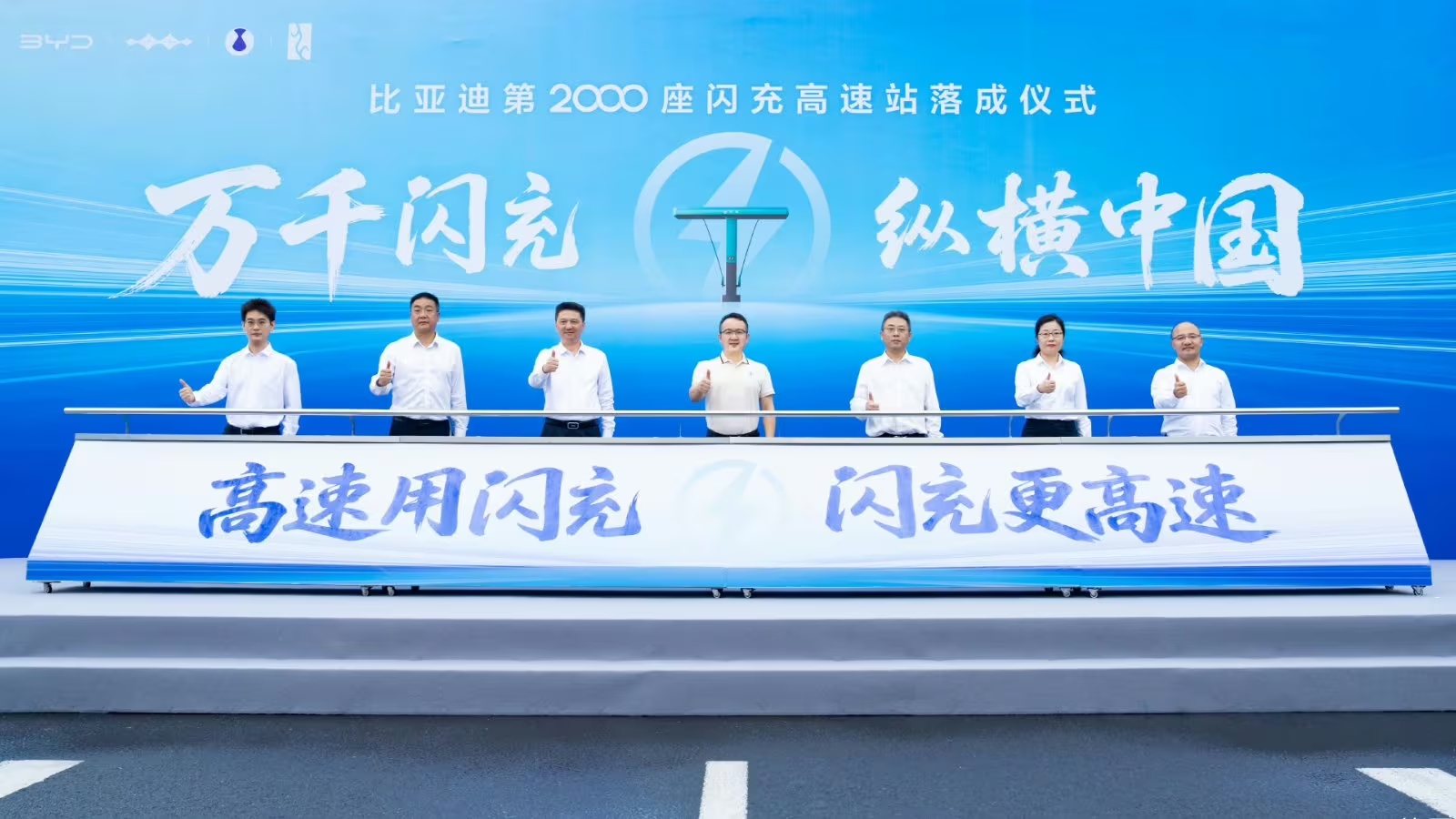
- BYD flash charging stations reach 2,000 highway sites.
- Network now spans 11,586 stations across 341 cities.
- New chargers deliver up to 1,500 kW per connector.
BYD flash charging stations have reached 2,000 highway locations in China, allowing BYD Co Ltd to complete its annual highway construction target roughly three months ahead of schedule. The milestone arrives before China's upcoming Mid-Autumn Festival and National Day holiday travel period, when long-distance electric vehicle use typically puts additional pressure on charging infrastructure. BYD announced the achievement through its official Weibo account on Thursday, describing it as another significant step in its “Flash Charging China” strategy. The company had previewed the milestone one day earlier, while its broader plan calls for 20,000 flash charging stations in China by the end of 2026.
BYD Completes 2,000 Highway Charging Sites Early
BYD's March 5 plan called for 2,000 flash charging stations to be built along highways by the end of 2026, alongside a broader national target of 20,000 stations. Completing the highway portion before the year-end deadline brings additional high-speed charging capacity to China ahead of the holiday travel rush. The milestone is significant because charging queues have remained a challenge for electric vehicle drivers making long-distance journeys. BYD's accelerated construction therefore expands the physical availability of high-power charging locations before a period when highway traffic and charging demand are expected to increase.
Highway Network Covers Nearly One-Third of Service Areas
The 2,000 highway flash charging stations cover nearly one-third of China's highway service areas, with average spacing of just over 100 kilometers, according to previously reported figures. The highway network forms one part of BYD's larger domestic charging rollout, which had reached 10,000 stations by August 28. As of September 24, the company had built 11,586 flash charging stations across 341 cities in China. BYD continues to target 20,000 domestic stations by the end of 2026, meaning the company is still expanding substantially beyond the highway milestone already completed. The broader network is designed to extend fast-charging availability across urban and long-distance travel routes.
BYD Plans Further Domestic and Overseas Expansion
Under BYD's earlier expansion plan, the 18,000 stations beyond the 2,000 highway locations are intended to be developed with charging network operators. The company has also outlined plans to establish 6,000 flash charging stations outside China. This approach extends the charging strategy beyond infrastructure directly built around BYD vehicles and positions the network as part of a wider charging ecosystem. The company's domestic progress provides a substantial base for that expansion, while the overseas target represents another stage in the rollout of its charging technology. The infrastructure strategy therefore combines highway deployment, broader domestic coverage, operator partnerships, and international expansion.
New Flash Chargers Deliver 1,500 kW
BYD's new-generation flash chargers unveiled in March provide maximum output of 1,500 kW per connector. When paired with the company's second-generation Blade Battery, BYD says the system can charge a vehicle from 10% to 70% in five minutes and from 10% to 97% in nine minutes under normal temperatures. These figures describe the capability of the charging system and compatible vehicle technology rather than a result guaranteed for every electric vehicle. Actual charging performance depends on the vehicle's charging architecture, battery characteristics, temperature, and other technical conditions. The combination of high-power infrastructure and compatible batteries is central to BYD's flash-charging strategy.
Charging Network Is Open to Other Brands
The flash charging network is also available to electric vehicles from other brands, although the charging power achieved by each vehicle depends on its own capabilities. BYD has therefore not limited the network exclusively to its vehicles. Usage data released on August 28 showed that the network had delivered a cumulative 210 million kWh of electricity and served more than 1.83 million users. Owners of vehicles from other brands represented nearly one-third of those users. The figures indicate that the infrastructure is being used beyond BYD's own customer base, while also showing that advertised peak charging performance cannot be assumed across all compatible vehicle models.
Geely Raises the Competition in Ultrafast Charging
The expansion comes as Chinese automakers intensify competition around ultrafast charging technology. Geely Auto unveiled its Geely Smart Charging technology and fifth-generation chargers on September 23, one day before BYD completed its highway target. Geely's fifth-generation chargers have a peak output of 2,250 kW, compared with the maximum 1,500 kW per connector specified for BYD's flash chargers. The comparison highlights the rapid development of high-power charging systems among Chinese automakers, with charging infrastructure and compatible battery technology increasingly becoming important elements of the electric vehicle experience alongside vehicle range and conventional performance specifications.
Geely Demonstrates Faster Charging in Tests
Geely said vehicles equipped with its Shendun Golden Battery demonstrated charging from 10% to 70% in four minutes and 30 seconds during tests. The models identified in the announcement were the Lynk & Co 10 and Zeekr 001. This charging result compares with BYD's stated five-minute 10%-to-70% charging time for its second-generation Blade Battery and flash-charging system. The two automakers are consequently presenting increasingly similar use cases around reducing charging stops for electric vehicle drivers, while using different charging architectures and battery technologies. Actual charging times remain dependent on vehicle configuration, charging conditions, battery temperature, and the capabilities of the specific vehicle and charger combination.
Industry Impact & Outlook
BYD's early completion of its highway target expands high-power charging coverage before a major holiday travel period while reinforcing the importance of charging infrastructure in China's electric vehicle market. The development also places greater emphasis on network scale, charging compatibility, and battery technology as automakers compete to reduce charging times. BYD's 2,000 highway sites and wider domestic rollout create a large infrastructure base, while Geely's higher peak charger output shows that technical competition is continuing alongside network expansion. The next phase will depend on how quickly additional stations are deployed, how broadly compatible vehicles can use their available power, and how these charging technologies develop across domestic and overseas markets.
Frequently Asked Questions
How many highway flash charging stations has BYD completed?
BYD has completed 2,000 highway flash charging stations in China, reaching its planned highway construction target about three months ahead of the original year-end deadline. The milestone was completed before the upcoming Mid-Autumn Festival and National Day holiday travel period. The highway network covers nearly one-third of China's highway service areas, with average spacing of just over 100 kilometers. BYD's broader flash charging network had reached 11,586 stations across 341 cities as of September 24.
How fast can BYD's new flash charging system charge?
BYD says its new-generation flash chargers can provide a maximum output of 1,500 kW per connector when compatible with the required vehicle technology. Paired with its second-generation Blade Battery, the system can charge from 10% to 70% in five minutes and from 10% to 97% in nine minutes under normal temperatures. These figures represent stated system capabilities rather than guaranteed results for every electric vehicle. Actual charging power and charging time depend on the vehicle's battery, charging architecture, temperature, and other operating conditions.
Can electric vehicles from other brands use BYD's flash chargers?
Yes. BYD's flash charging network is open to electric vehicles from other brands, although the charging power achieved depends on each vehicle's technical capabilities. Data released by BYD on August 28 showed that the network had delivered 210 million kWh of electricity and served more than 1.83 million users. Owners of other brands accounted for nearly one-third of users. This means the network is not restricted to BYD vehicles, but vehicles from different manufacturers may experience different charging speeds when using the same charging infrastructure.
Click above to visit the official source.
Discussion
Join the conversation.