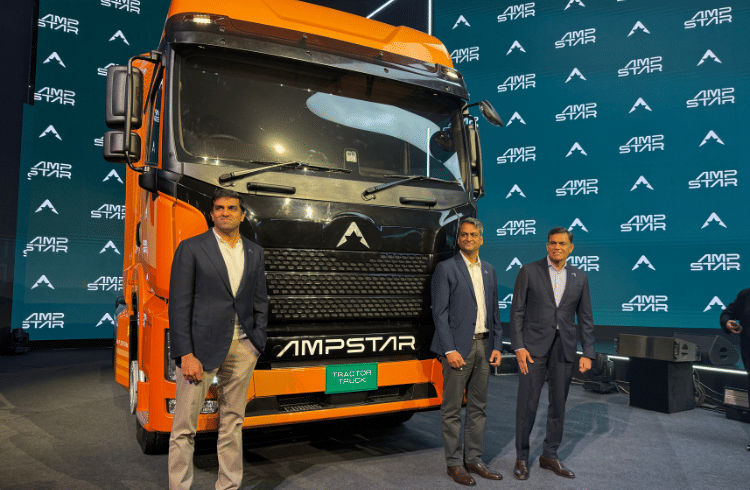
- Ampstar electric commercial vehicle brand launches in India.
- JSW Greentech plans 15,000 vehicles annually.
- The first phase carries a ₹2,500 crore investment.
JSW Greentech has introduced the Ampstar electric commercial vehicle brand in India, marking JSW Group’s entry into the country’s truck and bus market. The company presented a 55-tonne electric tractor-trailer and an electric bus in Mumbai, with commercial production planned at a new manufacturing facility in Chhatrapati Sambhajinagar, Maharashtra. The new brand will cover the group’s electric truck and bus portfolio as it seeks to support the shift from diesel-powered commercial transportation toward electric mobility. Ampstar combines the words “ampere,” the unit used to measure electric current, and “star,” which the company associates with aspiration, leadership and progress.
JSW Greentech’s Electric Commercial Vehicle Investment
The first phase of the electric commercial vehicle business represents an investment of about ₹2,500 crore by JSW Group. The planned 90-acre manufacturing facility is designed for annual production of 15,000 vehicles, including 10,000 electric buses and 5,000 electric trucks. The scale of the planned operation provides the business with dedicated production capacity across both vehicle categories from the outset. The facility will be located in Chhatrapati Sambhajinagar, Maharashtra, where commercial vehicle manufacturing activities are expected to begin after the plant is established. The investment forms the initial industrial foundation for the company’s planned expansion in electric commercial transportation.
Heavy-Duty Electric Truck Strategy
The initial truck offering will center on 55-tonne tractor-trailers intended for demanding industrial applications, including steel, cement, mining and port operations. The company plans to broaden the range with tippers, fixed-body trucks and dumpers before moving into additional commercial vehicle categories. Vehicles will use either fixed or swappable battery architectures, with battery configurations tailored to individual applications and customer operating requirements. Sumit Mittal, CEO of JSW Greentech, described the approach as customized rather than based on an off-the-shelf product, with pricing expected to vary according to vehicle features and the application for which each vehicle is configured.
Closed-Loop Operations Support Initial Deployment
The initial deployment strategy will concentrate on closed-loop operations, where commercial vehicles travel predictable routes between facilities such as factories, mines and ports. These operating patterns can support the installation of charging or battery-swapping infrastructure at defined locations, reducing the infrastructure complexity associated with less predictable long-distance operations. The strategy also gives the company an existing industrial ecosystem in which to introduce its vehicles and evaluate operating economics. JSW’s steel, cement and port businesses collectively use around 17,000 trucks, creating a captive environment in which electric commercial vehicles can potentially be deployed across established industrial routes.
Electric Bus Portfolio and Manufacturing Facility
The electric bus portfolio is planned to cover vehicles ranging from seven to 18 meters in length. Intended applications include staff transportation, city services, school transportation and airport-tarmac operations, giving the business exposure to several fleet-oriented use cases. The Chhatrapati Sambhajinagar facility will combine truck-cabin manufacturing, electric-bus body building and battery-pack assembly within the same manufacturing operation. Battery cells will initially be imported. The company also said the plant will be the first commercial vehicle facility in India equipped with a pre-treatment and electro-deposition system, a manufacturing process intended to improve corrosion protection and vehicle durability.
Digitized Production and Plant Development
The manufacturing operation is planned to integrate enterprise resource planning, product lifecycle management and manufacturing execution systems as part of its production infrastructure. These systems are intended to connect different stages of manufacturing and product management within the facility. The plant’s groundbreaking took place in October 2024, establishing the project before the launch of the commercial vehicle brand. Its planned capabilities extend beyond vehicle assembly by incorporating battery-pack production and specialized surface-treatment processes. The combination of these operations is intended to support production across the company’s planned truck and bus portfolio while establishing a dedicated manufacturing base for its electric commercial vehicle business.
Direct B2B Sales Model and Fleet Services
Initially, JSW Greentech will use a direct business-to-business sales model instead of immediately establishing a nationwide dealership network. Dealers could be appointed in selected markets where they are able to support concentrated groups of fleet customers. The company plans to offer vehicles through several commercial structures, including outright purchases, cost-per-kilometer arrangements and wet-lease models. Its broader mobility proposition is also expected to include financing support, charging infrastructure, maintenance and battery-as-a-service offerings. This approach is designed around fleet customers whose operating requirements may extend beyond the vehicle itself and include the infrastructure and services needed for electrified operations.
JSW Group’s Entry Into Electric Commercial Mobility
JSW Group Chairman Sajjan Jindal said the company’s objective is to act as a catalyst for changing how transportation operates in India. He acknowledged that trucks and buses are outside the group’s traditional core business and said the primary objective is to accelerate the country’s transition from diesel-powered commercial vehicles to electric mobility. The company’s strategy therefore combines vehicle development with manufacturing, infrastructure, financing and service offerings. By focusing initially on industrial fleets and predictable routes, the business is positioning its first deployments around applications where charging or swapping locations can be planned alongside established commercial operations.
Industry Impact & Outlook
The launch expands competition in India’s electric commercial vehicle market while bringing a major industrial group into heavy-duty trucks and buses. Its initial emphasis on closed-loop fleets, customized battery configurations and integrated mobility services could make industrial applications an important testing ground for electric commercial vehicle economics. The planned 15,000-vehicle annual capacity also establishes a sizable manufacturing base for future portfolio expansion. Near-term progress will depend on production readiness, fleet deployment, charging and battery-swapping infrastructure, and customer adoption across industrial and fleet applications. The development is particularly relevant to operators in steel, cement, mining, ports, urban services and other sectors where predictable vehicle routes can support electrification.
Frequently Asked Questions
What is Ampstar’s initial electric commercial vehicle strategy?
Ampstar is initially targeting heavy-duty trucks and buses for predictable fleet operations across industrial and transportation applications. Its first truck is a 55-tonne tractor-trailer, while the bus portfolio will cover vehicles from seven to 18 meters. The company plans to support customers through vehicle sales, cost-per-kilometer and wet-lease models, alongside financing, charging, maintenance and battery-as-a-service offerings. Production is planned at the Chhatrapati Sambhajinagar facility, which is designed for annual capacity of 15,000 vehicles across electric trucks and buses.
Click above to visit the official source.
Discussion
Join the conversation.