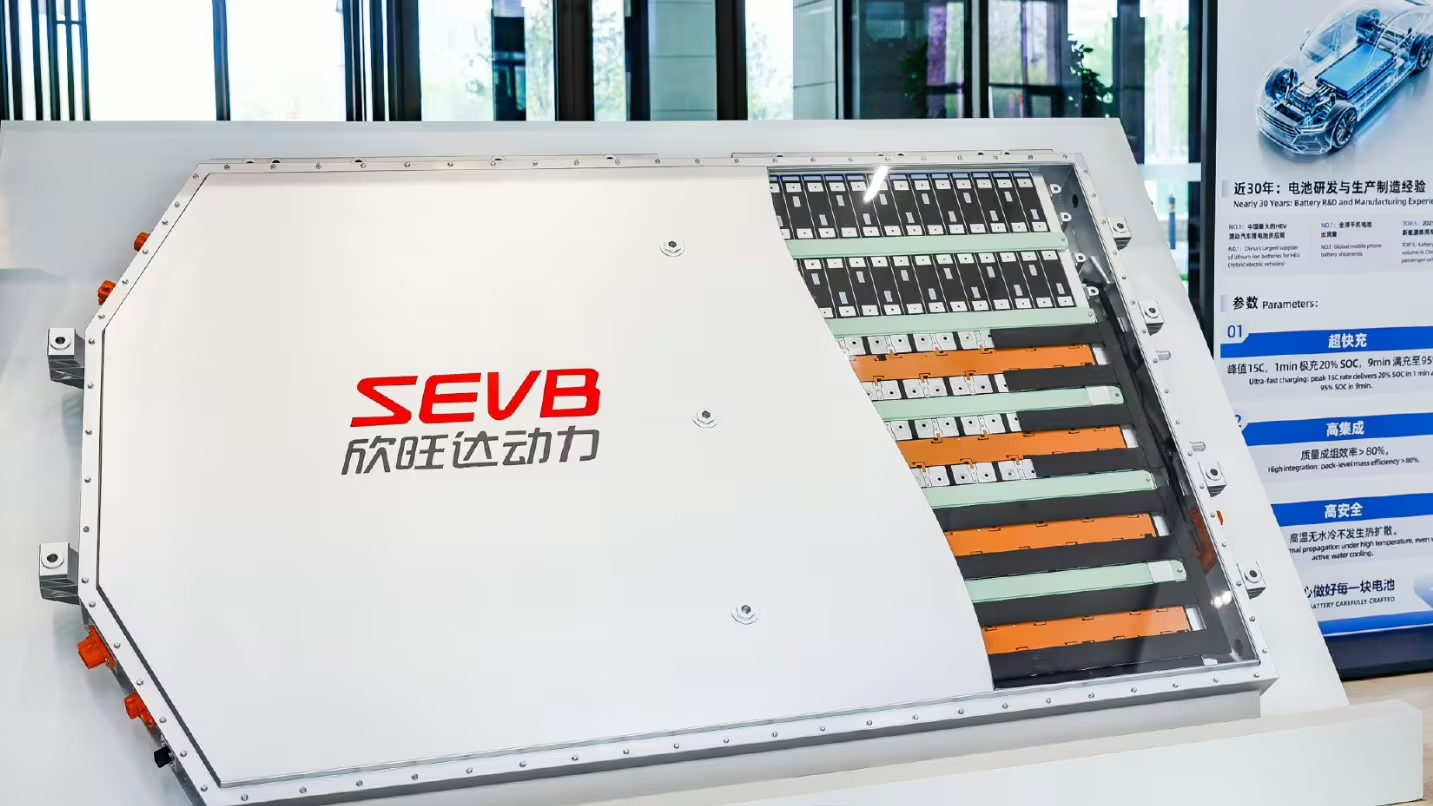
- Sunwoda flash charging battery targets 10,000 stations.
- New system reaches 97% charge in nine minutes.
- AI monitoring warns of faults days ahead.
Sunwoda Unveils 15C Flash Charging Battery
Sunwoda Electric Vehicle Battery Co Ltd (Sunwoda EVB) has introduced a 15C smart flash charging battery system and plans to establish 10,000 megawatt charging stations by the end of 2027. The company announced the system on September 17 after presenting it at a battery industry conference held September 16-17 in Zaozhuang, Shandong province. The launch adds another major development to China's rapidly expanding flash charging sector, where battery manufacturers and automakers are competing on both charging performance and infrastructure deployment. The announcement follows recent ultrafast charging and battery developments from BYD, Hongqi, Dongfeng and Xpeng.
Charging Performance Targets Higher Speed
Sunwoda said its new battery system can charge from 10% to 70% in five minutes and from 10% to 97% in nine minutes at room temperature. A one-minute charging session can add 100 kilometers of driving range, according to data presented at the conference. At minus 20°C, the system requires 15 minutes to charge from 10% to 97%, while the company says the battery can support a driving range of more than 700 kilometers. The room-temperature charging times announced by Sunwoda match the corresponding figures BYD presented for its second-generation Blade Battery in March, highlighting the closely contested performance targets emerging in China's flash charging market.
Battery Durability And Smart Monitoring
Beyond charging speed, Sunwoda designed the system to address battery durability and monitoring concerns associated with high-rate charging. The company said the battery can meet warranty requirements of 10 years or 300,000 kilometers and supports unlimited ultrafast charging sessions for vehicles that are not used commercially. The system also combines smart battery cells 3.0, an energy domain controller and an AI cloud-control platform to strengthen monitoring and early fault detection. Sunwoda said the platform can issue warnings for more than 20 types of faults between two and 10 days in advance, with an accuracy rate of 99.77%. These capabilities are intended to complement the battery's high charging performance with additional monitoring functions.
Sunwoda Expands Into Charging Infrastructure
Sunwoda also unveiled an open ecosystem platform combining solar power, energy storage and flash charging, extending its offering beyond the battery system itself. The platform integrates flash charging EV batteries, energy storage systems, megawatt charging units, high-power liquid-cooled charging terminals and an AI cloud-control platform. It is designed to support vehicles from multiple brands and accommodate different partnership models. Sunwoda expects this flash charging ecosystem to include 10,000 megawatt charging stations by the end of 2027. The company did not disclose the planned station locations, investment requirements, first vehicle models using the new battery or a timetable for mass production, leaving several implementation details unresolved.
China's Flash Charging Race Shifts Toward Networks
The competitive focus in China's flash charging market is increasingly extending from individual technology announcements to large-scale charging network deployment. BYD said it completed its 10,000th flash charging station in China on August 28 and reiterated a goal of 20,000 stations by the end of 2026. Other automakers are advancing competing technologies. Hongqi reported in July that a jointly developed battery with China Automotive New Energy Battery Technology could charge from 10% to 70% in three minutes and 41 seconds at 25°C. Dongfeng introduced a prototype 1,500-kilowatt ultrafast charger on July 29, while Xpeng began operating its first X-Energy megawatt charging station in Hong Kong on September 15 with local charging provider Halo.
Industry Comparison Highlights Infrastructure Challenges
The latest developments show that flash charging competition involves both battery capabilities and the infrastructure required to deliver high power consistently. Dongfeng's prototype has a peak output of 1,500 kilowatts per charging connector, matching the peak output of BYD's new flash charger announced in March. Xpeng's Hong Kong station has a peak output of one megawatt and includes 400 kWh of energy storage while remaining open to drivers of all vehicle brands. However, a charging station's rated output does not necessarily represent the power received by an individual vehicle, because actual charging performance depends on the vehicle's battery and charging capabilities. This distinction remains important as megawatt charging networks expand.
Industry Impact & Outlook
Sunwoda's announcement reinforces a shift in the Chinese EV charging market toward integrated ecosystems that combine high-rate batteries, powerful charging hardware, energy storage, solar generation and software-based monitoring. The planned 10,000-station network would give Sunwoda a substantial infrastructure objective, although the absence of disclosed locations, investment plans, vehicle applications and mass-production timing leaves execution details open. For automakers and charging operators, compatibility across vehicle brands and charging capabilities will remain important as competing networks expand. The development also suggests that future differentiation may depend not only on peak charging speed, but on battery durability, fault detection, energy management and the practical availability of high-power charging infrastructure.
Frequently Asked Questions
What is Sunwoda's new 15C battery system?
Sunwoda's new 15C battery system is designed for ultrafast EV charging, with the company reporting charging from 10% to 97% in nine minutes at room temperature. It can add 100 kilometers of range in one minute and support more than 700 kilometers of driving range. At minus 20°C, Sunwoda says the system takes 15 minutes to charge from 10% to 97%. The system also incorporates smart battery cells, an energy domain controller and an AI cloud-control platform for monitoring and early fault detection.
Click above to visit the official source.
Discussion
Join the conversation.