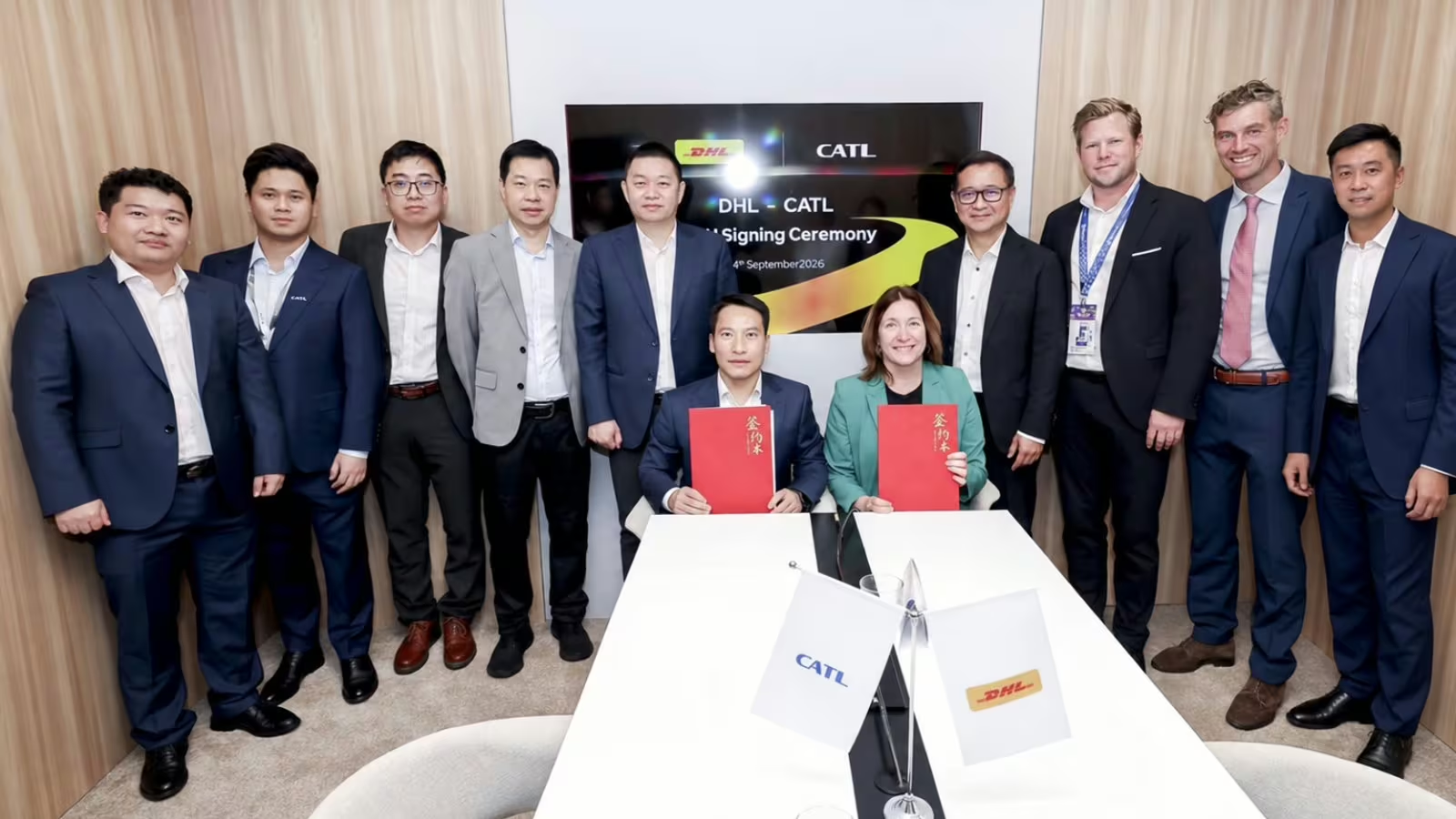
- CATL DHL Green Freight Corridors Europe MoU advances cooperation
- MoU excludes specific corridors and investment commitments
- Tectrans II supports charging and battery swapping
CATL and DHL Expand European Freight Electrification Cooperation
CATL DHL Green Freight Corridors Europe are at the center of a new memorandum of understanding signed by CATL and DHL Group to examine green freight corridors across Europe. Announced on September 14 in Hanover, Germany, the agreement builds on the companies’ global MoU from September 2024 and places greater emphasis on electrifying and decarbonizing European road freight. The framework combines DHL’s logistics requirements with CATL’s battery, charging, and swapping capabilities to explore repeatable operating models across different routes rather than a single technology or pilot.
The potential cooperation covers several elements of freight electrification, including identifying transport corridors suitable for electrification, engaging electric vehicle manufacturers, deploying mobile and stationary charging infrastructure, and testing battery swapping. CATL and DHL are therefore considering an integrated approach that connects vehicles, energy infrastructure, and logistics demand. The MoU itself establishes a framework for evaluating opportunities rather than committing the companies to specific projects. The latest statement did not identify individual corridors, investment amounts, or launch dates, leaving those details to be determined as cooperation opportunities are assessed.
DHL Group is CATL’s strategic logistics partner and intends to develop and scale sustainable freight solutions across Europe, including transportation within CATL’s European supply chain. Akin Li, executive president of CATL’s overseas business, said freight electrification requires more than batteries or vehicles, pointing to the need to combine real logistics demand with charging, energy storage, battery swapping, and lifecycle services. This approach places operational requirements alongside technology development and could allow the companies to evaluate corridor models based on actual freight use cases.
The proposed charging and energy infrastructure work could involve QUIBO Energy and FleetBoost. QUIBO Energy, strategically backed by CATL and Xiaomi, was formerly known as SUNNIC, while FleetBoost is a European provider of high-power charging and energy storage solutions. The two companies previously jointly developed the FleetBooster 20 and FleetBooster 40 using CATL battery technology and are now working on scalable mobile energy and charging solutions. Their potential participation would add infrastructure capabilities to the broader corridor framework under consideration.
Battery swapping is another potential component of the cooperation, with Swaptopus identified as a possible participant. Swaptopus is a joint venture established by CATL and Octopus Energy to develop an electric truck battery swapping network across Europe. When the joint venture was announced in June, the companies said the first demonstration stations were expected to begin operating in the UK in 2027, followed by plans to expand the UK network to more than 30 stations by 2035. Individual corridor projects may also involve other vehicle manufacturers, infrastructure providers, energy companies, logistics partners, and investors.
The corridor initiative also aligns with CATL’s expansion in commercial vehicle batteries. On September 14 in Hanover, the company launched its Tectrans II commercial vehicle battery solution, including a heavy-duty truck version with a claimed range of up to 1,000 kilometers in its highest configuration. The solution supports both charging and battery swapping, providing different replenishment options for transport applications. These capabilities are relevant to the corridor concept because freight operators can require different energy and turnaround models depending on route length, vehicle use, and infrastructure availability.
CATL has stated that the cooperation framework is intended to combine battery technology, charging, swapping, and logistics requirements rather than focus on one technical solution. Other vehicle manufacturers, infrastructure providers, energy companies, logistics partners, and investors may participate in individual projects depending on the requirements of each corridor. This structure leaves room for different combinations of technologies and participants while the companies assess where electrification can be applied effectively within European road-freight operations.
European Freight Corridor Cooperation Framework
The new MoU provides a framework for evaluating European road-freight electrification opportunities, while several important implementation details remain undecided. The following table summarizes the principal disclosed elements of the agreement and related developments described by the companies.
| Item | Disclosed Detail |
|---|---|
| Agreement | New memorandum of understanding |
| Signing Date | September 14 |
| Location | Hanover, Germany |
| Primary Focus | European road-freight electrification and decarbonization |
| Potential Cooperation | Electric corridors, charging infrastructure, battery swapping |
| Specific Corridors | Not disclosed |
| Investment Amounts | Not disclosed |
| Project Launch Dates | Not disclosed |
DHL Group has stated an ambition to reach net-zero logistics-related carbon dioxide emissions by 2050, making collaboration among logistics providers, vehicle manufacturers, and the energy sector a central part of its decarbonization approach. The new European MoU provides a framework for translating that broader objective into potential corridor-level projects, while its lack of fixed routes, investment commitments, or launch dates means the practical scope remains open. The next phase will depend on which routes and operating requirements the companies identify as suitable for electrification and scalable infrastructure.
Industry Impact & Outlook
The proposed framework could influence how European road-freight electrification projects are evaluated by connecting actual logistics demand with vehicle, charging, energy-storage, and swapping requirements. Its significance lies less in a single announced deployment than in the possibility of developing repeatable corridor models that can be adapted to different routes. For CATL, DHL Group, infrastructure providers, and participating vehicle or energy companies, the relevant next step is identifying projects where the technical options and freight requirements can be assessed together before specific investments or launch schedules are established.
Frequently Asked Questions
What is the CATL and DHL Group green freight corridor MoU?
CATL and DHL Group’s MoU focuses on exploring green freight corridors in Europe through road-freight electrification, charging infrastructure, and battery swapping. The agreement builds on their September 2024 global cooperation and is intended to evaluate operating models that could be replicated across different routes. Potential work includes identifying suitable corridors, engaging electric vehicle manufacturers, and deploying mobile or stationary charging. The companies have not yet disclosed specific corridors, investment amounts, or launch dates, so individual projects remain subject to further assessment and planning.
Click above to visit the official source.
Discussion
Join the conversation.