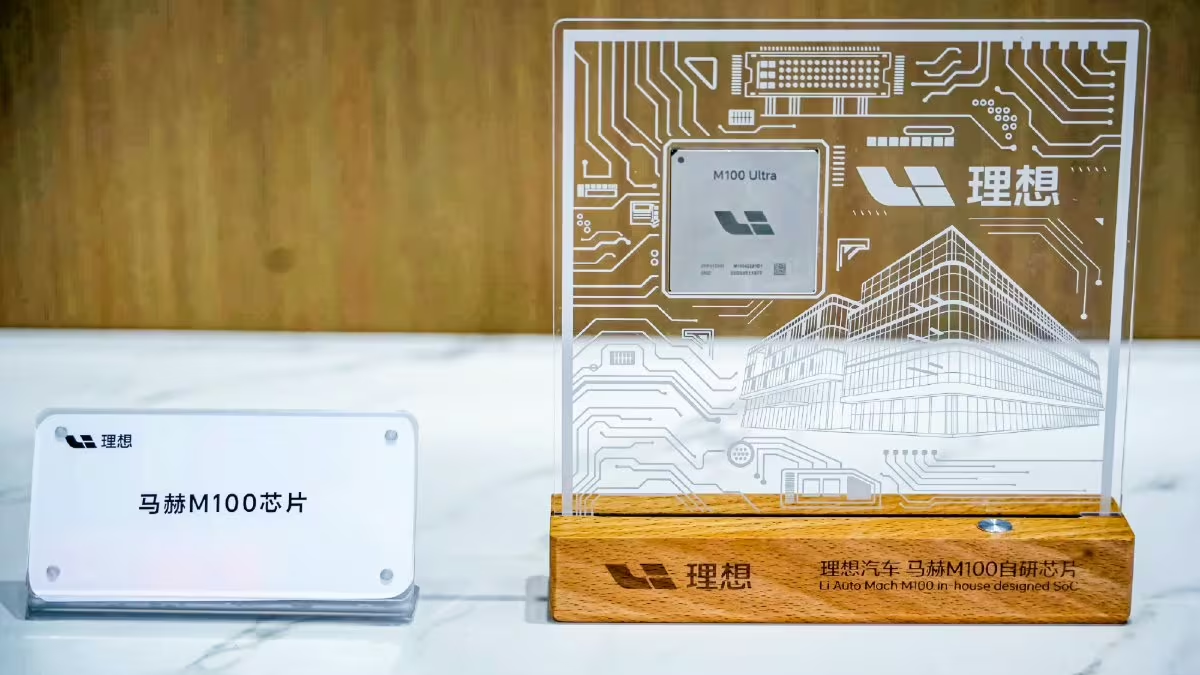
- Li Auto chip business targets external customers
- Mach M100 delivers 1,280 TOPS per chip
- Sike Semiconductor is preparing for outside funding
Li Auto Expands Technology Commercialization Beyond Vehicles
Li Auto chip business is moving toward external commercialization as the Chinese automaker seeks to generate revenue from technologies developed primarily for its own vehicles. Since the beginning of this year, Li Auto has been preparing to supply several core technologies to outside customers while shifting some operations toward more independent structures and external funding, according to a 36Kr report citing multiple industry sources. The reported initiative covers Mach chips, silicon carbide modules and range-extender systems. However, the report did not identify signed supply contracts, order volumes or related revenue, leaving the scale and timing of any external business uncertain.
Mach Chip Business Moves Toward Spinoff
Li Auto's senior management has approved a planned spinoff of its chip business, with business-development work advancing alongside the organizational changes, the report said. Company executives have reportedly discussed the Mach chip with embodied artificial intelligence companies, although the potential customers were not identified and no purchase agreements were disclosed. Adoption could depend partly on how difficult it would be for prospective customers to migrate their existing algorithms to the chip. That technical transition requirement means discussions with potential customers do not yet establish that external commercial deployment will occur.
Dedicated Entity Established for Chip Operations
Li Auto has also established a separate corporate vehicle for its chip operations. Xinchuang Zhihe (Shanghai) Technology Co Ltd was established in Shanghai on July 13, with a business scope covering integrated circuit chip design and sales. The structure provides a dedicated entity through which the company can pursue independent chip activities. The move follows years of internal investment in semiconductor technology and gives Li Auto a clearer organizational basis for developing an external customer business while continuing to use its own chips in vehicles.
Mach M100 Provides Existing Vehicle Deployment
The Mach M100 is Li Auto's first mass-produced driver-assistance chip and is already deployed in the company's vehicles. Developed using a 5 nm automotive-grade process, the chip provides 1,280 TOPS of computing power per chip. Its existing vehicle application gives Li Auto an operating track record for the technology, while the proposed external strategy would test whether the same platform can meet the requirements of other technology companies or automotive customers. The original report did not provide information on external validation, contracted volumes or commercial pricing for the Mach M100.
Sike Semiconductor Pursues Greater Independence
Li Auto's silicon carbide module operation is following a similar path toward greater independence. Sike Semiconductor, established jointly by Li Auto and Hunan Sanan Semiconductor in 2022, has been working to broaden its external customer base. According to 36Kr, Sike changed its reporting structure in February so that management reports to its own board rather than Li Auto's manufacturing division. It now operates independently and carries responsibility for its own profits and losses. Li Auto currently owns 70% of Sike, while the company is preparing to seek outside funding and has begun preparations for an initial public offering.
Outside Funding Could Broaden Supplier Access
Outside capital could give Sike additional resources while potentially reducing its dependence on Li Auto. The structure may also address a commercial concern for other automakers: purchasing critical components from a supplier controlled by a competing vehicle manufacturer can create strategic and supply considerations. A broader ownership base could therefore make Sike more attractive to prospective customers, although the report did not disclose specific new customers, investment terms or an IPO timetable. The proposed financing and listing preparations remain part of the company's broader effort to operate as a more independent supplier.
Range Extenders Open to External Customers
The commercialization effort extends beyond semiconductors. Li Auto has indicated that its range-extender systems are open to external customers, and the company now develops and manufactures its third-generation range extender internally. Batteries, however, are not currently included in the external-supply strategy. Industry sources cited by 36Kr said the high degree of battery customization makes supplying outside customers more difficult. This distinction suggests that Li Auto is focusing first on technologies that can potentially be standardized or adapted across customers while retaining its battery systems primarily for internal vehicle programs.
Technology Monetization Comes Amid Profit Pressure
The push to monetize internal technology comes while Li Auto faces pressure on profitability and continues to maintain substantial research and development spending. The company reported a second-quarter net loss of 1.7 billion yuan, compared with net profit of 1.1 billion yuan in the same quarter a year earlier. Li Auto still had 87.5 billion yuan in cash reserves at the end of the second quarter, while quarterly research and development spending remained around 3 billion yuan for six consecutive quarters. External orders could potentially broaden the revenue base and distribute research and manufacturing costs across a larger business, although the article provides no estimate of future external revenue.
Other Chinese EV Makers Pursue Similar Strategies
Li Auto is not alone among Chinese electric vehicle manufacturers in pursuing external commercialization of internally developed technology. Nio Inc has spun off its chip business into GeniTech Co Ltd, also known as Shenji, and is seeking third-party customers. The M97 chip jointly developed by Shenji and Axera Semiconductor reportedly drew interest from Geely, according to a September 2 36Kr report, but no supply agreement or mass-production plan had been disclosed at that time. The developments show that Chinese EV manufacturers are exploring ways to turn internal semiconductor capabilities into businesses serving customers beyond their own vehicle brands.
Xpeng Expands Its External Technology Strategy
Xpeng is pursuing a broader external technology strategy as well. The company plans to offer technology to more overseas customers beyond Volkswagen, including electrical and electronic architecture, cockpit systems, chips and driver-assistance software. Taken together with Li Auto's plans and Nio's semiconductor spinoff, these moves indicate that Chinese EV manufacturers are examining external commercialization as a way to extend the value of technology developed for vehicle programs. The available reports do not establish how large these supplier businesses will become or whether the initiatives will produce material financial returns.
Industry Impact & Outlook
Li Auto's commercialization strategy could affect both the economics of internal technology development and the competitive structure of automotive suppliers. If external customers adopt its chips, silicon carbide modules or range extenders, Li Auto could gain additional routes to monetize research and manufacturing capabilities while potentially sharing costs across a wider customer base. Sike's planned outside funding and possible IPO could further separate supplier interests from Li Auto's vehicle business. The practical impact will depend on customer adoption, technology migration requirements, supply agreements and the ability of these businesses to operate independently while serving companies that may compete with Li Auto.
Frequently Asked Questions
What technologies is Li Auto seeking to supply to external customers?
Li Auto is reportedly seeking external customers for Mach chips, silicon carbide modules and range-extender systems developed through its internal technology programs. The company has approved a planned chip-business spinoff, while Sike Semiconductor is pursuing greater independence and outside funding. Li Auto has also indicated that its third-generation range extender is open to external customers. Its batteries are not currently part of the external commercialization effort because their high degree of customization makes supplying outside customers more difficult, according to industry sources cited in the report.
Click above to visit the official source.
Discussion
Join the conversation.