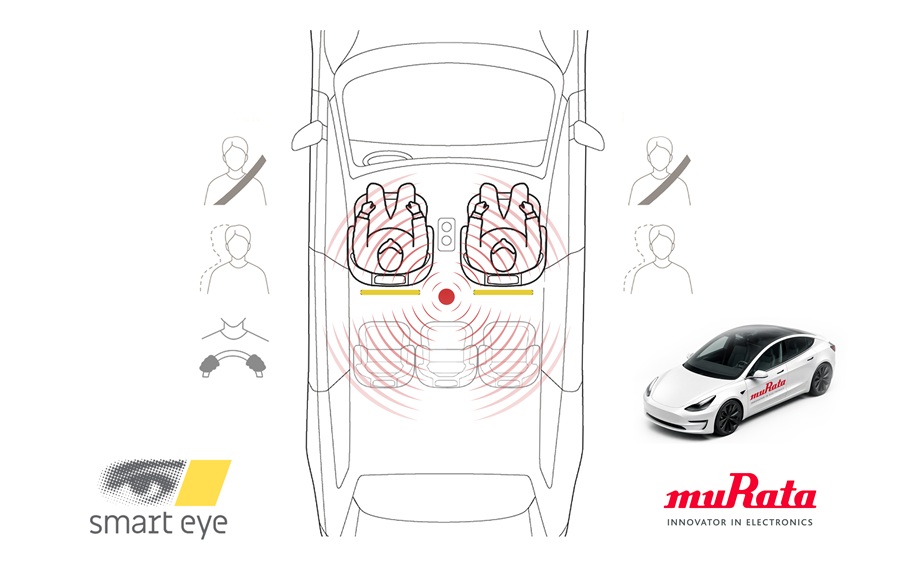
- Murata Manufacturing camera-radar sensor fusion demonstrates comprehensive interior sensing.
- 60 GHz radar complements cameras in low-light conditions.
- Smart Eye software supports driver and occupant monitoring.
Murata Manufacturing and Smart Eye Demonstrate Camera-Radar Sensor Fusion
On September 16, Murata Manufacturing Co Ltd announced a collaboration with Smart Eye to demonstrate how camera-radar sensor fusion can create a more comprehensive view of a vehicle’s interior. The demonstration combines Murata’s 60 GHz radar technology with Smart Eye’s AI-based software for Driver Monitoring, Occupant Monitoring, and Child Presence Detection. The approach builds on camera-based occupant monitoring while adding radar sensing that can detect people in conditions where cameras may have limitations. The companies will present the technology to automotive OEMs and Tier 1 suppliers at InCabin/AutoSens.
Combining Cameras With 60 GHz Radar
The demonstration combines Murata’s 60 GHz radar technology with Smart Eye’s AI-based software for Driver Monitoring, Occupant Monitoring, and Child Presence Detection. Vehicles already use cameras to monitor occupants, while 60 GHz radar is increasingly being used to detect people, including under low-light conditions. Combining the two sensing methods can provide more comprehensive occupant detection while potentially reducing the need for separate sensors. The companies say this approach can also simplify vehicle systems and lower costs, creating an integrated sensing architecture for interior applications.
Improving Occupant Detection and Safety Functions
More accurate information about an occupant’s position and posture can support vehicle safety functions that depend on understanding how people are positioned inside the cabin. This information can help improve airbag and seatbelt control by providing additional details about occupant location and posture. Better occupant detection can also reduce unnecessary warnings and improve Child Presence Detection. By combining camera and radar information, the system is intended to provide a broader understanding of occupants than either sensing method may provide independently, particularly when environmental conditions affect camera performance.
Potential Expansion Into New Interior Features
The sensor-fusion approach could also support additional vehicle interior functions beyond driver and occupant monitoring. Murata and Smart Eye identify gesture recognition and vital sign monitoring as potential future applications for the same system. These capabilities would extend interior sensing from basic occupant detection toward a broader set of cabin-interaction and monitoring functions. The development therefore centers on using complementary sensing technologies and AI software within a scalable architecture. The companies are positioning the collaboration as a way to support additional interior applications without necessarily requiring a separate dedicated sensor for every function.
OEM and Tier 1 Collaboration
In addition to demonstrating the technology, Murata Manufacturing Co Ltd and Smart Eye are inviting automotive OEMs and Tier 1 suppliers to collaborate on scalable interior sensing systems. Their demonstration is intended to show how radar hardware and AI-based software can work together in vehicle interiors. Engagement with manufacturers and suppliers could help evaluate how the technology fits different vehicle architectures and sensing requirements. The companies will demonstrate the system at InCabin/AutoSens, providing an opportunity for automotive industry participants to examine the combined sensing approach and its potential applications.
Industry Impact & Outlook
The collaboration illustrates how combining complementary sensing technologies could influence the design of vehicle interior monitoring systems by consolidating occupant-related functions within a more integrated architecture. For automakers and Tier 1 suppliers, the potential benefits include broader occupant detection, improved information for safety controls, fewer separate sensors, and simpler system integration. The immediate focus remains on demonstrating the technology and engaging industry participants through InCabin/AutoSens. Further development will depend on how OEMs and suppliers evaluate scalability and application requirements, while potential functions such as gesture recognition and vital sign monitoring could expand the role of interior sensing if the technology progresses toward production use.
Frequently Asked Questions
What is Murata Manufacturing demonstrating with Smart Eye?
Murata Manufacturing and Smart Eye are demonstrating a vehicle interior sensing system that combines 60 GHz radar with AI-based camera software for occupant monitoring. The approach is designed to provide a more comprehensive understanding of people inside the vehicle by combining complementary sensing methods. Radar can detect occupants in low-light conditions, while camera-based software supports Driver Monitoring, Occupant Monitoring, and Child Presence Detection. The companies are also exploring potential applications such as gesture recognition and vital sign monitoring, while inviting automotive OEMs and Tier 1 suppliers to collaborate on scalable interior sensing systems.
Click above to visit the official source.
Discussion
Join the conversation.