
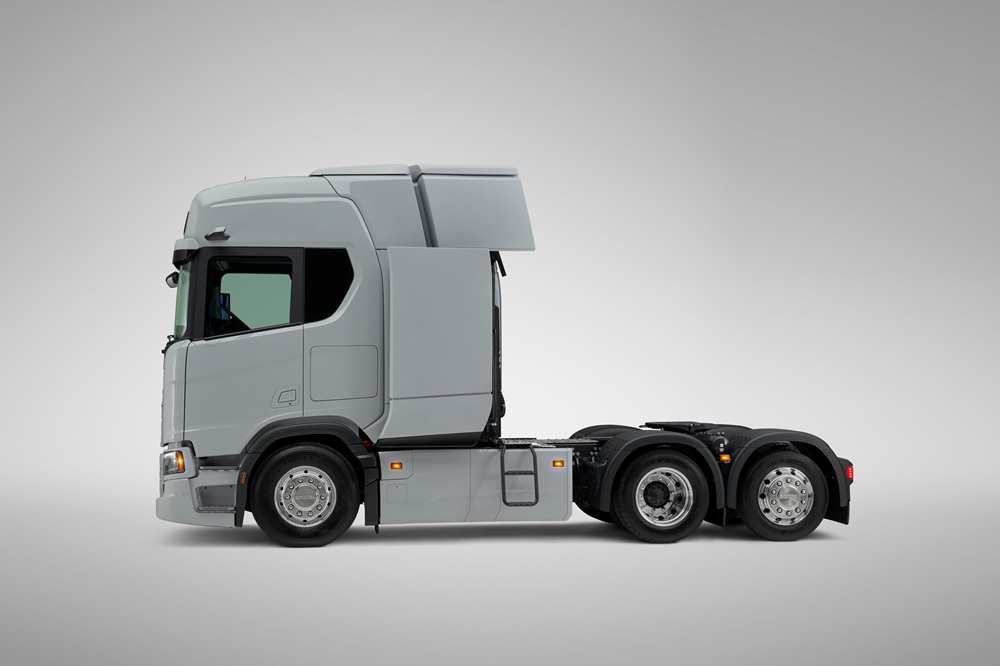
- Scania electric truck technology supports up to 720 km.
- Two MP20 packs add around 356 kWh.
- New front design cuts energy use up to 3%.
Scania Extends Electric Truck Range for Long-Haul Transport
Scania electric truck technology is being developed to support longer European long-haul operations through additional battery capacity, chassis-mounted batteries, and megawatt charging. Scania announced on September 14 that batteries positioned behind the cab can work alongside chassis-mounted battery packs to increase range while preserving operational flexibility. The approach is intended to support standard European trailer combinations while giving operators greater ability to balance driving range against payload requirements. With the available configuration, electric trucks can reach up to 720 km of range, creating a broader operating window for long-distance freight applications without relying exclusively on batteries mounted within the chassis.
Protruding IVD Front Supports Longer Electric Configurations
Scania’s protruding IVD, or Increased Vehicle Dimension, front design is part of the configuration developed for longer-range electric trucks. The setup supports 6x2*4 trailer combinations with extended electric range even when total vehicle length exceeds 16.5 meters. At the same time, the configuration maintains trailer compatibility and maneuverability, which are important considerations for European long-haul operations. The design therefore combines additional battery packaging with the dimensional flexibility needed for trailer use. This approach allows the vehicle architecture to accommodate more energy storage while continuing to support practical transport requirements for operators running standard European trailer combinations.
Aerodynamic Design Can Reduce Energy Consumption
The revised front design also addresses energy efficiency by improving the truck’s aerodynamic performance. According to Scania, the new front can reduce energy consumption by up to 3%, although the actual reduction depends on the vehicle configuration and operating conditions. For an electric long-haul truck, lower energy consumption can contribute to more effective use of available battery capacity because less energy is required to cover the same operating distance under comparable conditions. The aerodynamic improvement therefore works alongside the additional battery capacity rather than replacing it, providing another element of the overall approach to extending electric driving capability for long-distance freight operations.
Additional Batteries Increase Range and Configuration Flexibility
Battery packs installed behind the cab give Scania another location for increasing energy storage beyond the batteries already mounted on the chassis. A typical configuration can use two MP20 battery packs, adding approximately 356 kWh of capacity. When combined with chassis and under-cab batteries, the additional packs can support configurations capable of up to 720 km of range. This packaging approach also gives operators greater flexibility when considering the tradeoff between range and payload. Rather than depending solely on chassis-mounted batteries, the additional behind-cab capacity provides another way to configure an electric truck for demanding long-haul applications.
Megawatt Charging Completes the Long-Haul Electric Setup
The battery configuration is designed to work together with MCS charging, allowing the electric truck to replenish substantial amounts of energy during long-haul operations. Combined with chassis-mounted and under-cab batteries, the two MP20 packs create a system intended for long-distance transport using standard European trailer combinations. Megawatt charging is particularly relevant to this configuration because increasing battery capacity addresses driving range, while high-power charging can support the practical turnaround requirements associated with longer freight routes. The combined approach gives Scania a way to address both energy storage and charging needs within an electric truck architecture designed for European long-haul transport.
European Trailer Compatibility Remains Central
The configuration is designed around the operational requirements of Europe, where trailer compatibility, vehicle dimensions, payload, and maneuverability all influence long-haul truck deployment. Scania’s use of the protruding IVD front allows 6x2*4 combinations to accommodate longer electric range even when the overall vehicle length exceeds 16.5 meters. Maintaining compatibility with standard European trailer combinations is significant because additional battery capacity must provide greater range without undermining the vehicle’s practical freight role. The combination of behind-cab batteries, chassis-mounted storage, and MCS charging consequently targets a balance between electric range and the operating flexibility expected from conventional long-haul transport equipment.
Scania’s Integrated Approach to Electric Long-Haul Trucks
Scania’s approach combines several vehicle-level changes rather than depending on a single technology to extend electric truck capability. Additional battery packs provide greater energy storage, the IVD front improves aerodynamic efficiency while accommodating the required configuration, and MCS charging supports energy replenishment for longer-distance operations. The result is an electric truck concept that can offer up to 720 km of range while retaining compatibility with standard European trailer combinations. By integrating these elements, Scania is addressing range, payload flexibility, vehicle dimensions, maneuverability, and charging as connected requirements for the deployment of electric trucks in long-haul freight applications.
Industry Impact & Outlook
The development could broaden the practical operating envelope for electric commercial vehicles in European long-haul transport by addressing several constraints simultaneously: available battery capacity, aerodynamic efficiency, charging capability, payload balance, and trailer compatibility. The combination is particularly relevant to operators whose routes require longer electric range without abandoning established trailer configurations. Scania’s ability to package additional batteries behind the cab also indicates how vehicle architecture can evolve to support higher energy storage within dimensional requirements. The next practical consideration will be how these configurations perform under different operating conditions, since actual energy consumption and achievable range will vary with the vehicle and its use.
Frequently Asked Questions
How far can Scania’s electric truck configuration travel?
Scania’s electric truck configuration can provide up to 720 km of range when additional battery packs are combined with chassis and under-cab batteries and MCS charging. The system can use two MP20 battery packs, adding around 356 kWh of capacity behind the cab. This additional storage gives operators more flexibility to balance range and payload while supporting standard European trailer combinations. The actual range and energy consumption can vary depending on the vehicle configuration and operating conditions, while the revised IVD front can reduce energy consumption by up to 3% through improved aerodynamics.
Click above to visit the official source.
Discussion
Join the conversation.