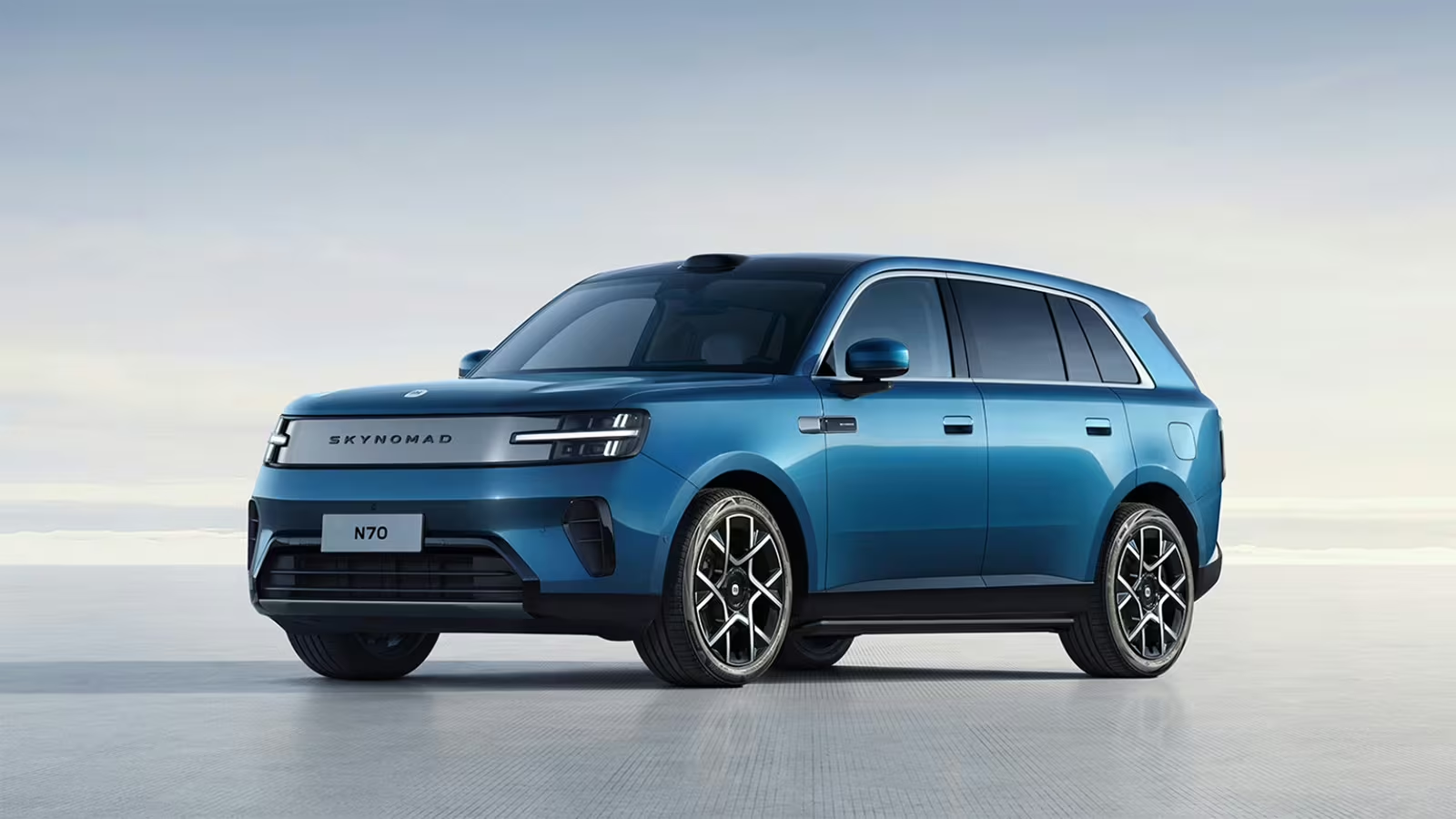
- Xiaomi Sky Nomad expands Xiaomi’s EREV lineup.
- N90 Max offers up to 1,705 kilometers combined.
- Xiaomi targets 550,000 annual vehicle deliveries.
Xiaomi Expands Into Extended-Range SUVs
Xiaomi launched its Sky Nomad lineup of extended-range SUVs on Monday, marking Xiaomi Auto’s first move beyond battery electric vehicles into the extended-range electric vehicle segment. Starting at 209,900 yuan ($30,960), the lineup broadens the company’s vehicle portfolio with more family-oriented models and a wider price range. The initial range includes the five-seat N70 Pro and N70 Max, the seven-seat N90 Max, and the five-seat N90 Max Explorer edition. The launch gives Xiaomi another route to expand its customer base beyond the SU7 sedan and YU7 SUV, which previously represented its battery-electric-only automotive lineup.
Sky Nomad Pricing Covers Four Variants
The N70 Pro is priced at 209,900 yuan, while the N70 Max costs 239,900 yuan. The N90 Max starts at 269,900 yuan, and the N90 Max Explorer edition is priced at 299,900 yuan. Xiaomi reduced the N70 Max price by 20,000 yuan from its July 30 pre-sale price and cut the N90 Max by 30,000 yuan. Those reductions represent approximately 7.7% and 10%, respectively. The pricing structure gives buyers several choices across five- and seven-seat configurations while adding an extended-range powertrain option to Xiaomi Auto’s existing battery-electric vehicle portfolio.
N70 Series Combines Space With Extended Range
The N70 series is positioned as a mid-to-large-size five-seat SUV measuring 4,960 mm long and 1,998 mm wide, with a 2,950 mm wheelbase. The range emphasizes rear-seat space and flexible cabin arrangements. The entry-level N70 Pro uses a single-motor front-wheel-drive system with a maximum output of 210 kW, or 282 hp, and accelerates from 0 to 100 km/h in 7.9 seconds. Its 52-kWh lithium iron phosphate battery provides a CLTC electric range of 351 kilometers and a combined range of 1,351 kilometers when the battery and fuel tank are fully utilized.
N70 Max Adds All-Wheel Drive and Faster Charging
The N70 Max upgrades to a dual-motor all-wheel-drive powertrain producing up to 310 kW, reducing its 0-to-100 km/h acceleration time to 5.5 seconds. Air springs and continuously variable dampers are standard on the model. Its 76-kWh ternary lithium battery delivers a CLTC battery-only range of 505 kilometers and a combined range of 1,461 kilometers. Xiaomi says a 15-minute charge can add as much as 310 kilometers of range. Across the N70 series, standard equipment includes a sliding center console and a 9-liter refrigerator, while optional swiveling front seats and a 21.4-inch rear entertainment screen extend the cabin’s family and leisure functions.
N90 Max Targets Larger Families
The N90 Max is designed around a 2+2+3 seating configuration for seven occupants. It measures 5,285 mm long, 1,998 mm wide and 1,825 mm tall, with a 3,080 mm wheelbase. The SUV uses a 76-kWh battery and a 310-kW dual-motor all-wheel-drive system, delivering a CLTC electric range of 464 kilometers and a combined range of 1,705 kilometers. Air springs are standard, and the vehicle accelerates from 0 to 100 km/h in 5.9 seconds. The first two seating rows include massage functions, while the sliding center console and swiveling seats provide additional flexibility when the vehicle is parked.
N90 Max Explorer Adds Camping Functionality
The N90 Max Explorer edition focuses on outdoor and camping use through a factory-integrated power pop-top roof. Raising the roof creates a separate upper-level space and increases maximum interior height to 2,294 mm. The five-seat configuration includes rear seats that fold flat into a bed, along with underfloor heating. Its CLTC electric range is 462 kilometers, while its combined range reaches 1,688 kilometers. Xiaomi states that the pop-top roof can be operated only while the vehicle is parked away from public roads. The Explorer therefore adds a specialized recreational configuration without changing the lineup’s core extended-range architecture.
Shared Powertrain and Driver Assistance Technology
All Sky Nomad variants use a 1.5-liter turbocharged range extender compatible with China’s 92-octane gasoline. Official specifications indicate that every version can charge from 20% to 80% in as little as 18 minutes. The lineup also includes Xiaomi HAD, or Hyper Autonomous Driving, driver assistance powered by a Nvidia Drive Thor chip with 700 TOPS of computing power. The N70 Pro and N70 Max each use one LiDAR sensor, while the N90 Max and Explorer edition use two sensors positioned forward and rearward. Every version also features 4D millimeter-wave radar for its driver-assistance system.
Connected Cabin Technology Extends Xiaomi’s Ecosystem
The cabin runs Xiaomi HyperOS and uses a Snapdragon 8 Gen 3 chip for its in-vehicle computing functions. The system supports Xiao AI voice control and connectivity linking smartphones, vehicles and smart-home devices. This approach extends Xiaomi’s broader connected-device ecosystem into its vehicles while keeping the Sky Nomad lineup aligned with the company’s existing software strategy. The combination of HyperOS, voice control and cross-device connectivity is intended to make the cabin a more integrated digital environment rather than a standalone automotive interface. These technologies are offered alongside the hardware features designed for family travel and parked recreational use.
Xiaomi Auto Pushes Toward Its Annual Delivery Target
The Sky Nomad launch comes as Xiaomi Auto seeks to accelerate deliveries and narrow the gap to its annual target. Founder, chairman and CEO Lei Jun said Monday that cumulative vehicle deliveries had exceeded 800,000. Xiaomi Auto delivered 216,322 vehicles during the first seven months of the year, representing a 14.83% increase from the same period a year earlier. The company had also previously said August deliveries exceeded 30,000 vehicles, although it did not disclose an exact August figure. The latest SUV launch therefore arrives alongside an effort to expand both product coverage and delivery volume.
Xiaomi Auto Monthly Deliveries Through July 2026
The monthly delivery data show that Xiaomi Auto’s 2026 volumes were 39,002 vehicles in January, 20,414 in February, 21,440 in March, 36,702 in April, 32,759 in May, 34,738 in June and 31,267 in July. For comparison, the company delivered 22,897 vehicles in January 2025, 23,728 in February, 29,244 in March, 28,585 in April, 28,013 in May, 25,459 in June and 30,452 in July. August 2025 deliveries reached 36,396, while the company has only provided a lower bound of more than 30,000 vehicles for August 2026. The figures illustrate the delivery scale Xiaomi is seeking to build as its product portfolio expands.
| Month | 2024 | 2025 | 2026 |
|---|---|---|---|
| January | — | 22,897 | 39,002 |
| February | — | 23,728 | 20,414 |
| March | — | 29,244 | 21,440 |
| April | 7,058 | 28,585 | 36,702 |
| May | 8,630 | 28,013 | 32,759 |
| June | 14,296 | 25,459 | 34,738 |
| July | 13,120 | 30,452 | 31,267 |
| August | 13,111 | 36,396 | — |
| September | 13,559 | 41,948 | — |
| October | 20,726 | 48,654 | — |
| November | 23,156 | 46,249 | — |
| December | 25,815 | 50,212 | — |
EREV Market Faces Recent Pressure
Xiaomi is entering an extended-range electric vehicle market that has recently weakened in China, even as Lei Jun has continued to argue that the segment retains significant opportunity. China’s retail sales of EREVs declined 15.35% year over year to 535,000 vehicles from January through July, according to the China Passenger Car Association. Lei said on Weibo Monday that competitors including Li Auto continue to show that consumers are willing to pay for well-designed extended-range vehicles. Xiaomi’s decision to enter the segment therefore places its new SUVs in a market where demand has softened but where established competitors provide evidence of continued consumer interest.
Delivery Requirements Rise for Xiaomi Auto
Using the lower-bound August delivery figure of 30,000 vehicles, Xiaomi Auto would have reached about 44.8% of its 550,000-vehicle annual delivery target during the first eight months of the year. The company would then need to average approximately 75,900 deliveries per month across the final four months to reach that target. The calculation highlights the scale of the remaining delivery requirement and the importance of product expansion as Xiaomi approaches the final part of the year. The Sky Nomad lineup adds four configurations across two SUV families, potentially giving the company additional products with which to address family-oriented demand while it continues selling its existing battery-electric models.
Industry Impact & Outlook
The Sky Nomad launch expands Xiaomi Auto’s competitive position by adding EREV SUVs to a portfolio previously centered on battery-electric vehicles, while the broad range of seating configurations and prices gives the company more ways to address family and recreational use cases. In China, the timing is significant because EREV retail sales have declined even as established competitors continue to demonstrate consumer interest in the format. Xiaomi’s next challenge will be converting its broader product coverage into sustained deliveries while meeting its 550,000-vehicle annual target. The outcome could influence how effectively Xiaomi balances battery-electric and extended-range vehicles within its expanding automotive strategy.
Frequently Asked Questions
What is the Xiaomi Sky Nomad lineup?
Xiaomi Sky Nomad is a new family of extended-range SUVs that marks Xiaomi Auto’s first expansion beyond battery-electric vehicles into the EREV segment. The lineup includes the five-seat N70 Pro, five-seat N70 Max, seven-seat N90 Max and five-seat N90 Max Explorer edition. Prices range from 209,900 yuan to 299,900 yuan, while combined CLTC ranges reach as high as 1,705 kilometers. The vehicles use a 1.5-liter turbocharged range extender, and Xiaomi equips every variant with its HAD driver-assistance system and HyperOS connected cabin technology.
Click above to visit the official source.
Discussion
Join the conversation.